Home
Class 12
PHYSICS
Two fixed charges 4 Q (positive ) and q...

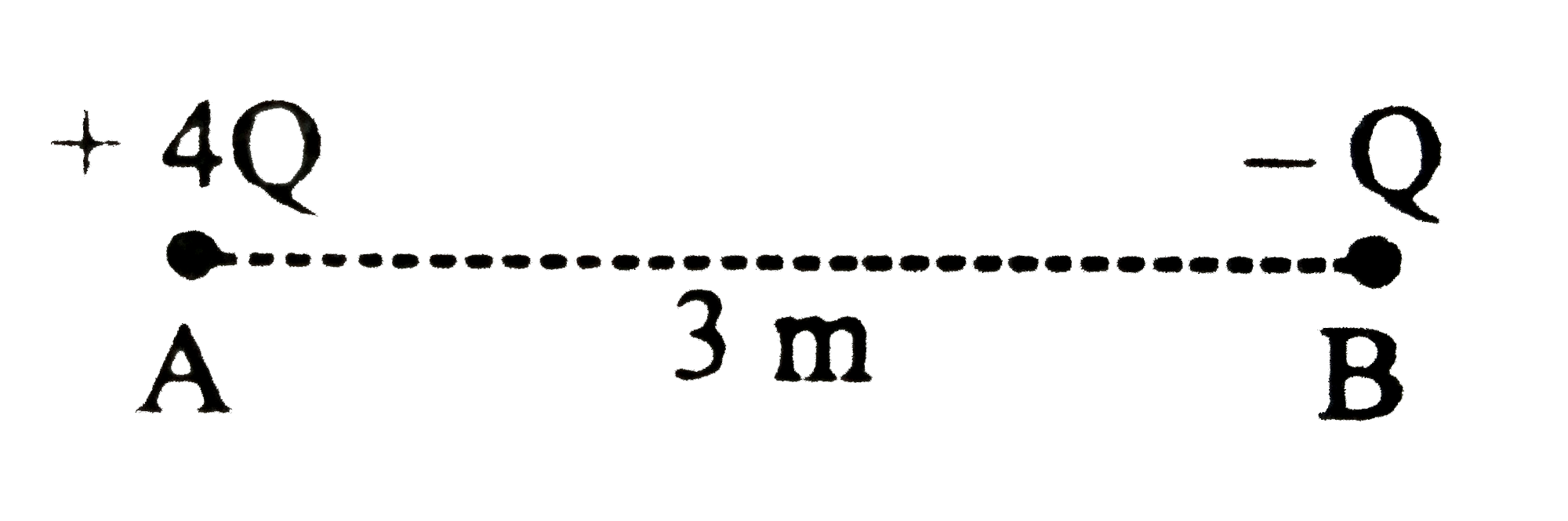
Two fixed charges ` 4 Q` (positive ) and `q` (negative ) are located at `A` and `B` , ther distance `AB` being `3 m`.
.

A

The point P where the resultant fiedld due to both is zero is on AB outside AB.

B

the point P where the resultant field due to both is zero is on `AB` inside `AB`.

C

If a positive charge is placed at P and displaced slightly along `AB` it will execute oscillations .

D

If a negative cahrge si placed at `P` and displaced slidghtly alogn `AB` it will execute oscillations .

Text Solution

Verified by Experts

The correct Answer is:

A, D

Position of point `P` where Net electric fieled is zero will be outside the line ` AB`. It's position from `B` is
` (##NG_PHY_C01_E01_065_S01.png" width="80%">.
Promotional Banner

Similar Questions

Explore conceptually related problems

Two fixed charges 4Q (positive) and Q (negative) are located at A and B the distance AB being 3m

Two fixed, equal, positive charges, each of magnitude 5xx10^-5 coul are located at points A and B separated by a distance of 6m. An equal and opposite charge moves towards them along the line COD, the perpendicular bisector of the line AB. The moving charge, when it reaches the point C at a distance of 4m from O, has a kinetic energy of 4 joules. Calculate the distance of the farthest point D which the negative charge will reach before returning towards C.

Two charges +Q " and " -2Q are located at points A and B on a horizontal line as shown below The electric field is zero at a point which is located at a finite distance

Two fixed charges -2Q and +Q are located at points (-3a,0) and (+3a,0) respectively. Then which of the following statement is correct?

Two positive charges q_(1) and q_(2) are located at the points with redius vectors r_(1) and r_(2) . Find a negative charge q_(3) and a radius vector r_(3) of the point at which it has to be placed for the force acting on each of the three charges to be equal to zero.

Two positive point charges Q and one negative point charge q are arranged in a straight line in such a manner that the complete system remains in equilibrium. What can be the magnituude of Q/q ?

Two negative charges of a unit magnitude and a positive charge q are placed along a straight line. At what position and value of q will the system be in equilibrium? (Negative charges are fixed).

Two point charges Q_(1) and Q_(2) are positioned at points I and 2. The field intensity to the right of the charge Q_(2) on the line that passes through the two charges varies according to a law that is represented in the figure. The field intensity is assumed to be positive if its direction coincides with the positive direction on the x-axis. The distance between the charges is l. (a) Find the sign of each charge (b) Find the ratio of the absolute values of the charges |(Q_(1))/(Q_(2))| (c) Find the value of b where the field intensity is maximum [(a) Q_(2) is negative and Q_(1) is positive (b) ((l +a)/(a))^(2) , (c) (l)/(((l+a)/(a))^(2//3)-1)]

Two free charges q and 4q are placed at a distance d apart A third charge Q is placed between them at a distance x from charge q such that the system is in equilibrium. Then magnitude of third charge and postion,
