Home
Class 12
PHYSICS
A dipole is placed at origin of corrdina...

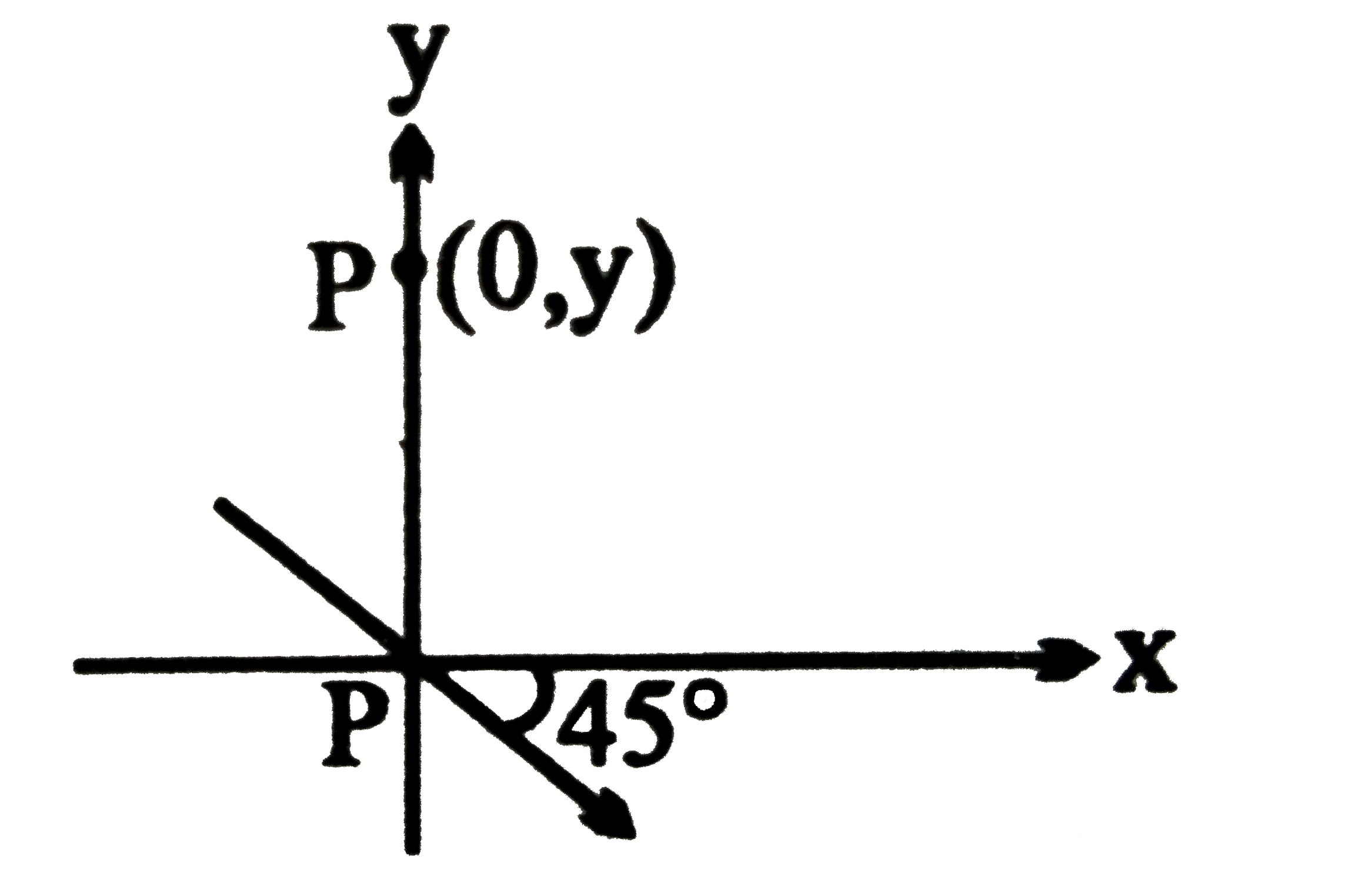
A dipole is placed at origin of corrdinate system as shown in figure, find the electric field at point ` P (0, y)`
.

Text Solution

Verified by Experts

The correct Answer is:

` (kP) /( sqrt 2 y^3) ( - hat I - 2 hat j)`

` E_1` fild intensity at `P` due to p cos `theta`
`E_2 =` Field intensity at `P` due to `P sin theta`
`vec E_1 = (KP cos theta )/y^3 ( - hat j)`
` (##NG_PHY_C01_E01_114_S01.png" width="80%">
`vec E _p = vec E_1 = vec E_2 = (KP cos theta)/(y^3) (- hat i) + ( 2 KP sin theta)/y^2 (- hat j)`
By putting `theta = 45^@, vec E_p = (KP)/(sqrt 2 y^3) (- hat i - 2hat j)`.
Promotional Banner

Similar Questions

Explore conceptually related problems

A dipole is placed at origin of coordinate system as shown in figure, find the electric field at point P(0,y). [(KP)/(sqrt(2)y^(3))(-hat(i)-2hat(j))]

Three infinitely long charge sheets are placed as shown in figure. The electric field at point P is

Three infinitely long charge sheets are placed as shown in figure. The electric field at point P is

Four charges are arranged on y axis as shown in figure. Then the electric field at point P is proportional to:

In a system of two dipoles placed in the way as shown in figure :

A short magnetic dipole when placed at origin with its dipole moment oriented along x-axis , the magnetic field at the point (a,0) is vecB . What will be the magnetic field at the above point , if another identical dipole is also placed at origin with its dipole moment oriented along y-axis ?

An element Deltavecl=Deltaxhati is placed at the origin as shown in figure and carries a current I=2A . Find out the magnetic field at a point P on the y-axis at a distance of 1*0m due to the element Deltax=1cm . Give also the direction of the field produced.

A dipole is placed at the origin such that its dipole moment is overset(rarr)p=-phati,0 . The electric field and potential at (0,d,0) respectively are :

A short dipole of dipole moment P is placed near a point charge Q as shown in figure. Find force on the dipole due to the point charge
