Home
Class 12
PHYSICS
A non-conducting disc of radius a and un...

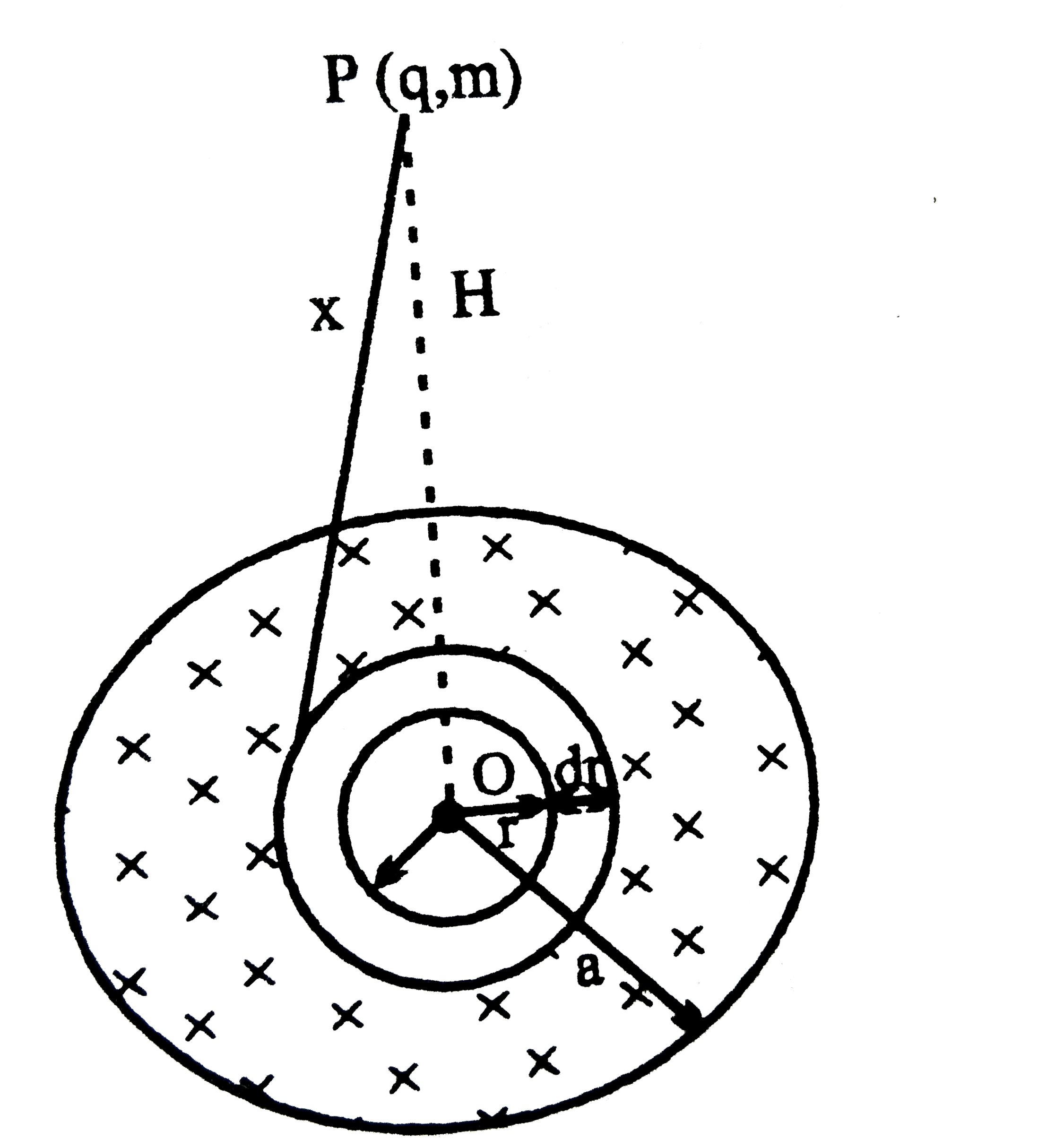
A non-conducting disc of radius a and uniform positive surface charge density `sigma` is placed on the ground, with its axis vertical. A particle of mass m and positive charge q is dropped, along the axis of the disc, from a height H with zero initial velocity. The particle has `q//m=4 in_0 g//sigma`
(a) Find the value of H if the particle just reaches the disc.
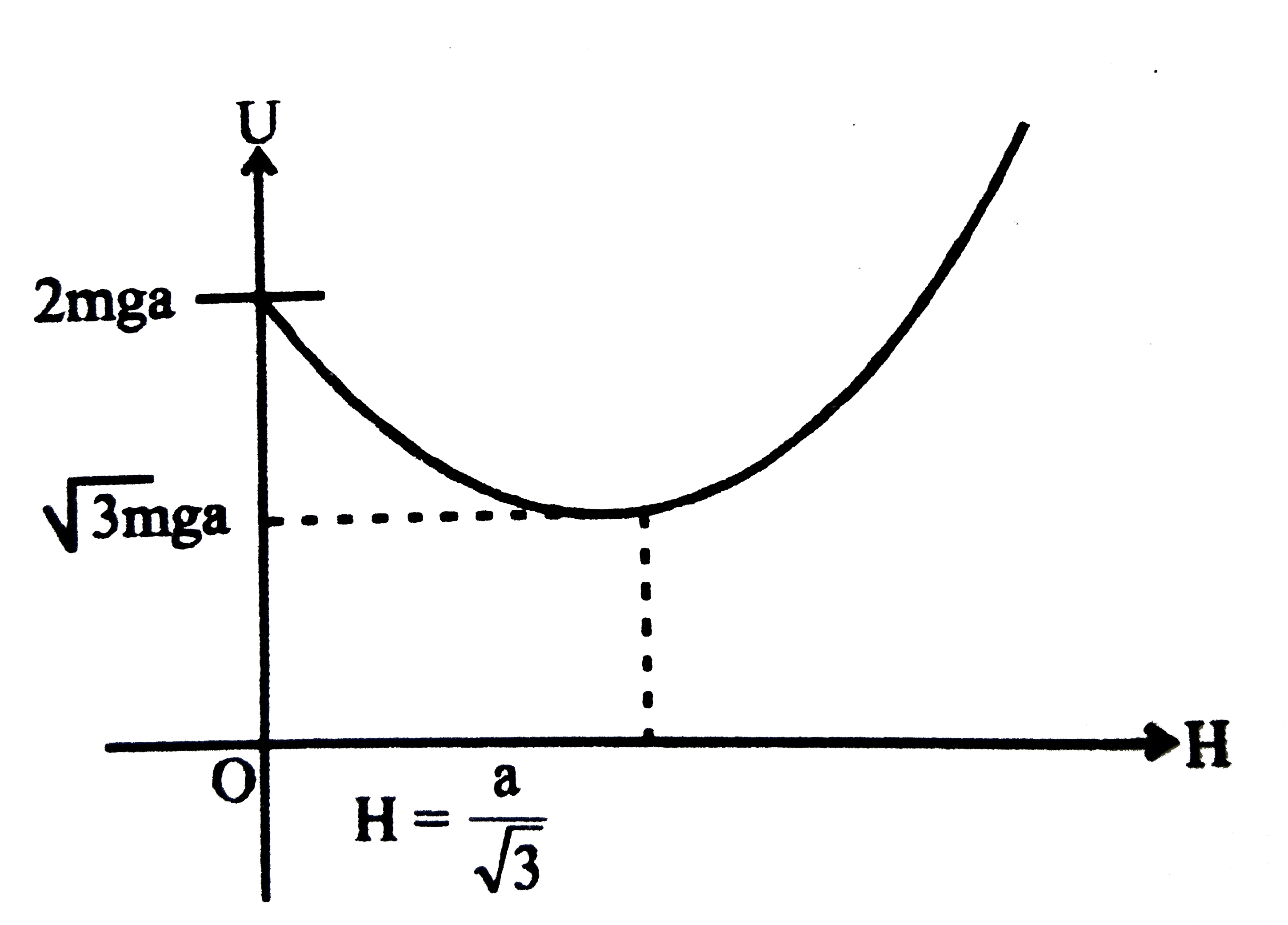
(b) Sketch the potential energy of the particle as a function of its height and find its equilibrium position.

Text Solution

Verified by Experts

The correct Answer is:
(a) `H = (4a)/3`, (b) `U = mg [ 2 sqrt ( h^2 + a^2 - h) ]`
equilibrium at ` h= a/( sqrt 3) `.

Potential at a height `H` on the axis of the disce `V` the charge `dp` conttained in the ring shown figure
`dp = sigma (2 pi r dr)`
Potentiall at `P` due to this ring
` d V = 1/(4 pi varepsilon_0) ( dq)/( sqrt H^2 +r^2)`
` rArr dV = 1/( 4 pi in_0) (( 2 pi rdr ) sigma)/(sqrt H^2 +r^2) = (sigma) /(2 pi_0) (rde)/( sqrt H^2 +r^2)`
`:.` Potential due to the complete disc `V_p = int _(r=0)^(r=a) dV`
` V_p = (sigma) /(2 in_0) imt_(r=0)^(r=a) (rdr)/(sqrt H^2 =r^2)`
.
`V_p = (sigma)/( 2 in_0) [ sqrt H^2 +a^2) -H]`
Poyenyial at center will be `V_0 = (sigmaa)/(2 varepsilon_0) as H=0`
(a) Particel is relased from `P` and it just reaches point `O`. therefore , form conservation of mechanical energy
Decrease in gravitational potential energy = Increase in eleratostatic potential energy
`put H = q [ V_0 - V_a]`
`gH= (q/m) [ (sigma)/( 2 in_0) a - (sigma)/(2 in_0) sqrt ( a^2 + H^2 ) - H ] `....(1)
`put q/m = ( 4 in_0 g)/( sigam)` in equation (1)
`H = (4/3) a`
`b` Potential energy of the particel at height `H=` Electrostyatic potential energy `+` gravitational potential energy .
` U = qV + mg H`
Here `V =` Potential at height `H`
` U = ( sigma) /(2 in_0) [ sqrt (a^2 + H^2)- H] mg H` ..(2)
At equilibrium potition : `F = (- dU)/(dh) =0`
differntiating `2` w.r.t `H`
or ` mg + ( sigmaq)/(2 in_0) [ ( 1/2) (2 H) 1/(sqrt (a^2 +H^20) -1 ] =0`
`[ :. (sigmaq)/( 2 in) = 2 mg]`
by sovloing `H = a/(sqrt3)`
From equation `2` we can write
`U - H` equation as
`U = 2 mg (sqrt (a^2 +H^2)-H)`
`U = 2 mga at H =0 ` and

` U =U _(min) = sqrt 3` mga at ` H = a/(sqrt 3)`
Therefor ` U - H ` graph will be as shown
Note that at `H = a/(sqrt 3)` is stable equilibrium postion .
Promotional Banner