Home
Class 12
PHYSICS
Three concentric conducting spherical sh...

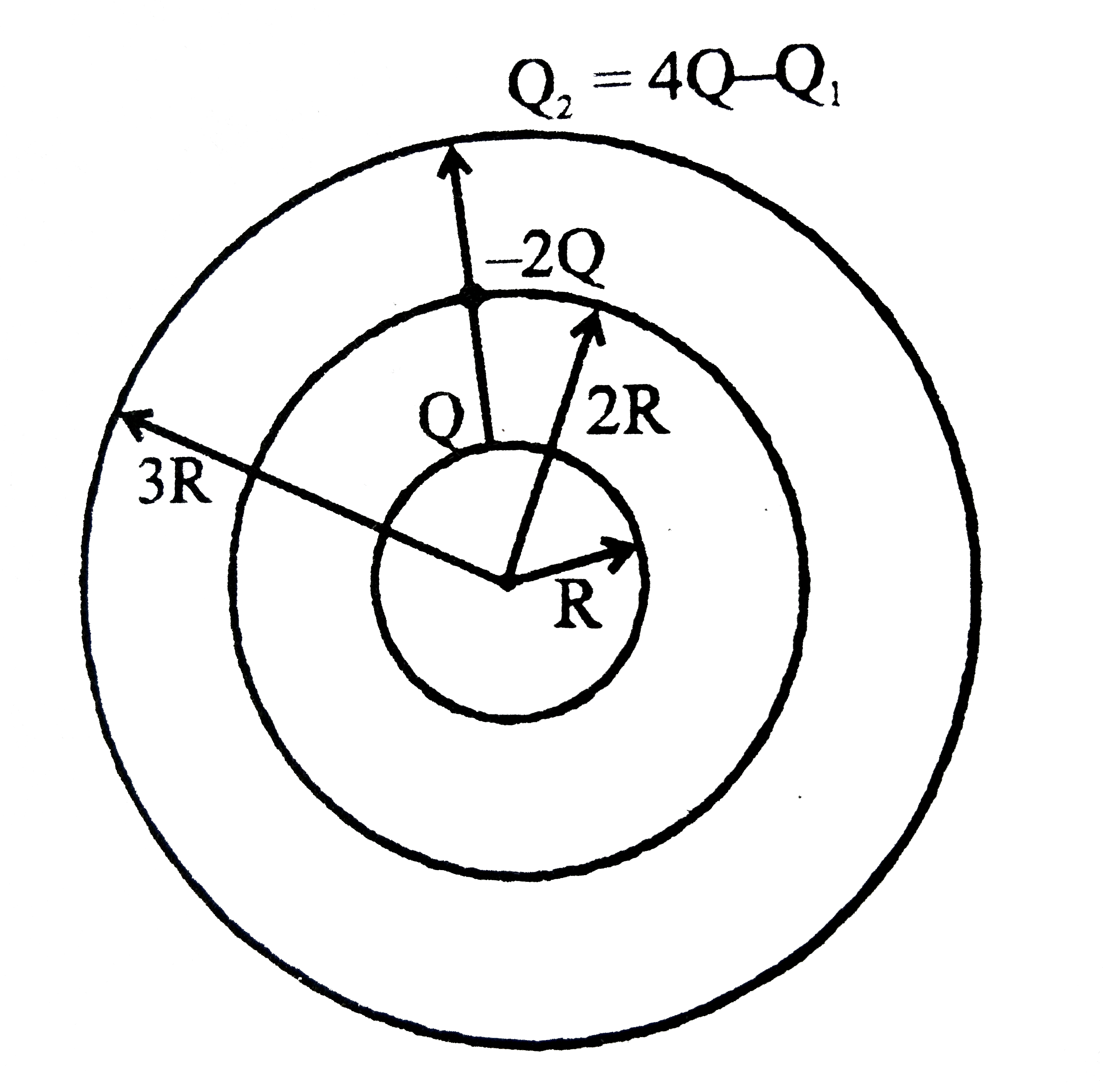
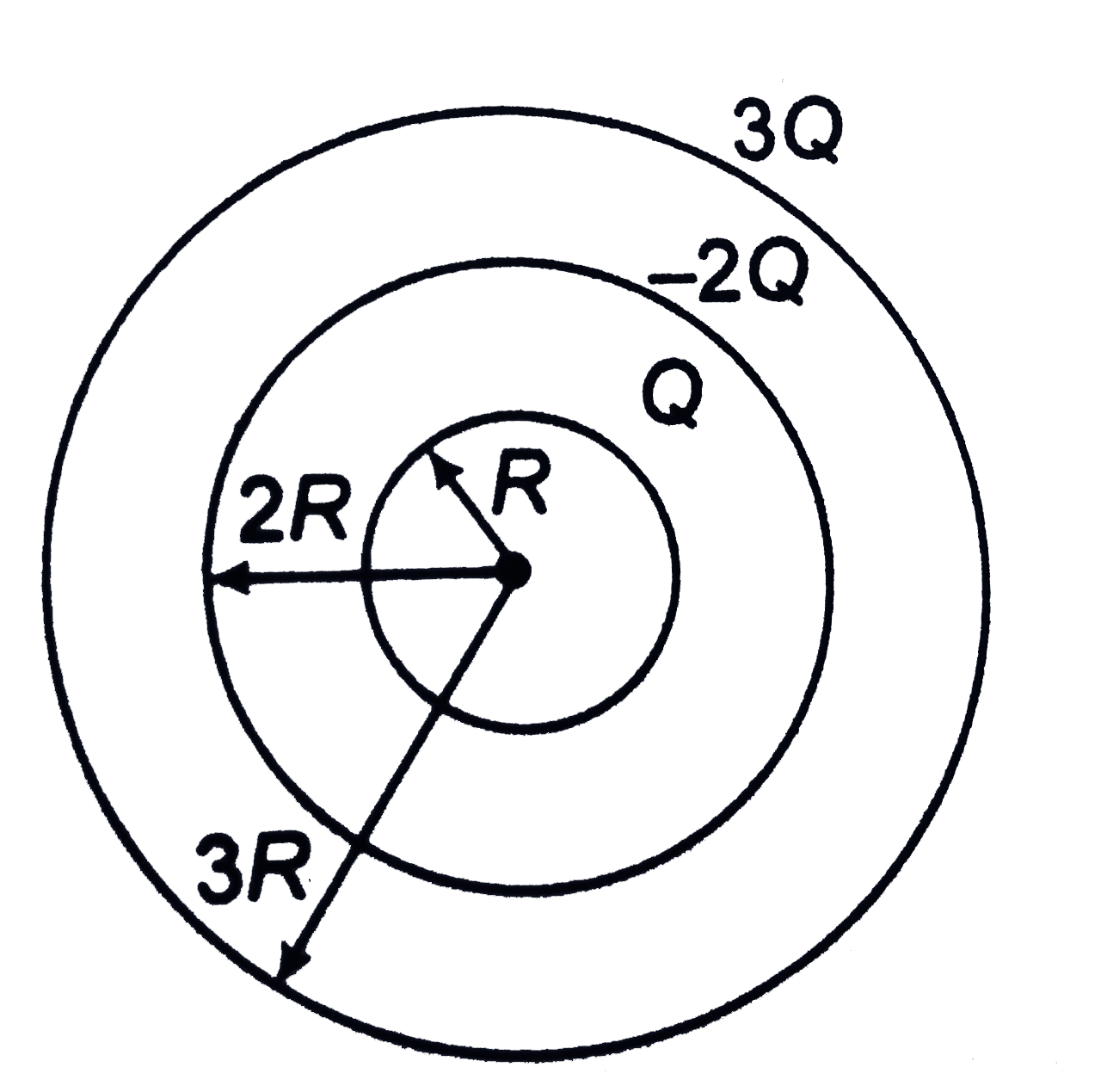
Three concentric conducting spherical shells of radii `R, 2R` and `3R` carry charges `Q, - 2Q` and `3Q`, respectively.

a. Find the electric potential at `r=R` and `r=3R` where r is the radial distance from the centre. ltbr. b. Compute the electric field at `r=5/2R`
`c. compute the total electrostatic energy stored in the system.
The inner shell is now connected to the external one by a conducting wire, passing through a very small hole in the middle shell. ltbr. Compute the charges on the spheres of radii R and `3R`.
e. Compute the electric field at `r=5/2R`.

Text Solution

Verified by Experts

The correct Answer is:
(a) ` Q/( 4 pi varepsilon_0 R), Q/( 6 pi varepsilon_0 R)` ; (b) ` (-Q)/(25 pi varepsilon_0 R^2) hat r`,
(c ) `Q^2/( 4 pi varepsilon_0 R) hat r,`
(d) `(Q + 2Q_1)/( 12 pi varepsilon_0R), Q_1 = Q/2 . Q_2 = ( 7Q)/2`
(e ) `- ( 3Q)/(50 varepsilon_0 R^2 hat r`.

(a) Potential of inner shpere
`V_R=` Potential due to won charge + ptential due to middle sphere + potential due to oute shere .
`V_R = (KQ)/R + (K (-2 Q))/(2R) + (K(3Q))/(3R)`

`V_R = (KQ)/R `
`V_r = 1/(4 pi in_0) Q/R`
` V_(3 R)`= Potential due to ininer shpere `+` potential due to middle sheere `+` pontential due to own charge .
` V_(3 R) = (KQ)/(2 R) + (K(-2Q))/(3R) + (K(3Q))/(3 R) = (2 KQ)/(3 R)= Q/(6 pi in_0R)`
(b) From gauss theorem
`oint vec E s vec S = (sum q)/(in_0) rArr e. 4 pi (5/2 R) ^2 = ((Q-2Q))/(in_0)`
`vec E=(-Q)/(25 pi in_0 r^2) vec r` .
(c) Chagrge distaribution will be as shown in so combination will acts as two sphereical capacitor of capacity `vec C` and `cex C_2`
`C_1 = 4 pi in_0 ( Rxx 2R)/((2 R-R))`

`C_1 = 8 pi in_0 R` ....(1)
`C_2 = 4 pi in_0 ((2 R xx 3 R))/((3 R-2 R)) =24 pi in_0 R` ...(2)
`U = U _1 + U_2`
`U=- (Q^2)/(2 C_1) + ((3Q))^2 /(2 C_2)` ....(3) Fpr, (1) , (2) and (3)
`U = Q^2/( 4 pi in_2 R)`
(d) Since inner sphere and out shere are connected by a sonducing wire so they have equal potential
`V_R = V_(3R)`
` (KQ_1)/R + (K(-@Q))/(2R) + (K (4 Q - Q_1 ))/(3 R) = (kQ_1)/(3R) + (K (-02Q))/(2R)`
`+ (K (4 Q-Q))/(3R)`
` Q_1 - Q= Q_1/3 - (2Q)/3`
`(2Q_1)/3 = Q/3 rArr Q_1 = Q2`
and `Q_2 = 4 Q -Q_1 = 4 Q- Q/2`
`Q_2 = ( 7 Q)/2`

`Electric field at `r = 5/2 R` .
`int _s vec Ed vec A = (sum q)/(in_0) rArr E. 4 pi (5/2 R)^2 = (Q_1-2Q)/(in_0)`
`E = q/(25 pi R^2 in_0) xx (Q/2- 2 Q) rArr E = (3 Q)/(50 pi in_0 R^2)`.
Promotional Banner

Similar Questions

Explore conceptually related problems

Two conducting hollow spherical shells of radius R and 2R carry charges -Q and 3Q respectively. How much charge will flow into the earth if inner shell is grounded?

Two concentric conducting spheres of radii R and 3R carrying charges Q and 2Q respectively.If the charge on inner sphere is doubled.The potential difference between inner and outer spheres will..?

Two concentric spherical conducting shells of radii R and 2R are carrying charges q and 2q, respectively. Both are now connected by a conducting wire. Find the change in electric potential (inV) on the outer shell.

Three concentric conducting spherical shells have radii r, 2r, and 3r and charges q_1,q_2 and q_3 , respectively. Innermost and outermost shells are earthed as shown in figure. The charges shown are after earthing. Select the correct alternative.

Two concentric spherical conducting shells of radii R and 2R carry charges Q and 2Q respectively.Change in electric potential on the outer shell when both are connected by a conducting wire is (k=(1)/(4 pi varepsilon_(0)))

A thin spherical conducting shell of radius R has a charge q. Another charge Q is placed at the centre of the shell. The electrostatic potential at a point P a distance R/2 from the centre of the shell is

Two concentric spherical shells of radii R and 2R have charges Q and 2Q as shown in figure If we draw a graph between potential V and distance r from the centre, the graph will be like

Two isolated concentric conducting spherical shells have radii R and 2R and uniform charges q and 2q respectively.If V_(1) and V_(2) are potentials at points located at distances 3R and (R)/(2) respectively from the centre of shells.Then the ratio of ((V_(2))/(V_(1))) will be