Home
Class 12
PHYSICS
The electrostatic potential (phi r) of a...

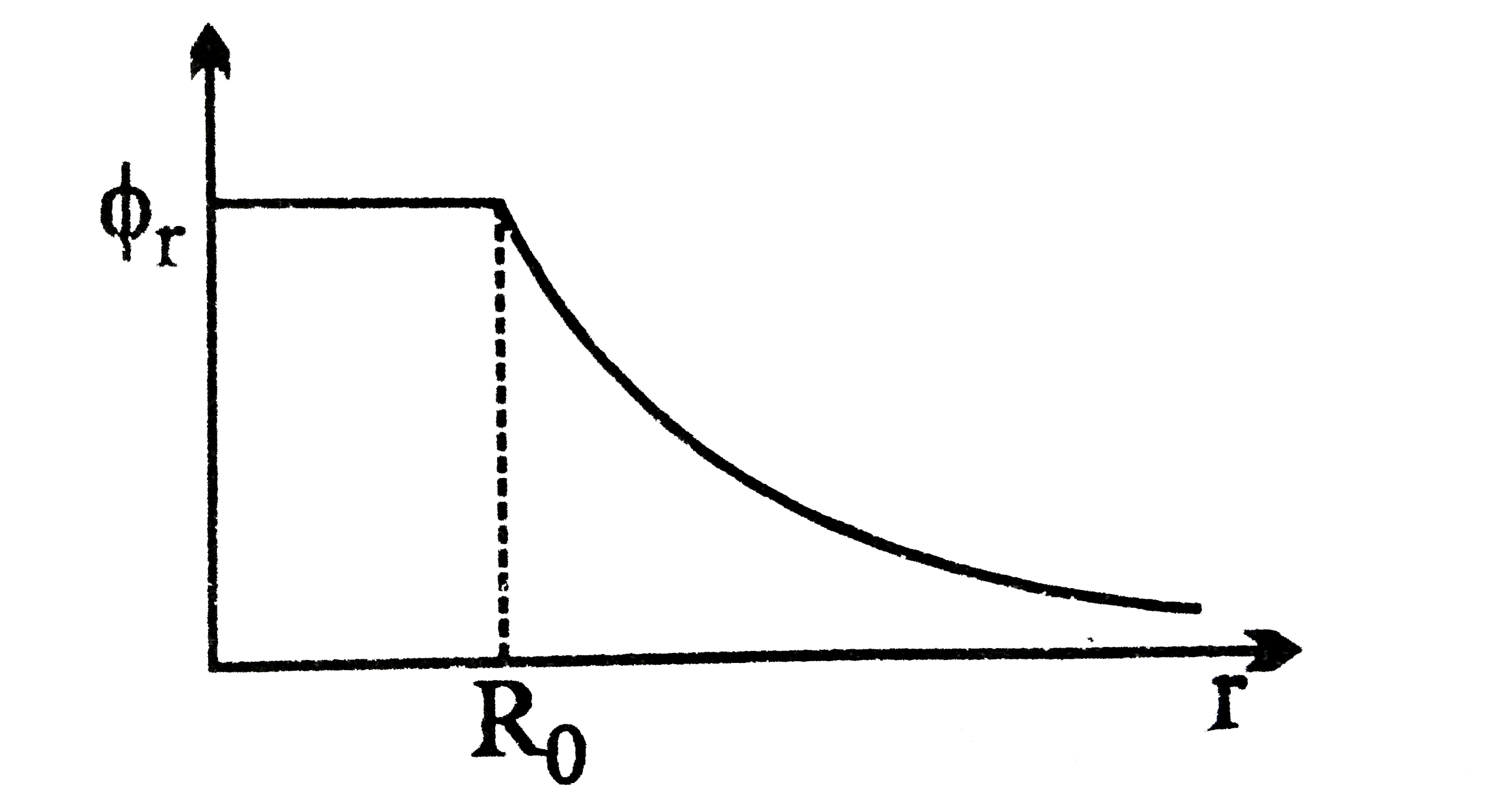
The electrostatic potential `(phi _r)` of a spherical symmetric system , kept at origin is shown in the adhacent figure, and given as
`phi _e = q/( 4 pi varepsilon_0 r) (r le R_o)`
`phi _e = q/( 4 pi varepsilon_0 R_o) (r le R_0)`

Which of the following option `s` in //are correct ?

A

For spherical region ` r le R_0` total electrostatic energy stored id zero .

B

Within ` r= 2R_0`, total charge is `q`.

C

There will be no charge anywhere except at ` r = R_0`.

D

Electric field is discontinuous at ` r= R_0`.

Text Solution

Verified by Experts

The correct Answer is:

A, B, C, D

Potential graph is of uniformly charged spherical sedll , so option ` A, B, C, D` are correct .
Promotional Banner

Similar Questions

Explore conceptually related problems

A spherical symmetric charge system is centered at origin. Given, Electric potential V=(Q)/(4piepsilon_0R_0)(rleR_0) , V=(Q)/(4piepsilon_0r)(rgtR_0)

The electrostatic potential of a uniformly charged thin spherical shell of charge Q and radius R at a distance r from the centre

The graph of a quadratic polynomial y=px^(2)-qx+r is as shown in the adjacent figure,then (i)r -4q 0 (iv) r-p-q>0

For spherical symmetrical charge distribution, variation of electric potential with distance from centre is given in diagram Given that : V=(q)/(4pi epsilon_(0)R_(0)) for r le R_(0) and V=(q)/(4 piepsilon_(0)r) for r ge R_(0) Then which option (s) are correct : (1) Total charge within 2R_(0) is q (2) Total electrosstatic energy for r le R_(0) is non-zero (3) At r = R_(0) electric field is discontinuous (4) There will be no charge anywhere except at r lt R_(0)

If S_(r) = sqrt(r+ sqrt(r+sqrt(r+sqrt(......oo)))) , r gt 0 then which the following is\are correct.

A conducting sphere A of radius a , with charge Q , is placed concentrically inside a conducting shell B of radius b . B is earthed. C is the common center of A and B . Study the following statements. (i) The potential at a distance r from C , where a le r le b, is (1)/(4 pi epsilon_0)(q/( r)) (ii) The potential difference between A and B is (1)/(4 pi epsilon_0) Q ((1)/( r) - (1)/B) (iii) The potential at a distance r from C , where a le r le b, is (1)/(4 pi epsilon_0) Q ((1)/r - (1)/B) Which of the following statements are correct ? .

Two concentric spherical shells of radii R and 2R have charges Q and 2Q as shown in figure Choose the correct optin (K = (1)/(4 pi epsi_(0)))

Let f be a function on R given by f(x) = x^(2) and let E = {x in R: - 1 le x le 0 } and F = { x in R , 0 le x le 1 } then which of the following is fase ?

Given |px^(2) + qx + r| le |Px^(2) + Qx + r|AA x in R and d=q^(2) - 4pr gt 0 and D =Q^(2) PR gt 0 Which of the following must be ture ?
