Home
Class 12
PHYSICS
A capacitor of capacitance C is charged ...

A capacitor of capacitance `C` is charged to a potential difference `V` from a cell and then disconncted from it. A charge `+Q` is now given to its positive plate. The potential difference across the capacitor is now

A

`V`

B

`V +(Q)/(C )`

C

`V+(Q)/(2C)`

D

`V-(Q)/(C )`, if `V lt CV`

Text Solution

Verified by Experts

The correct Answer is:
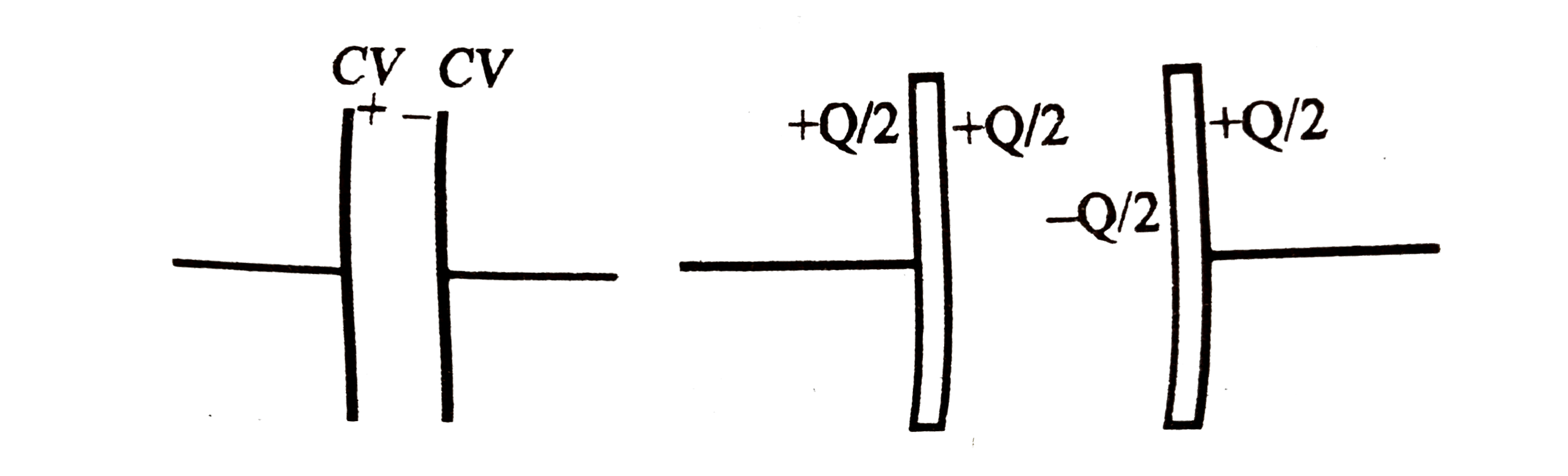
C

After redistribution half of total charge remains on outer surface and then apply

conservation of charge on each plate.
Charge on outer plates `= (Q +CV -CV)/(2) = (Q)/(2)`
Charge of innerface of first plate
`= Q +CV - (Q)/(2) = (Q)/(2)+CV`
Charge on innerface of second plate `= - ((Q)/(2)+CV)`
`V' = (Q//2+CV)/(C ) = V +(Q)/(2C)`
Promotional Banner

Similar Questions

Explore conceptually related problems

A capacitor of capacitance C is charged to a potential difference V_(0) . The charged battery is disconnected and the capacitor is connected to a capacitor of unknown capacitance C_(x) . The potential difference across the combination is V. The value of C_(x) should be

Find charge on each capacitor and potential difference across each capacitor .

A capacitor of capacitance 10 mu F is charged to a potential 50 V with a battery. The battery is now disconnected and an additional charge 200 mu C is given to the positive plate of the capacitor. The potential difference across the capacitor will be.

A capacitor or capacitance C_(1) is charge to a potential V and then connected in parallel to an uncharged capacitor of capacitance C_(2) . The fianl potential difference across each capacitor will be

A capacitor of capacitance 5 muF is charged to a potential difference of 10 volts and another capacitor of capacitance 9 muF is charged to a potential difference of 8 volts. Now these two capacitors are connected in such a manner that the positive plate of one is connected to the positive plate of other. Calculate the common potential difference across the two capacitors.

A 100pF capacitor is charged to a potential difference of 80.0V and the charging battery is disconnected. The capacitor is then connected in parallel with a second capacitor. If the potential difference across the first capacitor drops to 35.0 V what is the capacitance of this second capacitor?

The plates of a parallel plate capacitor are charged to a potential difference of 117 V and then connected across a resistor. The potential difference across the capacitor decreases exponentially with to time.After 1s the potential difference between the plates is 39 V, then after 2s from the start, the potential difference (in V) between the plates is

