
Home
Class 12
PHYSICS
The two identical parallel plates are gi...

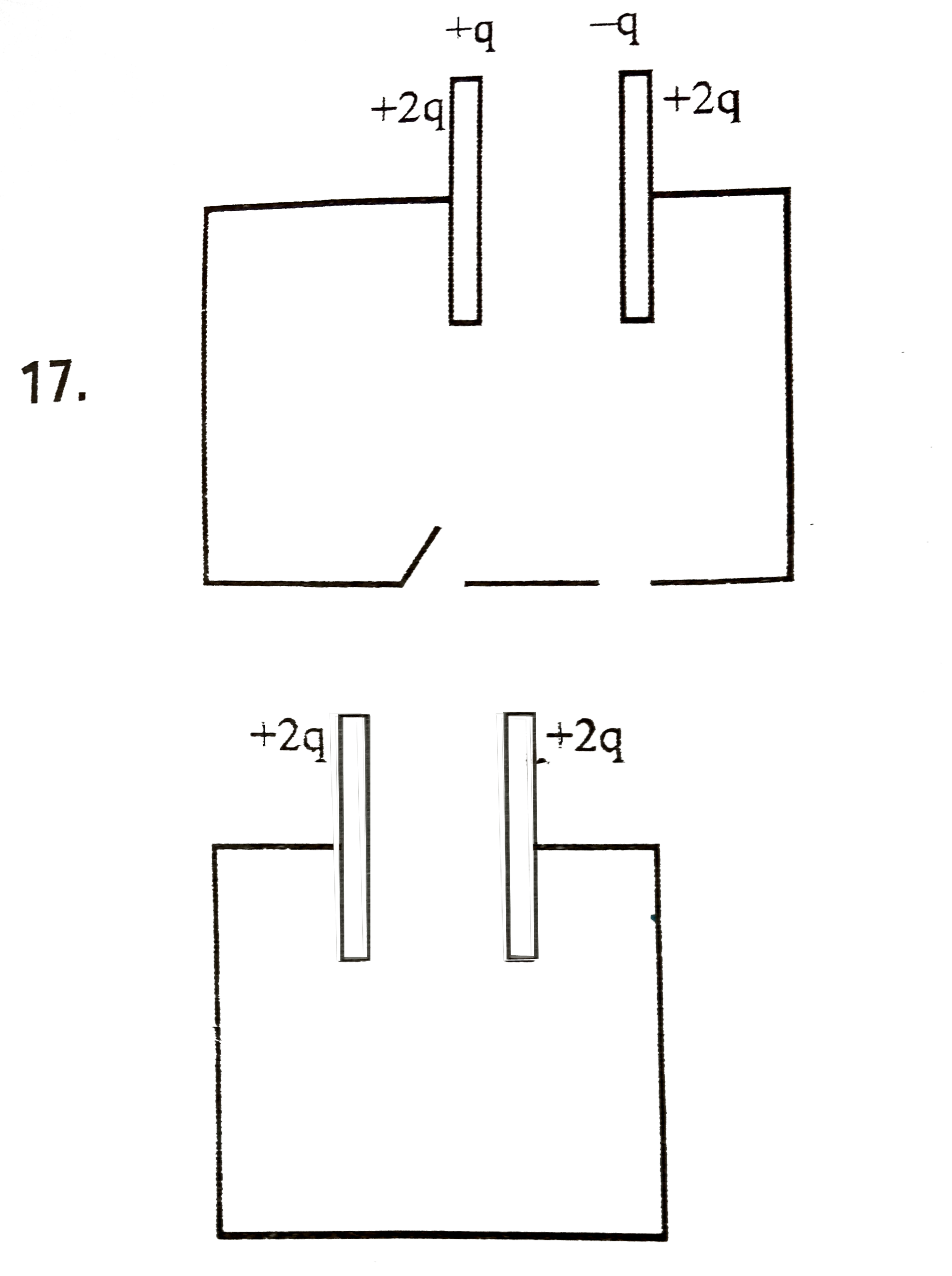
The two identical parallel plates are given charge as shown in figure. If the plate area of either face of each plate is `A` and seperation between plates is `d`, then find the amount of heat liberate after closing the switch.

Text Solution

Verified by Experts

The correct Answer is:
`(1)/(2)(q^(2)d)/(in_(0)A)`


Before closing the switch
After closing the switch
`{:(U_(i)=(q^(2))/(2C),,rArr,,U_(i)(q^(2)d)/(2in_(0)A)):}`
`H = U_(1) - U_(f) = (q^(2)d)/(2 in_(0)A)`
Promotional Banner

Similar Questions

Explore conceptually related problems

Find the charge on each plate given area of each plate is A and separation between two consecutive plates is d.

Three very large plate are given charges as shown in the figure, if the cross -sectional area of each plate is the same the final charge distribution on plate C is

Two large plates are given the charges as shown in figure. Now, the left plane is earthed. Find the amount of charge that will flow from the earth to the plate.

Four metal plates are arranged as shown in the figure. Capacitance between X and Y (Ararr" Area of each plate, d"rarr "distance between the plates") is

In the following figures, area of each plate is A and d is separation between adjacent plates. Find the capacitance of system between points A and B .

Force between two conducting large plates , with charges Q and Q/2 as shown in the figure, is (Area of each face of plate =A)

Three identical large plates are fixed at separation of d from each other as shown in figure. The area of each plate is A. Plate 1 is given charge +Q while plates 2 and 3 are neutral and are connected to each other through coil of inductances L and switch S. If resistance of all connected wires is neglected the maximum current flow through coil after closing switch is ( C=epsilone_0 A/d ) (neglect fringe effect)

Six plates each of area A arranged as shown· in figure. The separation between adjoining plates is d . Find the equivalent capacitance between points A and B :

