Home
Class 12
PHYSICS
Consider a block of conducting material ...

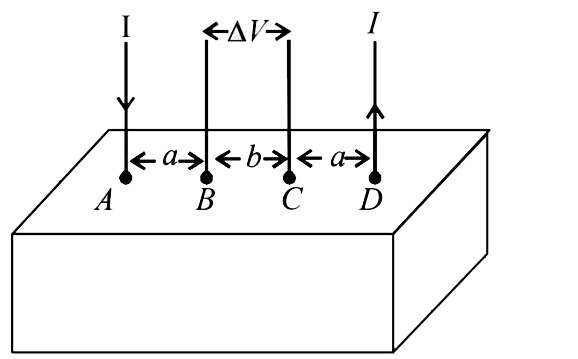
Consider a block of conducting material of resistivity `'rho'` shown in the figure. Current `'I'` enters at 'A' and leaves from 'D'. We apply superposition principle to find voltage `DeltaV` developed between 'B' and 'C'. The calculation is done in the following steps:
(i) Take current 'I' entering from 'A' and assume it to spread over a hemispherical surface in the block.
(ii) Calculate field E(r) at distance 'r' from A by using Ohm's law `E = rhoj,` where j is the current per unit area at 'r'.
(iii) From the 'r' dependence of E(r), obtain the potential V(r) at r.
(iv) Repeat (i), (ii) and (iii) for current 'I' leaving 'D' and superpose results for 'A' and 'D'.

`Delta V measured between B and C is

A

`(rhoI)/(2pi(a-b))`

B

`(rhoI)/(pia)-(rhoI)/(pi(a+b))`

C

`(rhoI)/a-(rhoI)/((a+b))`

D

`(rhoI)/(2pia)-(rhoI)/(2pi(a+b))`

Text Solution

Verified by Experts

The correct Answer is:

D
Promotional Banner

Similar Questions

Explore conceptually related problems

Consider a block of conducting material of resistivity 'rho' shown in the figure. Current 'I' enters at 'A' and leaves from 'D'. We apply superposition principle to find voltage DeltaV developed between 'B' and 'C'. The calculation is done in the following steps: (i) Take current 'I' entering from 'A' and assume it to spread over a hemispherical surface in the block. (ii) Calculate field E(r) at distance 'r' from A by using Ohm's law E = rhoj, where j is the current per unit area at 'r'. (iii) From the 'r' dependence of E(r), obtain the potential V(r) at r. (iv) Repeat (i), (ii) and (iii) for current 'I' leaving 'D' and superpose results for 'A' and 'D'. For current entering at A, the electric field at a distance 'r'

From the following calculate (i) Current ratio , and (ii) Quick ratio:

When some potential differece is maintained between A and B, current I enters the network at A and leaves at B

A current carrying wire is placed in the grooves of an insulating semicircular disc of radius 'R', as shown in Fig. The current enters at point A and leaves from point B. Determine the magnetic field at Point D.

ABCD is a square loop made of a uniform conducting wire. A current enters the loop at A and leaves at D . The magnetic field is

A uniform wire is bent in the form of a circle of radius R . A current I enters at A and leaves at C as shown in the figure : If the length ABC is half of the length ADC , the magnetic field at the centre O will be

Calculate current (i) flowing in part of the circuit shown in figure?
