Home
Class 12
PHYSICS
In the previous question,if the particle...

In the previous question,if the particle has`-Q` charge the time spend by the particle in the field will be .

A

`Ttheta`

B

`2Ttheta`

C

`T((pi +2theta)/(2pi))`

D

`T((pi -2theta)/(2pi))`

Text Solution

Verified by Experts

The correct Answer is:
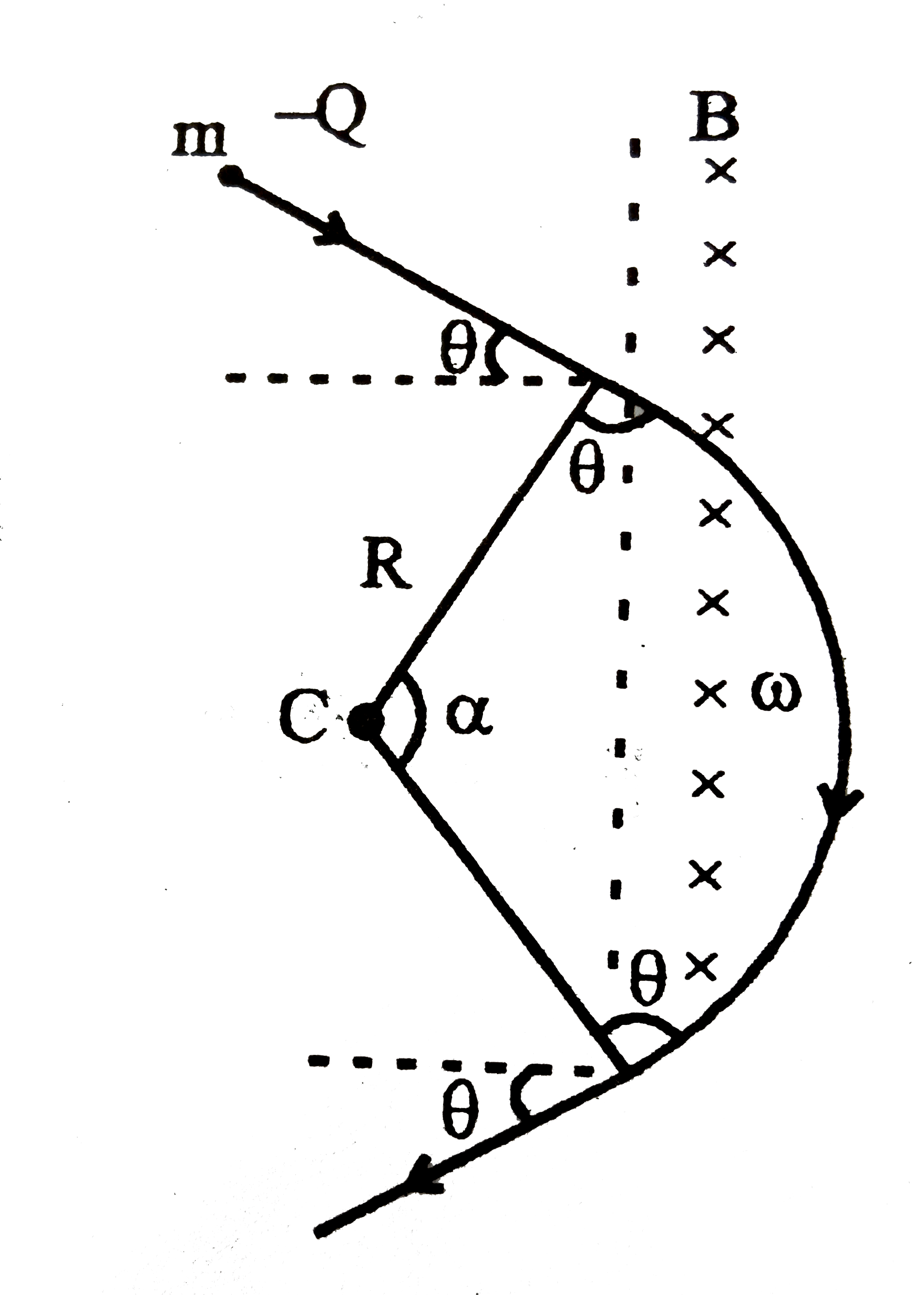
D

`alpha = pi - 2theta`
`t = (T)/(2pi) (pi - 2theta)`
.
Promotional Banner

Similar Questions

Explore conceptually related problems

In the previous question , if the conductor has a charge per unit length lambda , the particle has mass m and charge q then (choose the correct option)

In the previous problem, if time period, T =2(pi) m/(BQ) where Q is the charge of the particle and m is its mass, the ratio of time spent by the particle in field when (theta) is positive to when (theta) is negative is given by

For the previous question, the acceleration of the particle at any time t is :

For the previous question, the acceleration of the particle at any time t is :

A charged particle q is moving in the presence of a magnetic field B which is inclined to an angle 30° with the direction of the motion of the particle. Draw the trajectory followed by the particle in the presence of the field and explain how the particle describes this path.

In the previous question, the magnitude of velocity of particle at the mentioned instant is

In previous question if the particles started from rest and all are positively charge which particles must have been acted upon by a force other than that produced by the electric field.

A positive charge particle of mass m and charge q is projected with velocity v as shown in Fig. If radius of curvature of charge particle in magnetic field region is greater than d, then find the time spent by the charge particle in magnetic field.

A neutral particle is at rest in a uniform magnetic field B . At time t = 0 it decays into two charged particles, each of mass m . (a) If the charge of one of the particles is +q , what is the charge of the other? (b) The two particles move off in separate paths, both of them lie in the plane perpendicular to B . At a later time, the particles collide. Express the time from decay until collision in terms of m, B and q .

