
Home
Class 12
PHYSICS
In a region of space, a uniform magnetic...

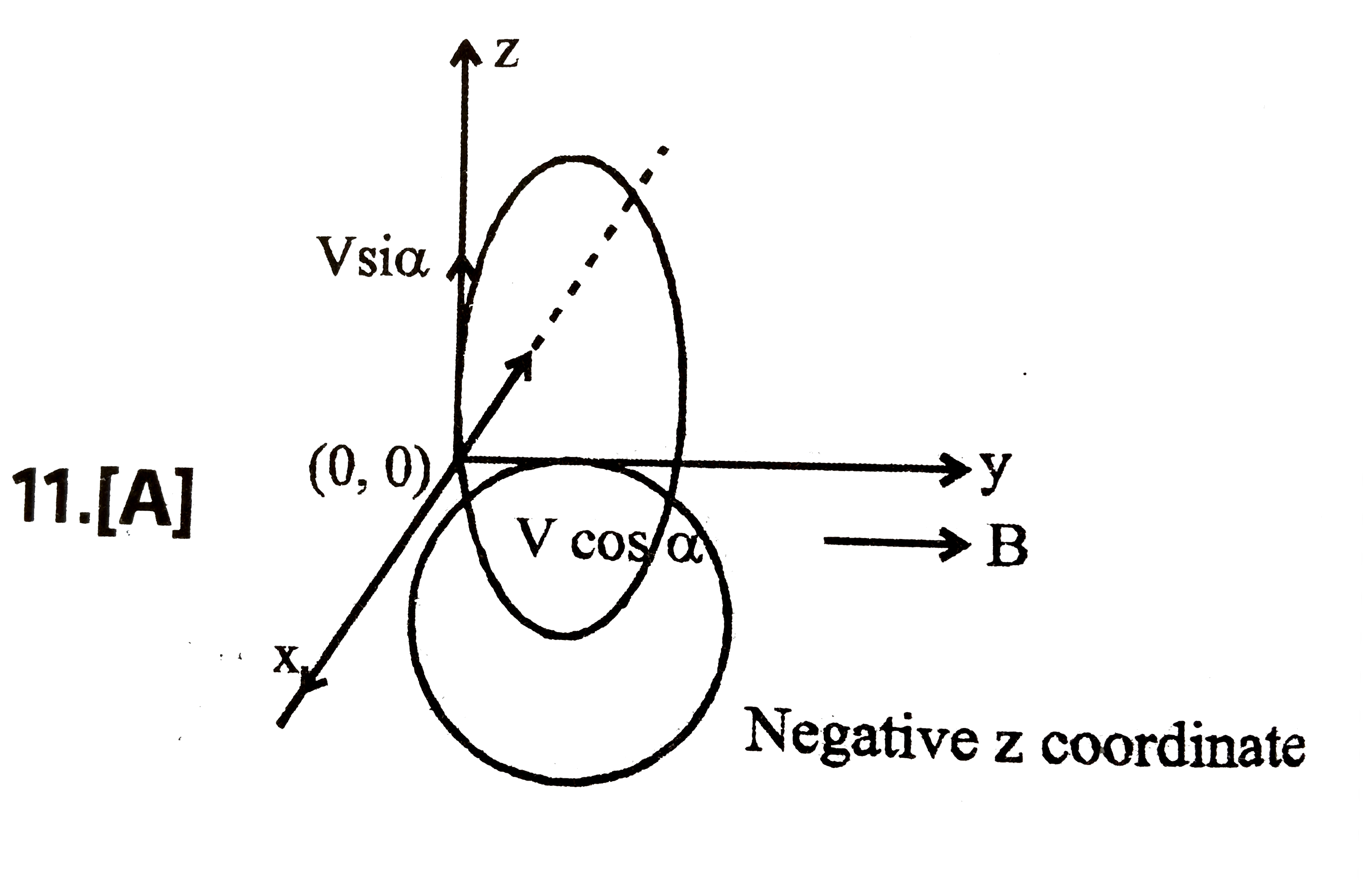
In a region of space, a uniform magnetic field `B` exists in the y-direction `A` proton is fired from the origin, with its initial velocity v making a small angle alpha with the y-direction in the yz plane. In the subsequent motion of the proton
.

A

its x-coordinate can never be positive .

B

itsx-and z-coo rdinates cannot both be zero at the same time

C

its z-coordinate can never be negative

D

its y-coordinate will be proportional the the square of its time of flight .

Text Solution

Verified by Experts

The correct Answer is:
A

.
Promotional Banner

Similar Questions

Explore conceptually related problems

In a region of space, a uniform magnetic field B exists in the x-direction. An electron is fired from the origin with its initial velocity u making an angle alpha with the y direction in the y-z plane. In the subsequent motion of the electron,

A portion is fired from origin with velocity vec(v) = v_(0) hat(j)+ v_(0) hat(k) in a uniform magnetic field vec(B) = B_(0) hat(j) . In the subsequent motion of the proton

A homogenous electric field E and a uniform magnetic field vecB are pointing in the same direction. A proton is projected with its velocity parallel to vecE . It will

A proton is fired from origin with velocity vecv=v_0hatj+v_0hatk in a uniform magnetic field vecB=B_0hatj .

Discuss the motion of a charged particle when subjected to a uniform magnetic field, when the direction of motion of the particle makes an angle phi with the direction of magnetic field.

In a certain region of space a uniform and constant electric field and a magnetic field parallel to each other are present. A proton is fired from a point A in the field with speed v=4xx10^(4)m//s at an angle of alpha with the field direction. The proton reaches a point B in the field where its velocity makes an angle beta with the field direction. If (sinalpha)/(sinbeta)=sqrt(3) . Find the electric potential difference between the points A and B . Take m_(p) (mass of proton) =1.6xx10^(-27)kg and c (magnitude of electronic charge) =1.6xx10^(19)C .

