Home
Class 12
PHYSICS
A metal bar AB can slide on two parallel...

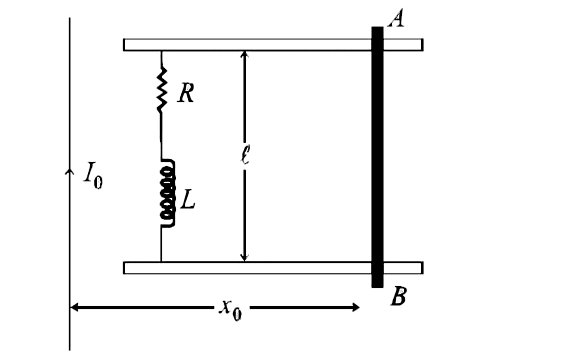
A metal bar AB can slide on two parallel thick metallic rails separated by a distance l. A resistance R and an inductance L are connected to the rails as shown in the figure. A long straight wire carrying a constant current `I_(0)` is placed in the plane of the rails and perpendicular to them as shown. The bar AB is held at rest at a distance `x_(0)` from the long wire. At t=0, it is made to slide on the rails away from wire. Answer the following questions.
(a) Find a relation among `i, (di)/(dt) and (d phi)/(dt)`, where i is the current in the circuit and `phi` is the flux of the megnetic field due to the long wire through the circuit.
(b) It is observed that at time t=T, the metal bar AB si at a distance of `2x_(0)` from the long wire and the resistance R carries a current `(i_1)`. Obtain an expression for the net charge that has flown through riesistance R form t=0 to t=T.
(c) THe bar is suddenly stopped at time T. THe current through resistance R is found to be `(i_1)/(4)` at time 2T. Find the value of `L/R` in terms of hte other given quantities.

Text Solution

Verified by Experts

The correct Answer is:
`(A) (dphi)/(dt)iR+L(di)/(dt)`,
`(B) 1/R[(mu_(0)I_(0)l)/(2pi)ln(2)-Li_(l)] (C )T/(ln(4))`

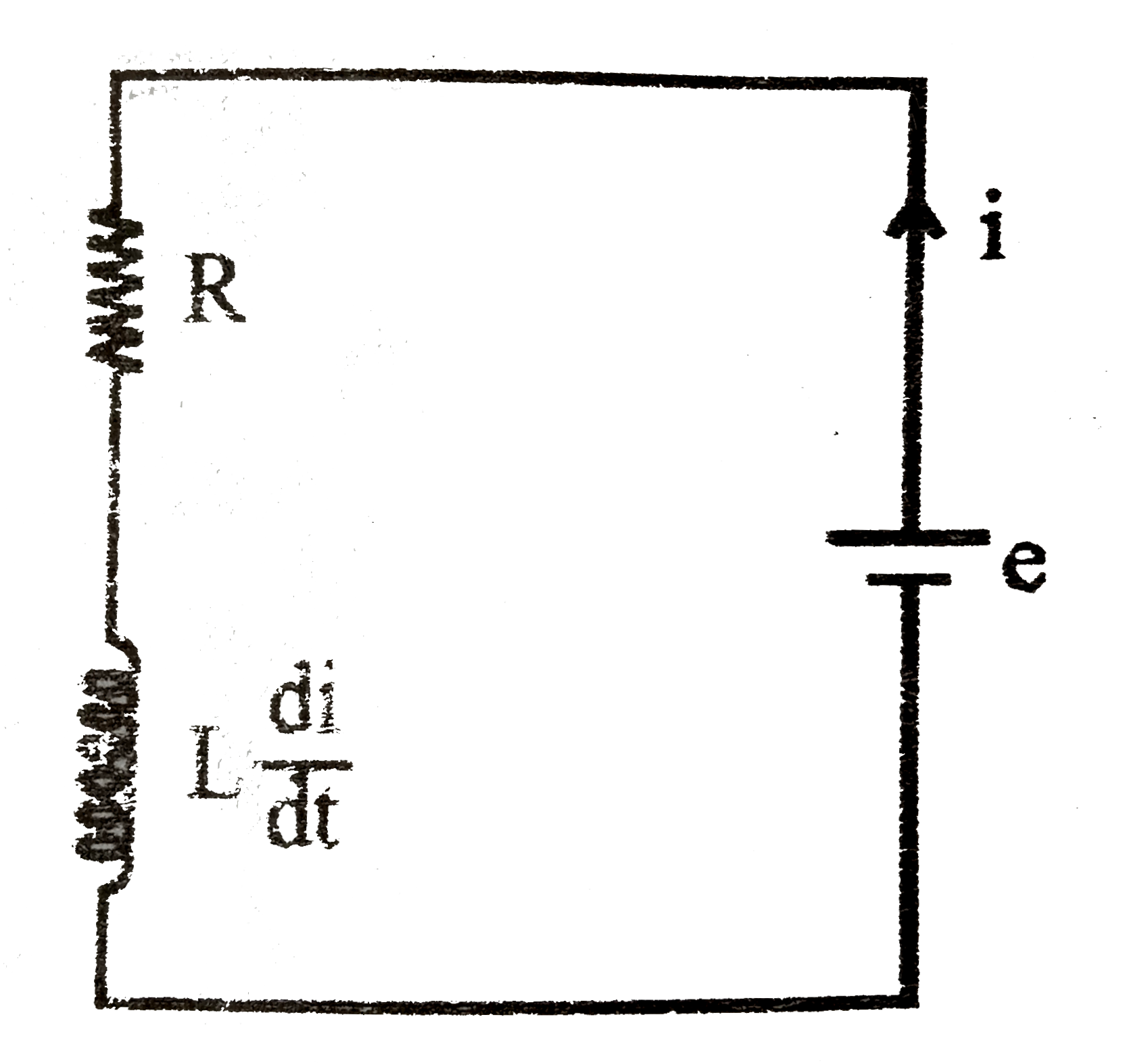
(a) If e is the induced emf and `(di)/(dt)` is the rate of increase of current in the circuit, then by Kirchhoff's II law, we have
`e-iR-L(di)/(dt)=0`
or `e=IR+L(di)/(dt)`

or `|(dphi)/(dt)|=iR+(Ldi)/(dt) …(1)`
(b) Equation (i) can written as
`dphi=R(idt)+Ldi
implies dphi=R(dq)+Ldi`
`int_(phi_(1))^(phi_(f))dphi=Rint_(0)^(q)dq+Lint_(0)^(i_(i))di`
Charge flown during the time `t=0` to `t=T`
will be `q=((phi_(f)-phi_(i)))/R-(Li_(1))/R`
The change in flux can be obtained as
`phi_(f)-phi_(i)=Rq+Li_(1)`
Change flown during the time `t=0 t=T` will be `q=((phi_(f)-phi_(i)))/R-(Li_(1))/R`
The change in flux can be obtained as
`phi_(f)-phi_(i)=int_(x_(0))^(2x_(0))BdA=int_(x_(0))^(2x_(0))(mu_(0)i_(0))/(2pix)(ldx)=(mu_(0)i_(0)l)/(2pi)ln2`
On substituting this value is equation (iii), we get `q=(mu_(0)i_(0)l)/(2piR)ln2-(Li_(1))/R`
(c ) When the bar is stopped, the induced enf becomes zero so from equation (i)
`(di)/i=-R/L dt implies int_(i_(1))^(i_(1)//4)(di)/i=-R/Lint_(T)^(2T)dt`
`|lni|_(i_(1))^(i_(1)//4)=-R/L(2T-T) implies ln(1/4)=- (RT)/L`
`ln4=(RT)/L implies L/R=T/(lm4)`
Promotional Banner

