Home
Class 11
PHYSICS
A man can swim at a speed of 3 km/h in s...

A man can swim at a speed of 3 km/h in still water. He wants t cross a 500 m wide river flowing at 2 km/h. He flow while swimming. A. Find the time he takes to cross the river. b.At what point on the opposite bank will he arrive?

Text Solution

Verified by Experts
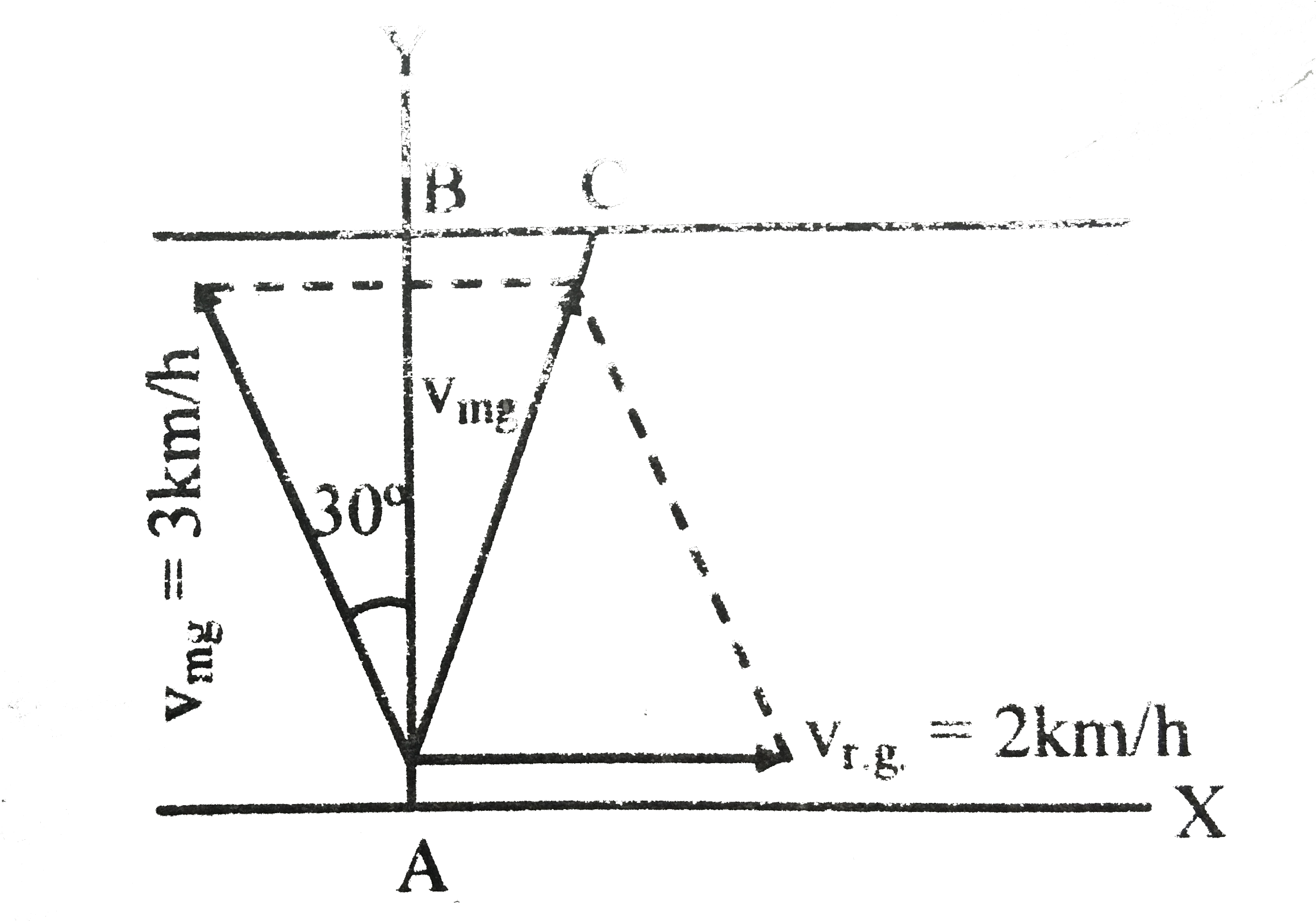
The situation is shown in figure.
Here `underset(v_(r.g))rarr` velocity of the river with respect to the ground
`underset(v_(m.r))rarr=` velocity of the man with respect to the river

`underset(v_(m.g))rarr=` velocity of the man with respect to the ground
(a) We have, `underset(v_(m.g))rarr = underset(v_(m.r))rarr + underset(v_(r.g))rarr ....(i)`
Hence, the velocity with respect to the ground is along `AC`, Taking `y`-components in equation (i),
`underset(v_(m.g))rarr sin theta = 3km//h cos 30^(@) +2km//h cos 90^(@)`
`= (3sqrt(3))/(2) km//h`
Time taken to cross the river
`= ("displacement along the Y-axis")/("velocity along the Y-axis") = (1//2km)/(3sqrt(3)2km//h) = (1)/(3sqrt(3)) h`.
(b) Taking x-components in equation (i),
`underset(v_(mg))rarr cos theta =-3 km//h sin 30^(@) +2km//h =(1)/(2)km//h`
Displacement along the X-axis as the man crosses the river `= ("velocity along the X-axis") ("time")`
`= ((1km)/(2h)) xx ((1)/(3sqrt(3))h) = (1)/(6sqrt(3))km`.
Promotional Banner

Similar Questions

Explore conceptually related problems

A man can swim at a speed of 3 km/h in still water. He wants t cross a 500 m wide river flowing at 2 km/h. He flow at an angle of 120 with the river flow while swimming. A. Find the time he takes to cross the river. b.At what point on the opposite bank will he arrive?

A man can swim at a speed of 5km//h in the still water. He wants to cross a 1600m wide river flowing at 4 km//h . He keeps himself at an angle 127^(@) with the river flow while swimming. (a) Find the time he takes to cross the river. (b) Find the distance traveled by him along the flow.

A man can swim at a speed of 3 km h^-1 in still water. He wants to cross a 500-m wide river flowing at 2 km h^-1 . He keeps himself always at an angle to 120^@ with the river flow while swimming. The time taken to cross the river is.

A man can swim at a speed of 3 km h^-1 in still water. He wants to cross a 500-m wide river flowing at 2 km h^-1 . He keeps himself always at an angle to 120^@ with the river flow while swimming. The drift of the man along the direction of flow, when he arrives at the opposite bank is.

A man can swim at a speed of 5 km/h W.r.t water. He wants to cross a 1.5 km wide river flowing at 3 km/h. He keeps himself always at an angle of 60° with the flow of direction while swimming, The time taken by him to cross the river will be

A man who can swim at a velocity v relative to water wants to cross a river of width b, flowing with a speed u.

A man can swin with speed 6 km/h in still water. If he tries of swim across a river flowing with speed 5km/h, how fast does a leaf floating on water appears to go , to the man ?

A man can swim at the rate of 5 km//h in still water. A river 1 km wide flows at the rate of 3km h^(-1) . A swimmer wishes to cross the river straight.

A boy can swim in still water at 1m//s . He swims across a river flowing at 0.6m/s which is 336 m wide. If the travels in shortest possible time, then what time he takes to cross the river?

A man can swim with a speed of 4kmh^(-1) in still water. He crosses a river 1km wise that flows steadly at 3kmh^(-1) . If he makes his strokes normal to the river current, how far down the river does he go when he reaches the other bank?

