Home
Class 11
PHYSICS
In the arrangement shown in the Fig, the...

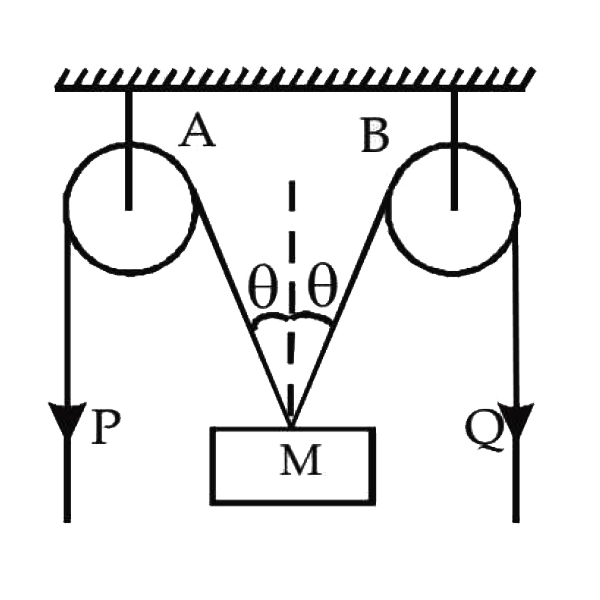
In the arrangement shown in the Fig, the ends P and Q of an unstretchable string move downwards with uniform speed U. Pulleys A and B are fixed.
Mass M moves upwards with a speed

Text Solution

Verified by Experts
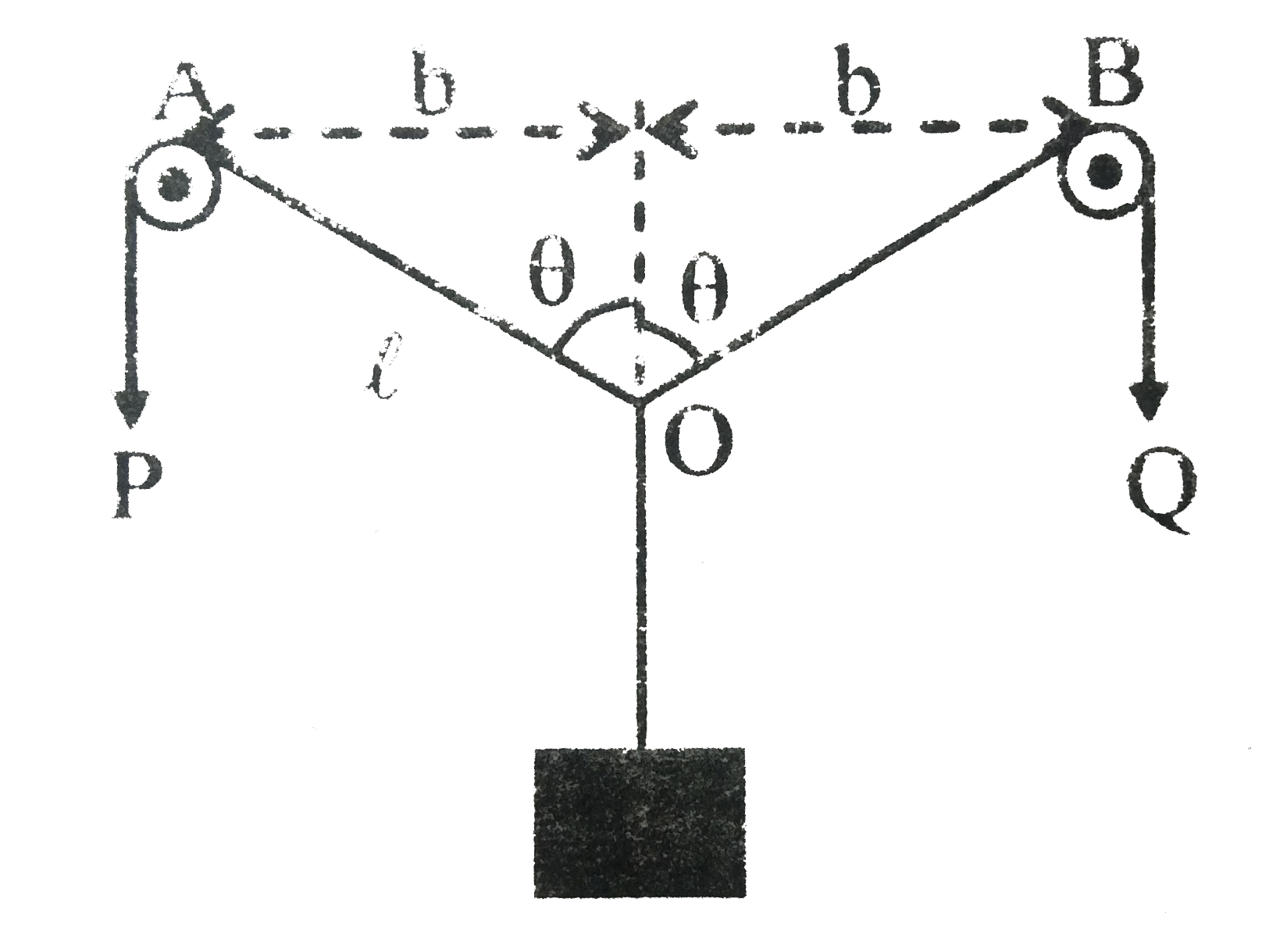
As `P` and `Q` move down, the lebgth `1` decreases at the rate of `Um//s`.
From figure, `1^(2) = b^(2) +y^(2)`
Differentiating with respect to time

`21(dl)/(dt) = 2y (dl)/(dt)` (`:' b` is constant)
`:. = (dy)/(dt) = (l)/(y).(dl)/(dt) = (1)/(cos theta).(dl)/(dt) = (U)/(cos theta)`
Promotional Banner

Similar Questions

Explore conceptually related problems

In the arrangement shown in figure the ends P and Q of an inextensible string move downwards with uniform speed u. Pulleys A and B are fixed. The mass M moves upwards with a speed

In the arrangement shown in figure, the ends P and Q of an inextensible string move downwards with uniform speed u . Pulleys A and B are fixed. The mass m moves upwards with a speed

In the arrangement shown in fig neglect the masses of pulleys and string and also friction Calculate acceleration of blocks A and B

Consider the arrangement shown in the figure. Find the acceleration of the block (a) A monkey moves upward with respect to the rope with acceleration a_(0) (b) A monkey moves downward with respect to the rope with acceleration a_(0) Assume the surface smooth, pulley and string light.

A weight W is tied to two strings passing over tha frictionless pulleys A and B as shown in the figure. If weights P and Q move downwards with speed v, the weight W at any instant rises with the speed :

In the arrangement shown in the fig, block A is pulled so that it moves horizontally along the line AX with constant velocity u. Block B moves along the incline. Find the time taken by B to reach the pulley P if u = 1m//s . The string is inextensible.

Consider the arrangement shown in figure. The string is wrapped around a uniform cylinder which rolls without slipping. The other end of the string is passed over a masslessm frictionless pulley to a falling weight, determine the acceleration of the falling mass m in terms of only the mass of the cylinder M , the mass m and g

In the figure, the blocks are of equal mass. The pulley is fixed. In the position shown, A moves down with a speed u, and v_(B) = the speed of B.

If block A of the pulley system is moving downward with a speed of 1 m//s while block C moving up at 0.5m//s determine the speed of block B

