Home
Class 11
PHYSICS
At aharbour enemy ship is at a distance ...

At aharbour enemy ship is at a distance `180sqrt(3)m` form the security cannot having a muzzle velocity of `60m//s`.
(a) To what angle must the cannot be elevated to hit the ship.
(b) What is the time of flight.
(c ) How for should the ship be moved away from its initial position so that it becomes beyond the range of the cannot `(g = 10m//s^(2))`.

Text Solution

Verified by Experts
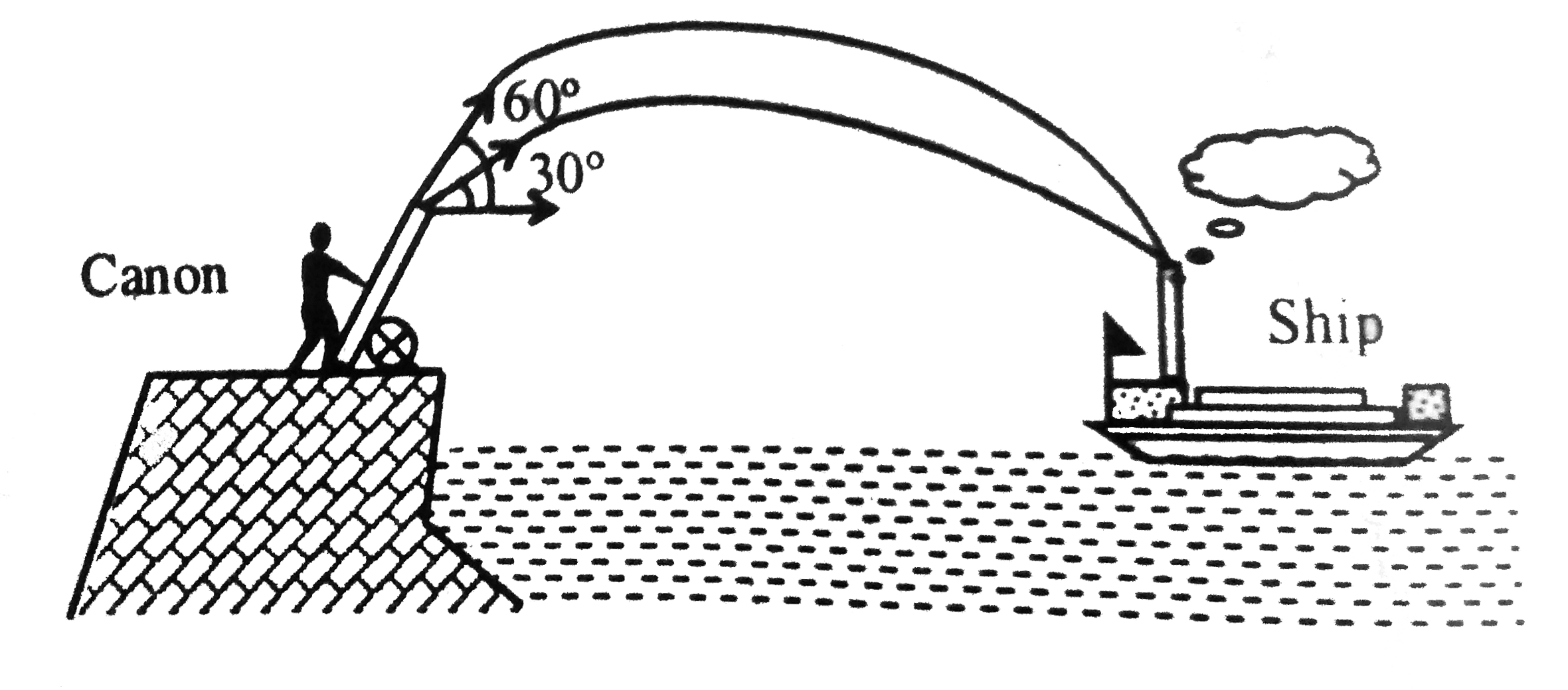
(a) For hitting the ship the range of cannon must be equal to the distance of ship from cannot i.e.,
Range `= 180sqrt(3)`

`(u^(2)sin 2theta)/(g) = 180 sqrt(3)`
r `sin 2 theta = (180sqrt(3)xx10)/(60xx60) = (sqrt(3))/(2)`
`{:(i.e.,2theta=60^(@),or,,120^(@)),(or,theta=30^(@),or,,60^(@)):}`
(a) The cannot mist be elevated at an angle of `30^(@)` or `60^(@)`
(b) As `T = (2usin theta//g)`, depending on `theta` there are two times of flight which are given by
`t_(1) = (2xx60)/(10) xx sin30 = 6s`
and `t_(2) = (2xx60)/(10) xx sin60 = 6sqrt(3) = 104s`.
(c) The maximum range of cannot (where `theta =45^(@))`
`R_(max) = (u^(2))/(g) = (60xx60)/(10) = 360m`
And as initially the ship is `180sqrt(3)m`, so to become out of maximum range of cannot, the ship should be moved away form the harbour form its initial position by at least
`360 - 180sqrt(3) = 48.6m.`
Promotional Banner

Similar Questions

Explore conceptually related problems

A coastguard ship locates a pirate ship at a distance of 560 m. It fires a cannon ball with an initial speed 82 m/s. At what angle from horizontal the ball must be fired so that it hits the pirate ship?

A particle is projected from the ground with an initial velocity of 20 m//s at angle fo 30^@ with the horizontal. What is the magnitude of chang in velocity in 0.5 scond ? ( g= 10 m//s^2) .

A particle A is projected from the ground with an initial velocity of 10m//s at an angle of 60^(@) with horizontal. From what height should an another particle B be projected horizontally with velocity 5m//s so that both the particles collide in ground at point C if both are projected simultaneously g=10 m//s^(2) .

Velocity v of a particle moving along x axis as a function of time is given by v = 2t m//s . Initially the particle is to the right of the origin and 2 m away from it. Find the position (distance from origin) of the particle after first 3 s .

How high must a body be lifted so that it gain P.E. equal to its KE while moving with a velocity of 30m//s ?Take g=10m//s^(2)

At what height above the ground must a mass of 5 kg be to have its PE equal in value to the KE possessed by it when it moves with a velocity of 10 m/s? (g = 10 m/s^(2))

A stress of 10^(6) N//m^(2) is required for breaking a material. If the density of the material is 3 xx 10^(3) Kg//m^(3) , then what should be the minimum length of the wire made of the same material so that it breaks by its own weight (g = 10m//s^(2))

At the height 80 m , an aeroplane is moving with 150 m//s . A bomb is dropped from it so as to hit a target. At what distance from the target should the bomb be dropped (given g = 10 m//s )

A ball is thrown at an angle theta with the horizontal. Its time of flight is 2 s. Its horizontal range is 100 m. What is the horizontal component of velocity of projection ? Take g =10 ms^(-2) .

A football ils kicked with a velocity of 20 m/s at an angle of 45^0 wilth the horizontal. A. Find the time taken by the ball to strike the ground. b.Find the maximum height it reaches. C. How far away from the kick dows it hit the ground? Take g=10 m/s^2 .

