Home
Class 11
PHYSICS
The pulley in the diagram are all smooth...

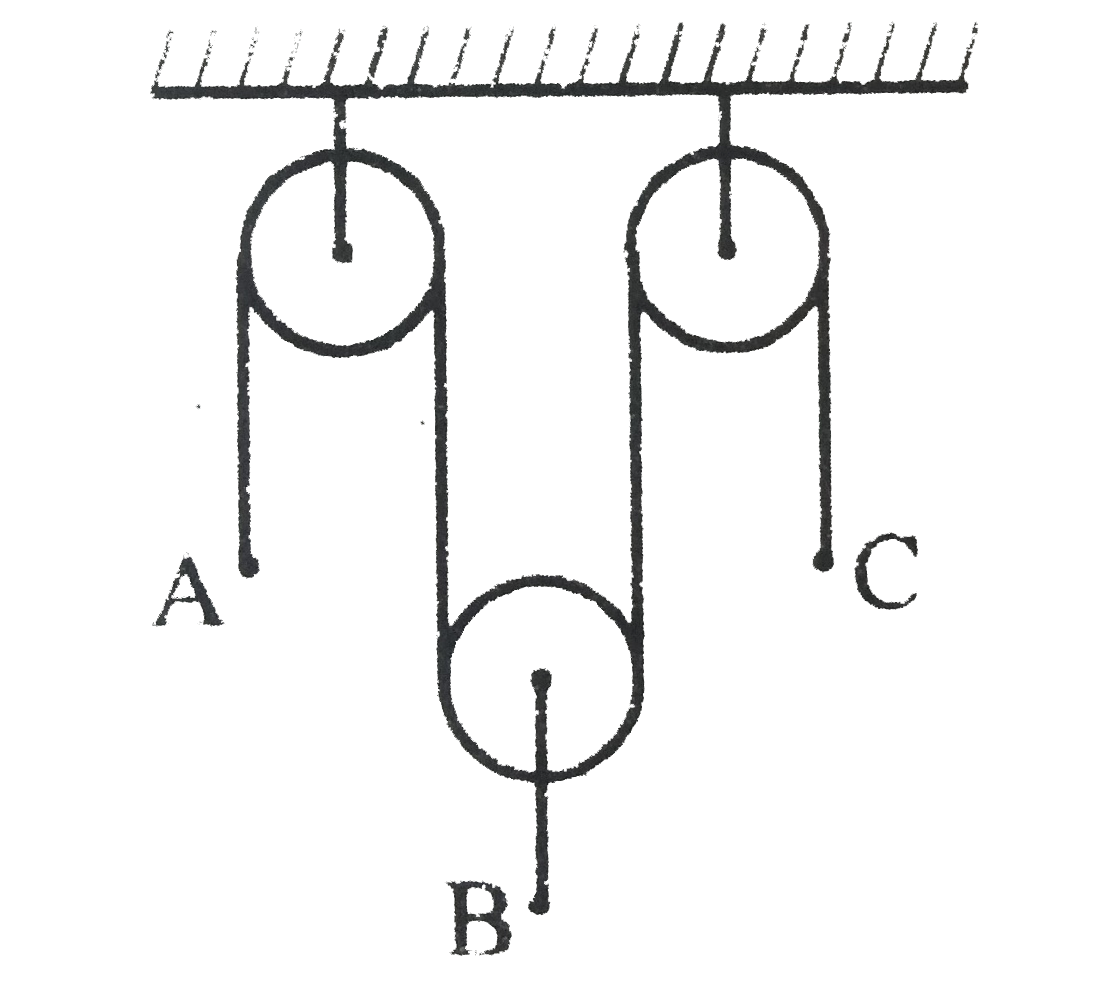
The pulley in the diagram are all smooth and light. The acceleration of `A` is a upwards and the acce,leration of `C` is `f` downwards. The acceleration of `B` is

A

`½(f-a) up`

B

`½(a+f)down`

C

`½(a+f)up`

D

`½(a-f)up`

Text Solution

Verified by Experts

The correct Answer is:
A

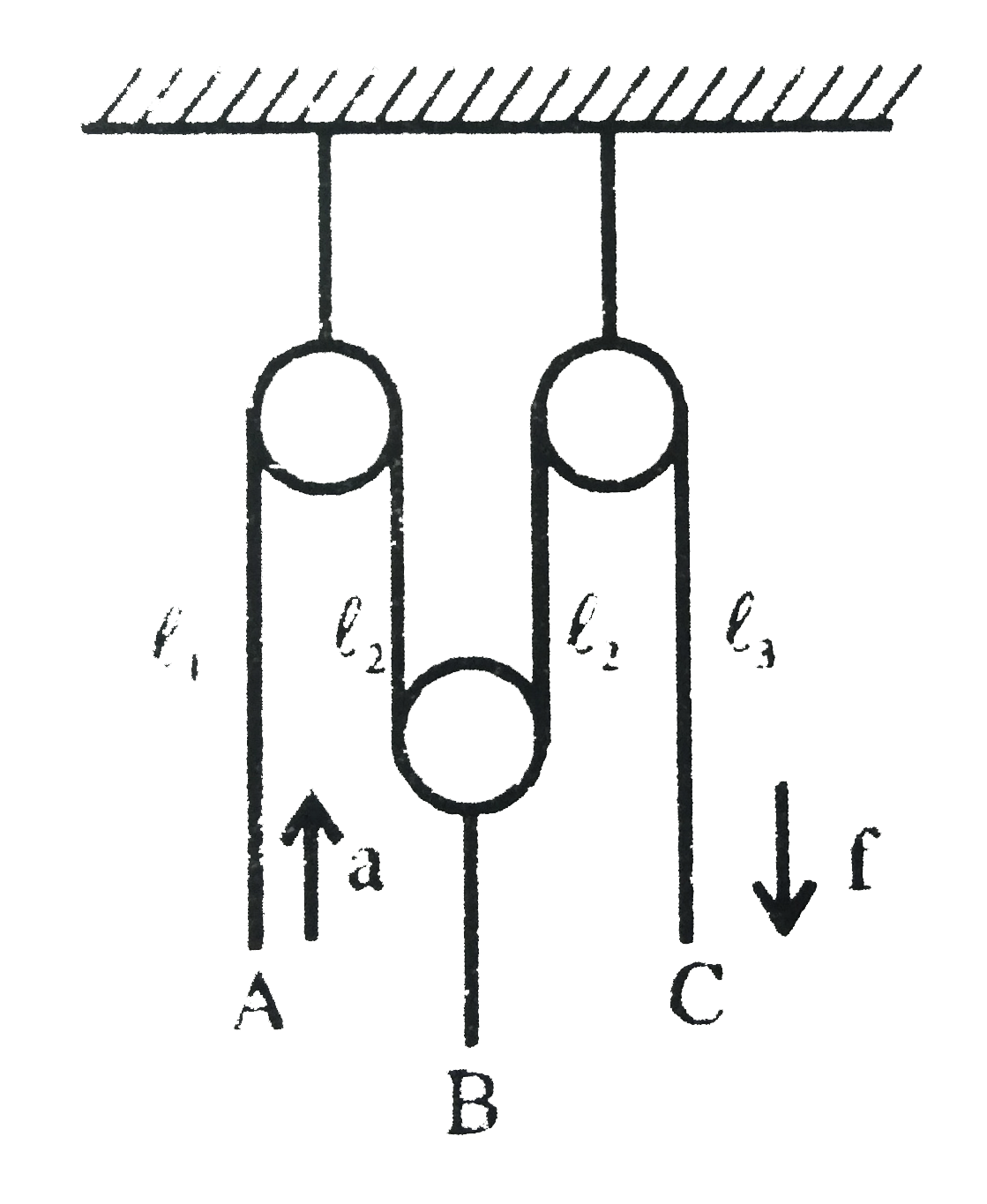
`l_(1) +2l_(2) +l_(3) =` constant ltbrltgt `(dl_(1))/(dt) +2(dl_(2))/(dt) +(dl_(3))/(dt) = 0`
`(d^(2)l_(1))/(dt^(2)) +2(d^(2)l_(2))/(dt^(2)) +(d^(2)l_(3))/(dt^(2)) = 0`
`rArr -a +2a_(B) +f = 0`
`a_(B) =- (1)/(2) (f-a) rArr a_(B) = (1)/(2) (f-a) uarr`
Promotional Banner

Similar Questions

Explore conceptually related problems

If acceleration of block B is 4 m//s^(2) upward & that of C is 6 m//s^(2) downward. Find acceleration of A :-

The acceleration of light pulley is

In the figure acceleration of A is 1m//s^(2) upward, acceleration of B is 7m//s^(2) upward acceleration of C is 2m//s^(2) upward. The acceleration of D will be.

At a certain moment of time, acceleration of the block A is 2 m//s^(2) . Upward and acceleration of block B is 3 m//s^(2) upward. The acceleration of block C is ( masses of pulleys and string are negligible )

In the pulley system shown the two upper pulleys are fastened together to form single unit. The cable is wrapped around the smaller pulley with its end secured to the pulleys so that it cannot slip. Determine the upward acceleration of block B if A has downward acceleration of 2 m//s^(2) :

If the string & all the pulleys are ideal, acceleration of mass m is :-

All surfaces are smooth. The acceleration of mass m relative to the wedge is

If pulleys shown in the diagram are smooth and massless and a_(1) and a_(2) are acceleration of blocks of mass 4 kg and 8 kg respectively, then -

In the figure shown, acceleration of 1 is x (upwards). Acceleration of pulley P_(3) , w.r.t. pulley P_(2) is y (downwards) and acceleration of 4 w.r.t. to pulley P_(3) is z (upwards). Taking upward +ve and downward -ve then {:(,"Column I",,,"Column II"),((A),"Absolute acceleration of 2",,(p),(y-x) "downwards"),((B),"Absolute acceleration of 3",,(q),(z-x-y) "upwards"),((C),"Absolute acceleration of 4",,(r),(x+y+z) "downwards"),(,,,(s),"None"):}

