Home
Class 11
PHYSICS
A large box moves vertically downwards w...

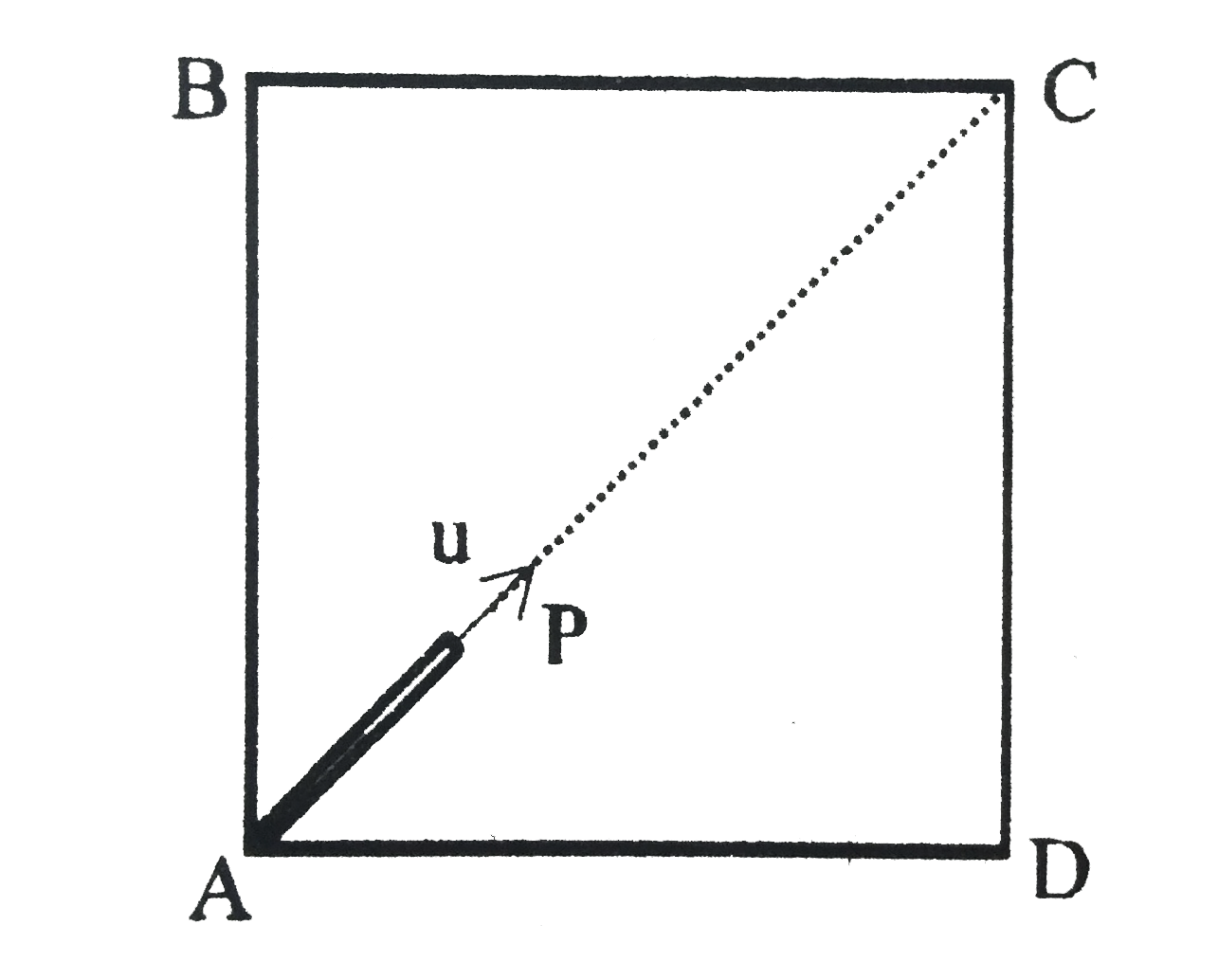
A large box moves vertically downwards with an acceleration a. A toy gun fixed at `A` aimed towards `C` fires a particle `P`.

A

`P` will hit `C` if `a = g`

B

`P` will hit the roof `BC`, if `fa gt g`

C

`P` will hit the wall `CD` if ` alt g`

D

May be either `(A),(B)` or `(C )`, depending on the speed of projection of `P`.

Text Solution

Verified by Experts

The correct Answer is:

A, B
Promotional Banner

Similar Questions

Explore conceptually related problems

A large rectangular box moves vertically downward with an acceleration a . A toy gun fixed at A and aimed towards C fires a particle P .

A large rectangular box ABCD falls vertically with an acceleration a. a toy gun fixed at A and aimed towards C fired a particle P.

Find the period of oscillation of a pendulum of length l if its point of suspension is (a) moving vertically up with acceleration a (b) moving vertically down with acceleration a(lt g) (c) failing freely under gravity moving horizontal with acceleration a .

A large box is moving on a horizontal floor with constant acceleration a=g. A particle is projected inside box with velocity u and angle theta with horizontal from box frame. For the given u, the value of theta for which horizontal range inside he box will be maximum is

Two particles are projected simultaneously from the same point, with the same speed, in the same vertical plane, and at different angles with the horizontal in a uniform gravitational field acting vertically downwards. A frame of reference is fixed to one particle. The position vector of the other particle , as observed from this frame, is vecr . Which of the following statement is correct?

A particle initially moving towards south in a vertically downward magnetic field is deflected toward the east. What is the sign of the charge on the particle?

A Vector bar(P) points vertically downwards and another vector bar(Q) points towards north then. The vector bar(P)timesbar(Q) points towards.

A particle is projected vertically upwards. What is the value of acceleration (i) during upward journey, (ii) during downward journey and (iii) at highest point?
