Home
Class 11
PHYSICS
A block is thrown with a velocity of 2m/...

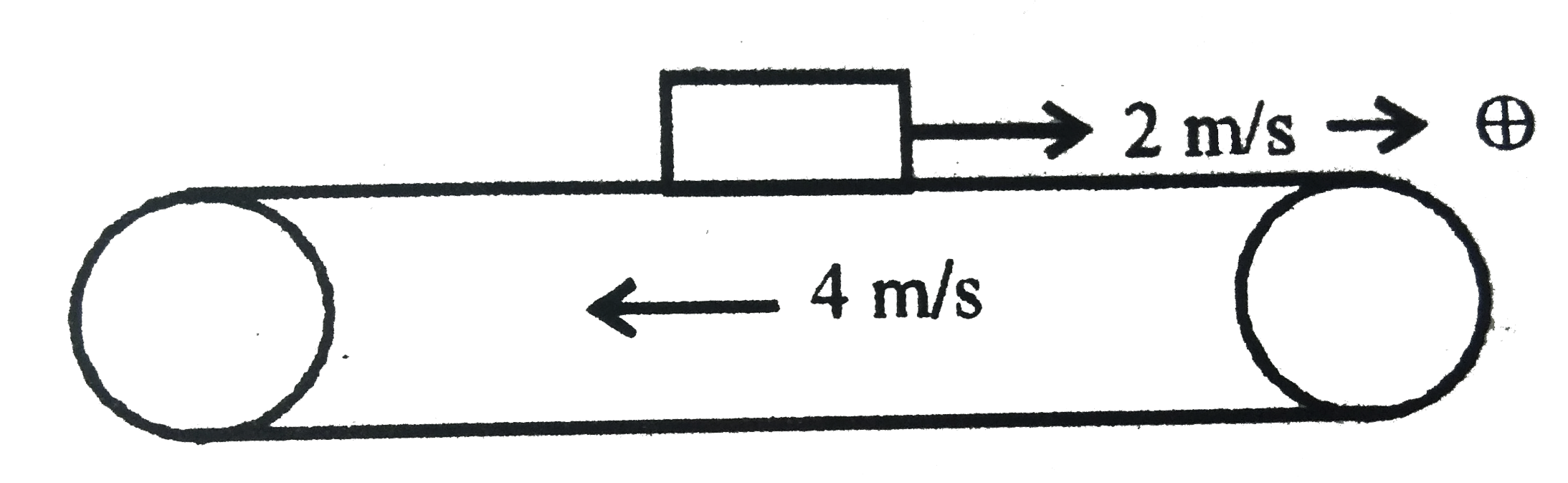
A block is thrown with a velocity of `2m//s^(-1)` (relative to ground) on a belt, which is moving with velcoity `4ms^(-1)` in opposite direction of the initial velcoity of block. If the block stops slipping on the belt after `4sec` of the throwing tehn choose teh correct statements `(s)`

A

Displacement with respect to ground is zero after `2.66` and magnitude of displacement with respect to ground is `12m` after `4sec`.

B

Magnitude of displacement with respect to ground in `4sec` is `4m`.

C

Magnitude of displacement with respect to belt in `4sec` is `12m`.

D

Displacement with respect to ground is zero in `8//3sec`.

Text Solution

Verified by Experts

The correct Answer is:
B, C, D

Blocks stops slipping when its velocity becomes`-4m//s` or equal to velcoity of belt.
`v = u +at rArr - 4 = 2 +a xx 4`
`a=- 1.5 m//s^(2) =- (3)/(2) m//s^(2)`

For displacement w.r.t. ground, `x = ut +(1)/(2)at^(2)`
`0 = 2t +(1)/(2) (-(3)/(2)) t^(2) rArr t = (8)/(3) sec`.
`rArr x_((4sec)) = 2 xx 4 +(1)/(2) (-(3)/(2)) xx (4)^(2)`
`= 8 - 12 =- 4m`
`rArr x_(B//"belt") = (u_(B//"Belt")) t +(1)/(2) a_((B//"Belt")) t^(2)`
`= 6 xx 4+(1)/(2) xx (-(3)/(2)) xx (4)^(2) = 24 - 12 = 12 m`
Promotional Banner

Similar Questions

Explore conceptually related problems

A block lying on a long horizontal conveyer belt moving at a constant velocity receives a velocity v_(0) = 5m//s relative to the ground in the direction opposite to the direction of motion of the conveyer. After t = 4s , the velocity of the block becomes equal to the velocity of the belt. The coefficient of friction between the block and the belt is mu = 0.2 . Determine the velocity v of the conveyer belt.

A 100 kg block is started with a speed of 2.0 m s^(-1) on a long, rough belt kept fixed in a horizontal position. The coefficient of kinetic friction between the block and the belt is 0.20. (a) calculate the change in the internal energy of the block=-belt system as the block comes to a stop on the belt. (b) consider the sutuation from a frame of reference moving at 2.0 m s^(-1) along the initial velocity of the block. as seen from this frame, the block is gently put on a moving belt and in due time the block starts moving with the belt at 2.0 m s^(-1) , calculate the increase in the kinetic energy of the block as it stops slipping past the belt. (c ) find the work done in this frame by the external force holding the belt.

A block of mass 5 kg moves from left to right with a velocity of 2ms^(-1) and collides with another block of mass 3 kg moving along the same line in the opposite direction with velocity 4 ms^(-1) . (i) If the collision is perfectly elastic, determine velocities of both the blocks after their collision. (ii) If coefficient of restitution is 0.6, determine velocities of both the blocks after their collision.

A block of mass m moving with a velocity v_(0) collides with a stationary block of mass M to which a spring of stiffness k is attached, as shown in Fig. Choose the correct alternative(s)

The velocity acquired by a body moving with uniformaccelertion is 30 m s^(-1) in 2s and 60 ms ^(-1) in 4 s , The initial velocity is .

An 8 gm bullet is fired horizontally into a 9 kg block of wood and sticks in it. The block which is free to move, has a velocity of 40 cm//s after impact. The initial velocity of the bullet is

An object is gently placed on a long converges belt moving with 11 ms^(-1). If the coefficient of friction is 0.4, then the block will side in the belt upto a distance of

A bullet of mass 4 g is fired with a velocity of 600 ms^(-1) into a block of metal weighing 9.996kg . The block is free to move. Calculate the common velocity of the bullet and block after the impact.

A block of mass 1 kg moving with a speed of 4 ms^(-1) , collides with another block of mass 2 kg which is at rest. If the lighter block comes to rest after collision, then the speed of the heavier body is

