Home
Class 11
PHYSICS
The block B moves with a velcoity u rela...

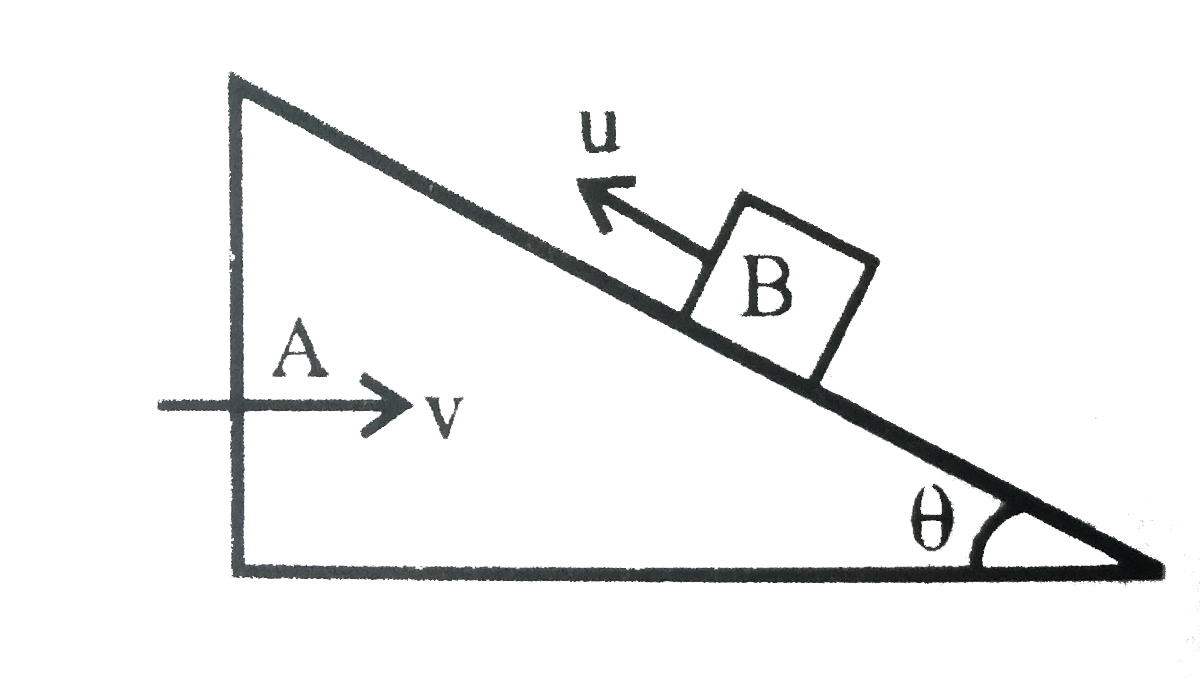
The block `B` moves with a velcoity `u` relative to the wedge `A`. If the velocity of the wedge is `v` as shown in figure, what is the value of `theta` so that the block `B` moves vertically as seen from ground.

Text Solution

Verified by Experts

The correct Answer is:

`cos^(-2) ((v)/(u))`

`-u cos theta hati +u sin theta hatj = vecV_(B//G) - vecV_(W//G)`
`-u cos theta hati +u sin theta hatj = vecV_(B//G) - vhati`
`(v- u cos theta) hati +usin theta hatj = vecV_(B//G)`
from given condition
`v - u cos theta = 0 rArr v = u cos theta`
`cos theta = (v)/(u) rArr theta = cos^(-1) (v)/(u)`
Promotional Banner

Similar Questions

Explore conceptually related problems

If block A is moving horizontally with velocity v_(A) , then find the velocity of block B at the instant as shown in fig.

A block of mass m is at rest on a rought wedge as shown in figure. What is the force exerted by the wedge on the block?

A block of mass m resting on a wedge of angle theta as shown in the figure. The wedge is given an acceleration a. What is the minimum value of a so that the mass m falls freely ?

A plank is moving on ground with a velocity v and a block is moving on the plank with respect to it with a velocity u as shown in figure. What is the velocity of block with respect to ground ?

A ball A is falling vertically downwards with velocity v_(1) . It strikes elastically with a wedge moving horizontally with velocity v_(2) as shown in figure . What must be the ratio (v_(1))/(v_(2)) , so that the ball bounces back in vertically upward direction relative to the wedge

A block of mass m is released from a wedge of mass m as shown in figure . Find the time taken by the block to reach the end of the wedge.

A block of mass m is initially lying on a wedge of mass M with an angle of inclination theta as shown in figure. Calculate the displacement of the wedge when the block is released and reaches to the bottom of the wedge.

A block of mass m is released from the top of a wedge of mass M as shown in figure. Find the displacement of wedges on the horizontal ground when the block reaches the bottom of the wedges. Neglect friction everywhere.

A block of mass m_(1) lies on the top of fixed wedge as shown in fig. and another block of mass m_(2) lies on top of wedge which is free to move as shown in fig. At time t=0 both the blocks are released from rest from a vertical height h above the respective horizontal surface on which the wedge is placed as shown. There is no friction between block and wedge in both the figures. Let T_(1) and T_(2) be the time taken by the blocks respectively to just reach the horizontal surface. then

A block A (mass 4M) is placed on the top of a wedge block B of base length l (mass=20M) as shown in figure. When the system is released from rest. Find the distance moved by the block B till the block A reaches ground Assume all surfaces are frictionless.
