Home
Class 11
PHYSICS
A parojectile thrown from platform at a ...

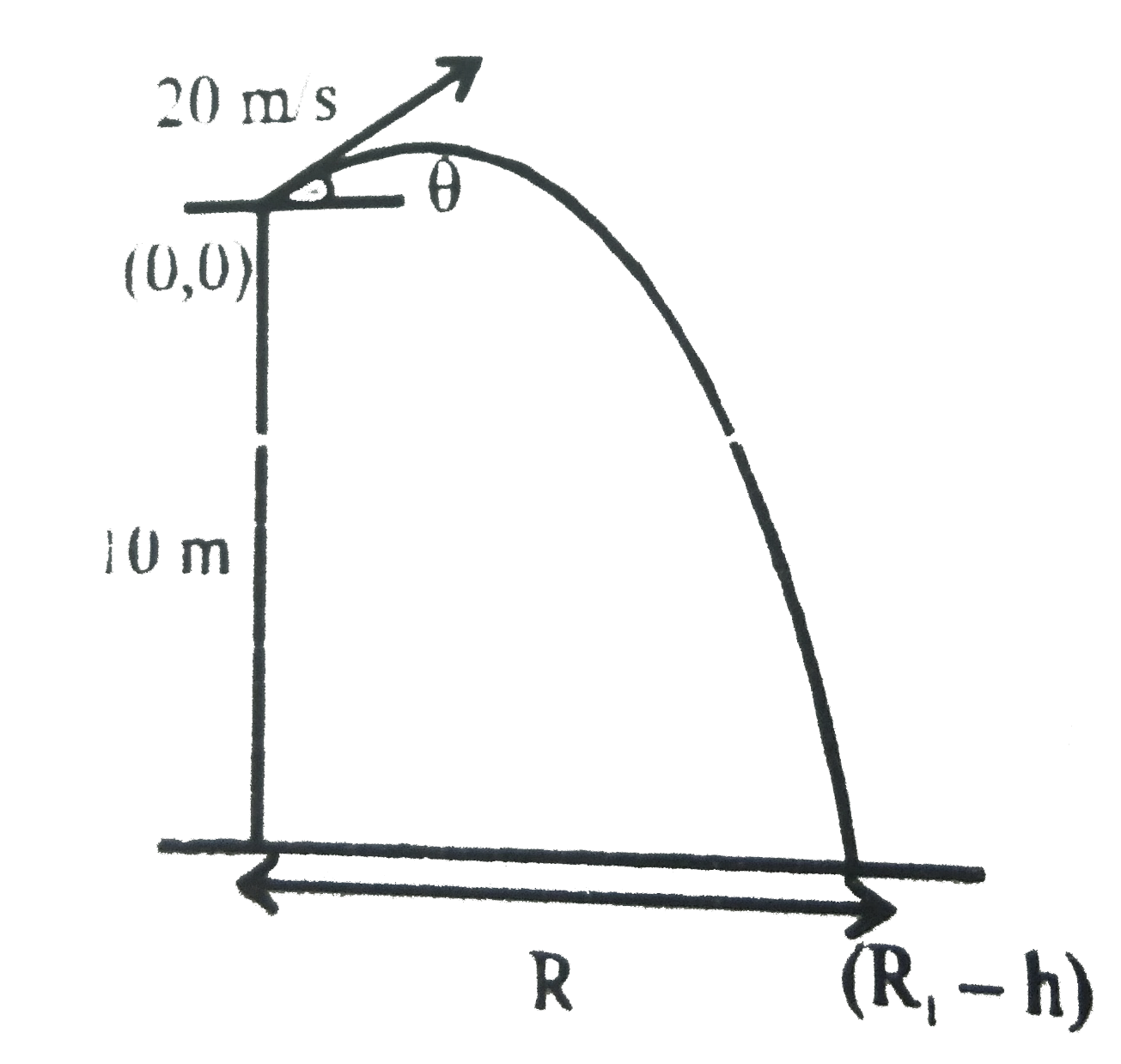
A parojectile thrown from platform at a height `10 m` above the gorund with velocity of `20m//sec`. At what angle should the projectile be thrown to reach the frathest point form `O`, which is vertcally below the point from which it is thrown.
`[g = 10m//s^(2)]`

Text Solution

Verified by Experts

The correct Answer is:
`tan^(-1) (sqrt(2//3))`

equaiton. of trajectory is `y = tan theta.x -(1)/(2) (gx^(2))/(u^(2)cos^(2) theta)`
`y = tan theta.x - (1)/(2) (g sec^(2) thetax^(2))/(u^(2))`
`y = tan theta.x - (1)/(2) (g(1+tan^(2) theta)x^(2))/(u^(2))`
`2u^(2)y = 2u^(2) tan theta.x - g(1+tan^(2) theta)x^(2)`
`(R,-h)` will stisfy the equaiton.of trajectroy.
`-2u^(2)h = 2u^(2) tan thetaR -gR^(2) (1+tan^(2) theta)`
`gR^(2) tan^(2) theta - 2u^(2) R tan theta +gR^(2) - 2u^(2)h = 0 ..(1)`
For real `tan theta` from quardatic equation `b^(2) - 4ac gt 0`

`(2u^(2)R)6(2) - 4gR^(2) (gR^(2) -2u^(2)h) ge 0`
`u^(2) - g^(2)R^(2) +2u^(2)hg ge0`
`((u^(4))/(g^(2))+(2u^(2)h)/(g))^(1//2) ge R rArr R_(max) = R^(1) = ((u^(4))/(g^(2))+(2u^(2)h)/(g))^(1//2)`
`R^(1) = (u^(4)/(g^(2))+(2u^(2)h)/(g))^(1//2)`
`rArr R^(1) = [(400 xx 400)/(100)+(2xx400xx10)/(10)]^(1//2)`
`R^(1) = [1600 +800]^(1//2) rArr R^(1) = (2400)^(1//2)`
`R^(1) =20 sqrt(6m)`
substitute the value of `R^(1)` in (1) we get on solving
`theta = tan^(-1) (sqrt((2)/(3)))`
Promotional Banner

Similar Questions

Explore conceptually related problems

A projectile thrown from a height of 10 m with velocity of sqrt(2)m//s the projectile will fall, from the foot of projection, at distance- (g=10m//s^(2))

A projectile is thrown with an initial velocity of (xveci + y vecj) m//s . If the range of the projectile is double the maximum height reached by it, then

A stone is thrown up from the top of a tower 20,m with a velocity of 24m/s a tan elevation of 30^(@) above the horizontal. Find the horizontal distance from the foot of the tower to the point at which the stone hits the ground. Take g = 10 m//s^(2)

A projectile is thrown with an initial velocity of vecv = (phati+qhatj) m/s. If the range of the projectile is four times the maximum height reached by it, then

A projectile A is thrown at an angle 30^(@) to the horizontal from point P. At the same time, another projectile B is thrown with velocity v_(2) upwards from the point Q vertically below the highest point A would reach. For B to collide with A the ratio (v_(2))/(v_(1)) should be

A projectile is thrown at angle of 30^(@) with a velocity of 10m/s .The change in velocity during the time interval in which it reaches the highest point is

A projectile is thrown with a velocity of 20 m//s, at an angle of 60^(@) with the horizontal. After how much time the velocity vector will make an angle of 45^(@) with the horizontal (in upward direction) is (take g= 10m//s^(2))-

