Home
Class 11
PHYSICS
A point p moves in counter - clockwise ...

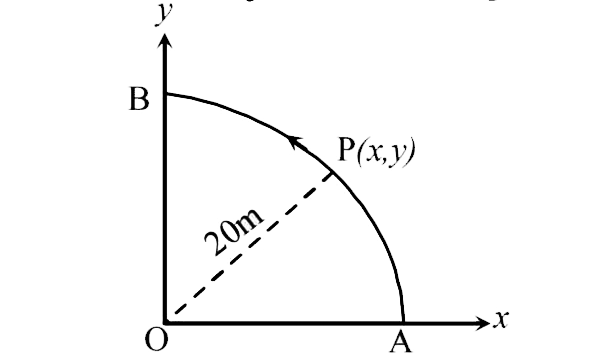
A point `p` moves in counter - clockwise direction on a circular path as shown in the figure . The movement of 'p' is such that it sweeps out in the figure . The movement of 'p' is such that it sweeps out a length `s = t^(3) + 5 ` , where `s` is in metres and ` t` is in seconds . The radius of the path is `20 m` . The acceleration of 'P' when ` t = 2 s` is nearly .

A

`14 m//s^(2)`

B

`13 m//s^(2)`

C

`12 m//s^(2)`

D

`7.2 m//s^(2)`

Text Solution

Verified by Experts

The correct Answer is:

A

`S = t^(3) +5`
Linear speed of the particle
`v = (dS)/(dt) = 3 t^(2)`
at `t = 2s v = (3 xx^(2)) m//s`
`12 m//s`
Linear acceleration
`a_(1) = (dv)/(dt) = 6t`
at `t = 2s, a_(1) = 12 m//s^(2)`
The centripetal acceleration
`a_(2) = (v^(2))/(R ) = (12^(2))/(20) m//s^(2)`
`= 7.2 m//s^(2)`
`:. a_(net) = sqrt(a_(1)^(2) +a_(2)^(2)) = sqrt(12^(2) +7.2^(2)) = 14m//s^(2)`
Promotional Banner

Similar Questions

Explore conceptually related problems

A point P moves in counter-clockwise direction on figure. The movement of P is such that it sweeps out a length s=t^(3)+5 , where s is in metre and t is in second. The radius of the pathh is 20 m. the acceleration of P when t=2s is nearly

A point P moves in counter-clockwise direction on a circular path as shown in the figure. The movement of P is such that it sweeps out a length s=t^3+5 , where s is in metres and t is in seconds. The radius of the path is 20 m. The acceleration of P when t = 2 s is nearly

A point P moves in counter-clockwise direction on a circular path as shown in the figure. The movement of P is such that it sweeps out a length s=t^(3)+5 , where s is in meters and t is in seconds. The radius of the path is 20 m. The acceleration of P when t = 2 s is nearly

A point P moves in counter clockwise direction on a circular path as shown in the figure. The movement of 'P' is such that it sweeps out a length s=t^(2)+5 , wheres is in metres and t is in seconds. The radius of the path is 20m. The acceleration of 'P' when t=5sqrt((3)/(10)) seconds is nearly:

A point P moves in a counter-clockwise direction on a circular path as shown in the figure. The movement of P is such that it sweeps out a length s= t^(3) +5 where s is in the metre and t is in seconds. The radius of the path is 27 m. The acceleration of P when t= 3 s is _________ m//s^(2) . (Take sqrt(13) = 3.6 )

The displacement of a particle moving in a straight line, is given by s = 2t^2 + 2t + 4 where s is in metres and t in seconds. The acceleration of the particle is.

Two charges are placed s shown in figure below. The potential at point P is

A car moves along a straight line whose equation of motion is given by s=12t+3t^(2)-2t^(3) where s is in metres and t is in seconds. The velocity of the car at start will be :-
