Home
Class 11
PHYSICS
A disc of circumference s is at rest at ...

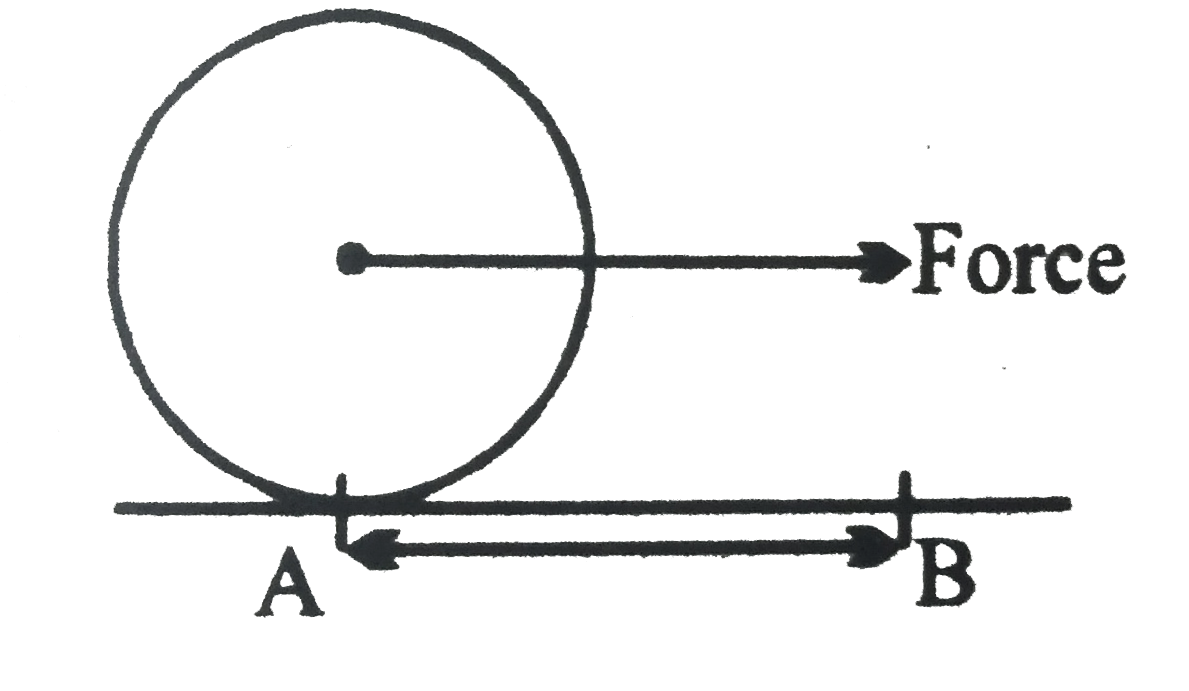
A disc of circumference `s` is at rest at a point `A` on a horizontal surface when a constant horizontal force begins to act on its centre. Between `A` and `B` there is sufficient friction toprevent slipping, and the surface is smooth to the right of `B.AB = s`. The disc moves from `A` to `B` in time `T`. To the right of `B`,
.

A

the angular acceleration of the disc will disappear, linear acceleration will remain unchanged.

B

linear acceleration of the disc will increase

C

the disc will make one rotation in time `T//2`

D

the disc will cover a distance greater than `s` in further time `T`.

Text Solution

Verified by Experts

The correct Answer is:

B, C, D

(B) To the right of `B`, friction vanishes, so linear acceleration of disc will increase.
( c) From `(A)` to `B` it complete one rotation in time `T`
`theta = (1)/(2) alpha t^(2), 2 pi = (1)/(2) alpha T^(2), alpha = (4 pi)/(T^(2))` ....(1)
& `omega = alpha T`...(2)
from (1) & (2)
`omega = (4 pi)/(T)`
after `B, omega` becomes constant there fore time taken to complete one rotation after `B`
`theta = omega t, 2 pi = (4 pi)/(T) t, t = (T)/(2)`
(D) After `B` disc is linearly accelerated so it will cover greater distance than `s` in further time `T`.
Promotional Banner

Similar Questions

Explore conceptually related problems

A disc of circumference S stands vertically on a horizontal surface as shown in figure-5.145, A horizontal force P acts on the centre of the disc. Half of the circumference {ABC) is rough and the friction is sufficient to prevent slipping when the disc rolls along X¥.The other half of the circumference (ADC) is smooth. The disc starts from rest when P begins to act and the point C is at the bottom. Find the distance moved by the disc along xy when it completes one rotation.

A constant horizontal force F acts on a solid circular disc (M, R) as shown. The disc rolls without slipping, even on smooth surface for x =R/n . Value of n is?

A uniform disc is rolling on a horizontal surface. At a certain instant B is the point of contact and A is at height 2 R from ground, where R is radius of disc - .

A block 'B' rests on 'A' A rests on a horizontal surface 'C' which is frictionless. There is friction between A and B If 'B' pulled to the right .

A block B is pushed momentarily along a horizontal surface with an initial velocity v . If mu is the coefficient of sliding friction between B and the surface, block B will come to rest after a time:

A disc of mass 2 kg is rolling on a horizontal surface without slipping with a velocity of 0.1 m/s. What is its rotational kinetic energy?

A disc of mass 100 g is rolling without slipping on a horizontal surface with a velocity of 10 cm s^(-1) . Calculate its total energy.
