Home
Class 11
PHYSICS
A hollow cylinder with inner radius R. O...

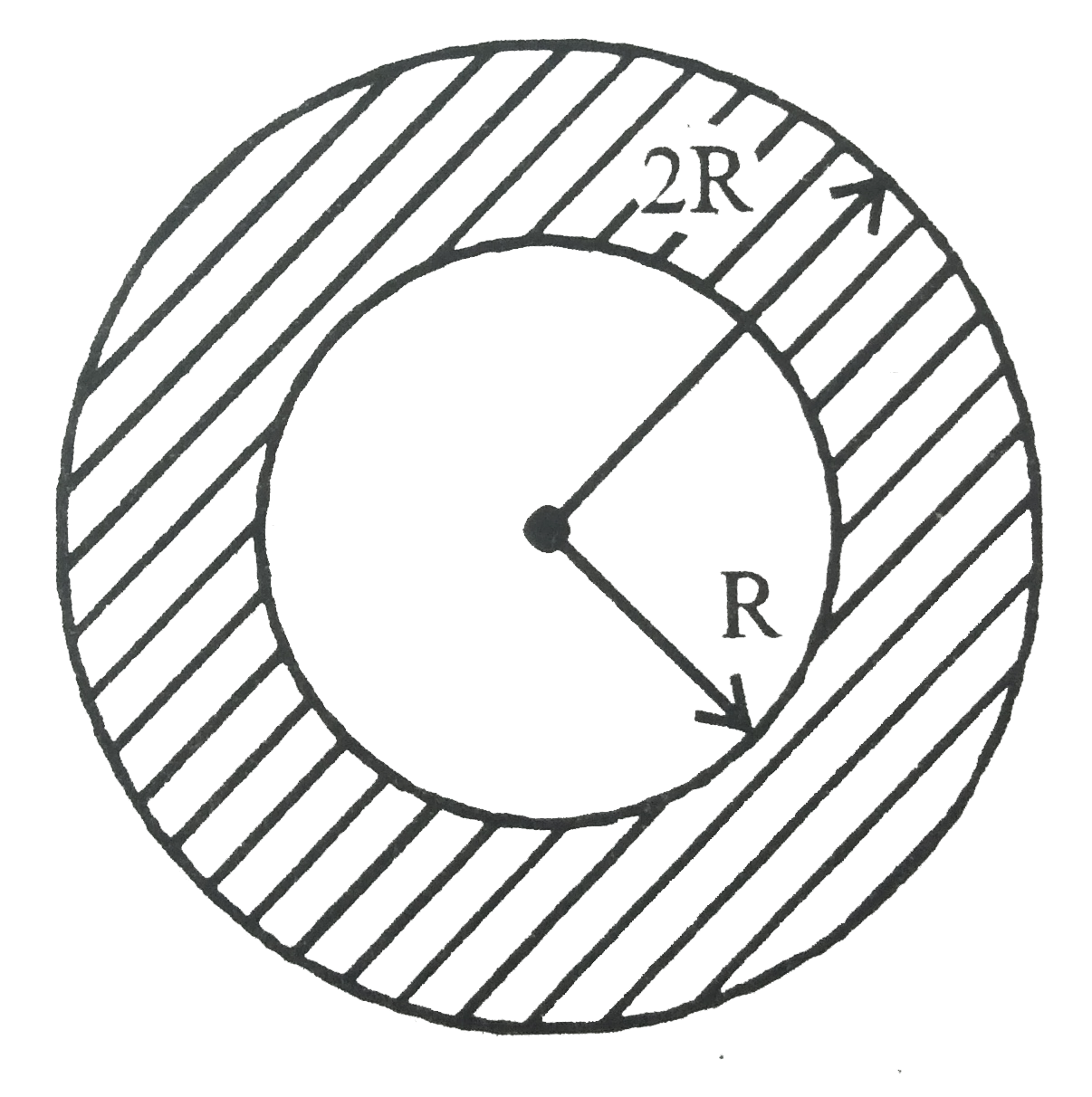
A hollow cylinder with inner radius `R`. Outer radius `2R` mass `M` is rolling with speed of it's axis `v`. What is its kinetic energy ?
.

Text Solution

Verified by Experts

The correct Answer is:

`(13)/(16) Mv^(2)`

`KE = (1)/(2) Mv^(2) + (1)/(2) I omega^(2)`
`KE = (1)/(2) Mv^(2) +(1)/(2) I((v)/(2 R))^(2)` ….(1)
Let we have solid cylinder of radius `2R` and mass `M` from which cylinder of radius `R` of mass `M' = (M')/(4)` is taken out from common axis
Mas of hollow cylinder `M = M' - M''`
`M =M' -(M')/(m) =(2M')/(4) rArr M=(3M')/(4)`
`rArr M' = (4M)/(3) & M'' = (M)/(3)`
`I_(2R) = I_(R) +I rArr I = I_(2R) -I_(R)`
`I = (1)/(2) M'(2R)^(2) -(1)/(2) M''R^(2)`
`I = [(1)/(2) xx (4M)/(3) xx 4R^(2) -(1)/(2) xx(M)/(3) R^(2)]`
`I = (5)/(2) MR^(2)` ....(2)
`KE = (13)/(16) Mv^(2)`
Alternatively : Let the length of cylinder is `l`
`I = int_(R)^(2R) dmr^(2) rArr I = int_(R)^(2R) (M)/([pi(2R)^(2) -piR^(2)]l) xx 2pi rdrl xx r^(2)`
`I = (2M)/(3R^(2)) int_(R)^(2R) r^(3) dr rArr I = (5)/(2) MR^(2)`.
Promotional Banner

Similar Questions

Explore conceptually related problems

A hollow cylinder of specific resistance rho , inner radius R , outer radius 2R and length 1 is as shown in figure. What is the net resistance between the inner and outer surfaces?

A hollow cylinder of mass 5 kg rolls down with a speed of 20 m/s without slipping. What will be its kinetic energy?

A thin ring of mass 1kg and radius 1m is rolling at a speed of 1ms^(-1) . Its kinetic energy is

A current i is uniformly distributed over the cross section of a long hollow cylinderical wire of inner radius R_1 and outer radius R_2 . Magnetic field B varies with distance r form the axis of the cylinder is

Let the moment of inertia of a hollow cylinder of length 30 cm (inner radius 10 cm and outer radius 20 cm ), about its axis be I. the radius of a thin cylinder of the same about its axis is also I is :

An infinitely long hollow coducting cylinder with inner radius R/2 and outer radus R carries a uniform current density along its length. The magnitude of the magnetic field |B| as a function of the radial distance r from the axis is best represented by

Figure shows the cross-sectional view of the hollow cylindrical conductor with inner radius 'R' and outer radius '2R' , cylinder carrying uniformly distributed current along it's axis. The magnetic induction at point 'P' at a distance (3R)/2 from the axis of the cylinder will be
