Home
Class 11
PHYSICS
A person pulls along a rope wound up aro...

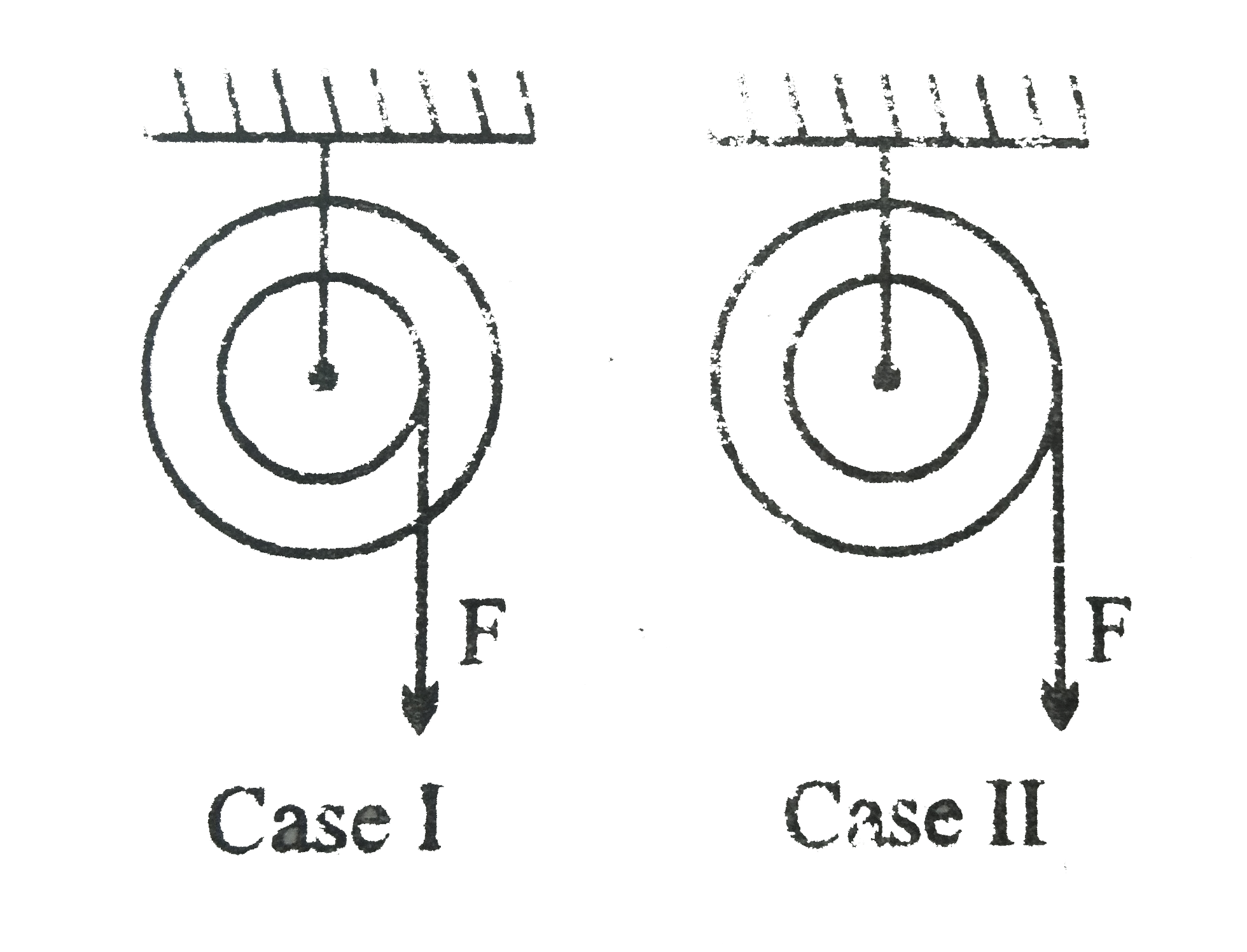
A person pulls along a rope wound up around a pulley with a constant force `F` for a time interval of `t` seconds. If `a` and `b` are the radii of the inner and the outer circumference `(a lt b)`, then find the ratio of work done by the person in the two cases shown in the figuer is `W_(1)//W_(2)`.
.

Text Solution

Verified by Experts

The correct Answer is:

`a^(2)//b^(2)`

case `- 1`
`F xx a = I alpha rArr alpha = (Fa)/(I)`
As `alpha` is constant `omega = alpha t, omega = ((Fa)/(I)) alpha`
`W_(1) = Delta KE rArr WD_(1) =(1)/(2) I omega^(2) rArr WD_(1) = (1)/(2) (I) (alpha^(2) t^(2))`
`WD_(1) =(1)/(2)I((Fa)/(I))^(2) t^(2)`.....(1)
similarly in case II `WD_(2) = (1)/(2) I ((Fb)/(I))^(2) t^(2)` ....(2)
from (1) & (2)
`(WD_(1))/(WD_(2)) = (a^(2))/(b^(2))`.
Promotional Banner

Similar Questions

Explore conceptually related problems

Force constant of two wires A and B of the same material are K and 2K respectively. If the two wires are strechted equally, then the ratio of work done in streching ((W_(A))/(W_(B))) is

A system is taken from state A to state B along two different paths 1 and 2 . The heat absorbed and work done by the system along these two paths are Q_(1) and W_(1) and W_(2) respectively.

Consider the two process on a system as shown in figure. The volumes in the initial state and in the final state are the same in the two process A and B. If W_(1) and W_(2) be the work done by the system in the processes A and B respectively then-

A woman lifts a box weighing 40N from the floor to a shelf 1.5 m above. (a) find the work done by the force (F) the woman exerts on the box (b) Find the work done on the box by its own weight (w) (c ) Find the net work done on the box.

A block of mass 30 kg is pulled up by a rope as shown in Fig. with a constant speed by applying a force of 200 N parallel to the slope. A and B are initial and the final positions of the block. Calculate: (a) the work done by the force in moving the block A to B, (b) the potential energy gained by the block, (c) account for the difference in work done the force and the increase in potential energy of the block.

A particle moves on a circular path of radius R under the action of two constant forces F_(1)and F_(2). F_(1) act along positive x axis and F_(2) acts along positive y-axis. Find the work done by F_(1)and F_(2) in moving the particle from position A to position B as shown in figure.

One mole of an ideal gas is taken from a and b along two paths denoted by the solid and the dashed line as shown in the graph below. If the work done along the solid path is w_(s) and that along the dotted path is w_(d) , then the integer closest to the ratio w_(d)//w_(s) is
