Home
Class 11
PHYSICS
A rectangular rigid fixed block has a lo...

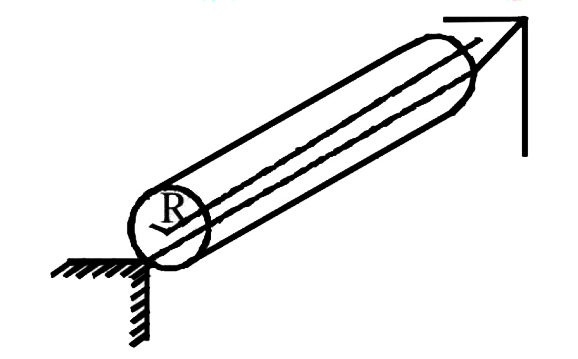
A rectangular rigid fixed block has a long horizontal edge. A solid homogeneous cylinder of radus R is placed horizontally at rest its length parallel to the edge such that the exis of the cylinder and the endg of the block are in the same vertical plane as shown in the figure below. Ther is sufficinet friction present at the edge s that a very small displacement causes the cylinder to roll off the edge without slipping. Determine:

(a) the angle `theta_c` through which the cylinder rotates before it leaves contact with the edge,
(b) the speed of the centre of mass of the cylinder before leaving contact with the edge, and
(c) the ratio of the translational to rotational kinetic energy of the cylinder when its centre of mass is in horizontal line with the edge.

Text Solution

Verified by Experts

The correct Answer is:
(a) `theta_(C) = cos^(-1) (4//7)`,
(b) `v = sqrt(4//7 gR)`
( c) `K_(T) //K_(R)) = 6`.

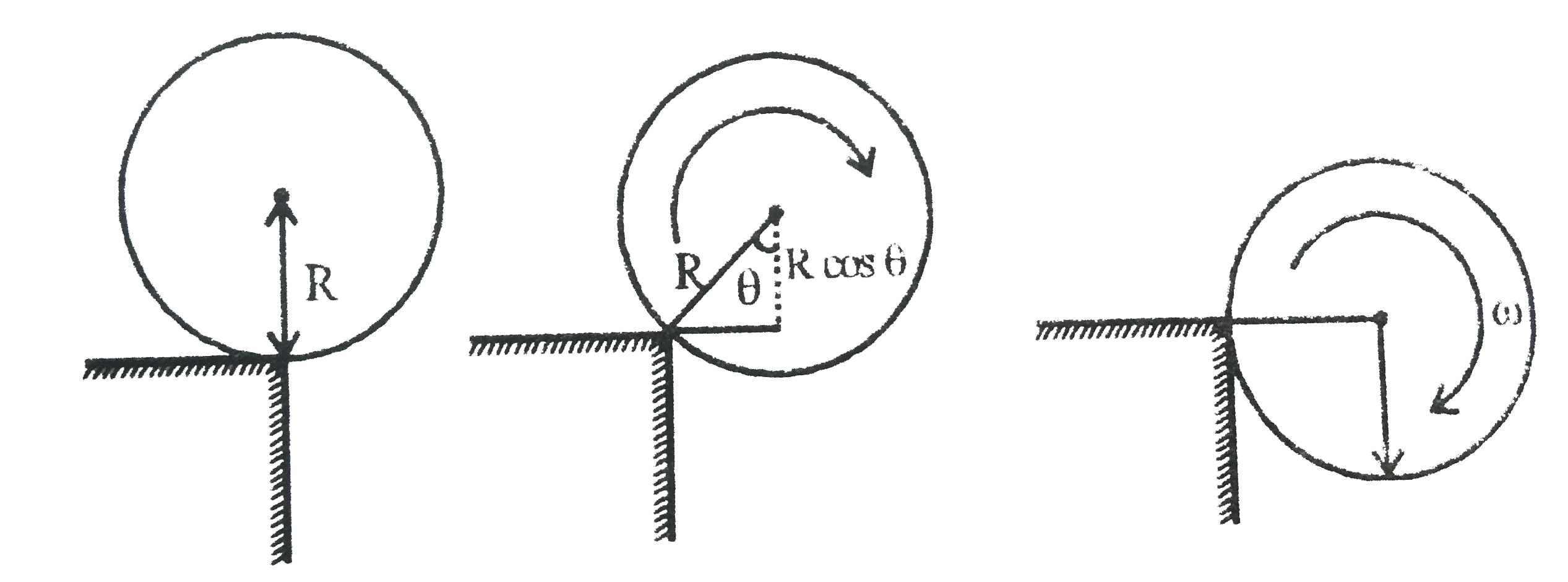
(a) The cylinder rotates about the point of contact. Hence, the mechanical energy of the cylinder will be conserved i.e.

:. `PE_(i) + KE_(i) = PE_(f) + KE_(f)`
:. `mgR + 0 + mgR cos theta + I omega^(2) + (1)/(2) mv^(2)`
but `omega = v//R` (No slipping at point of contact)
and `I = (1)/(2) mR^(2)`
Therefore,

`mgR = mgR cos theta +(1)/(2) ((1)/(2) mR^(2)) ((v^(2))/(R^(2))) + (1)/(2) mv^(2)`
`(v^(2))/(R) = (4)/(3) g (1 -cos theta)`...(1)
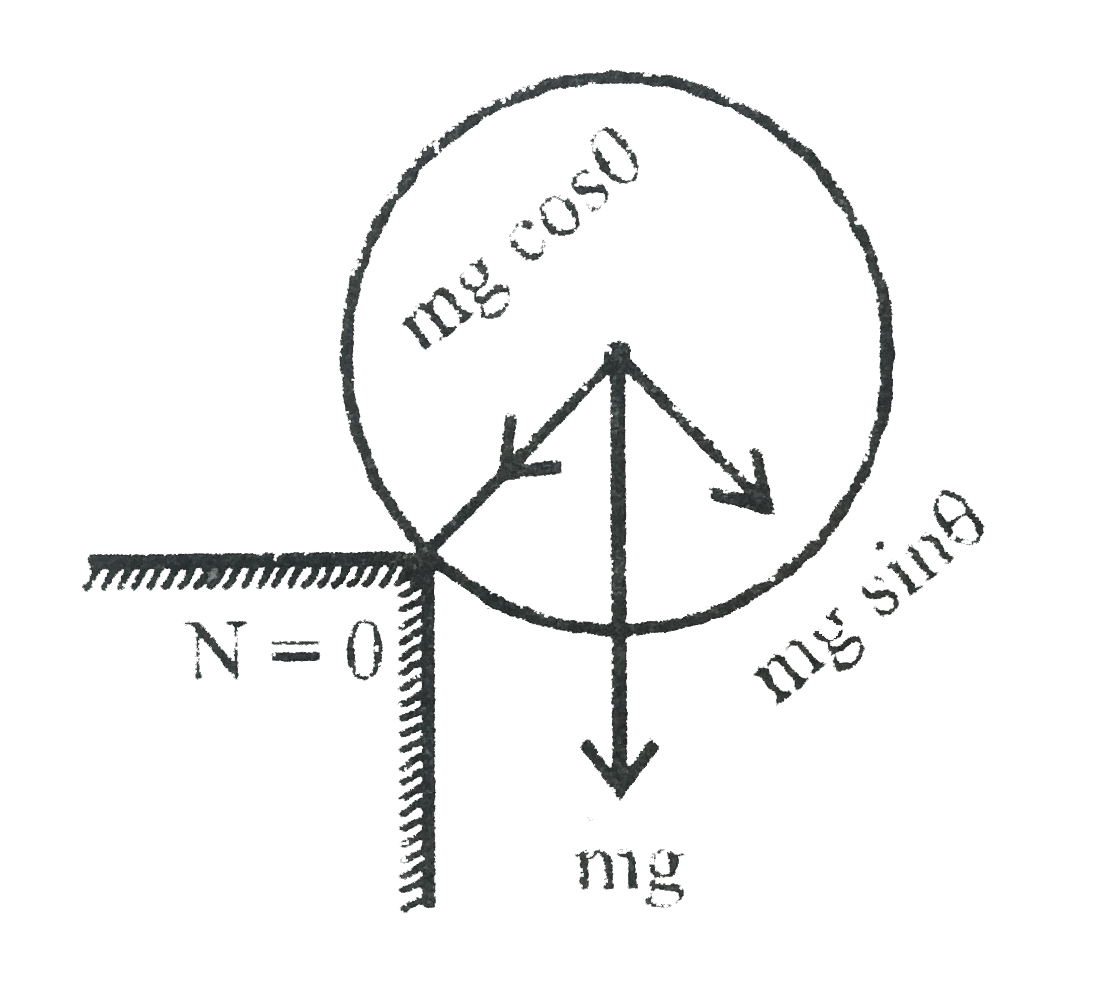
At the time of leaving contact, normal reaction `N = 0` and `theta = theta_(C)`, hence
`mg cos theta_(C) = mv^(2))/( R)`
`(v^(2))/( R) = g cos theta_(C )`...(2)
From Eqs. (1) and (2),
`(4)/(3) g(1- cos theta_(C)) = g cos theta_(C)`
`cos theta_(C) = 4//7 rArr theta_(C) = cos^(-1) (4//7)`
(b) `v = sqrt((4)/(3) gR(1-cos theta))` From Eq. (1)
At the time of loosing contact
`cos theta_(C) = (4)/(7)`
:. `v = sqrt((4)/(3) gR(1-(4)/(7))) `or `v = sqrt((4)/(7) gR)`
( c) At the moment, when cylinder looses contact
`v = sqrt((4)/(7) gR)` Therefore, `K_(R) = (1)/(2) I omega^(2)`
`K_(R) = (1)/(2) ((1)/(2) mR^(2)) (v^(2))/(R^(2)) rArr K_(R) = (1)/(4) mv^(2)`
`K_(R) = (1)/(2) ((4)/(7) gR) rArr K_(R) = (mgR)/(7)`....(3)
Now, once the cylinder losses its contact, `N = 0`, i.e. the frictional force, which is responsible for its rotation, also vanishes. Hence its rotation a kinetic energy now becomes constant, while its translational kinetic energy increases.
`KE_("translational") = Decrease i n PE_("gravitational") - K_(R)` ....(4)
`K_(T) =(mgR) -(mgR)/(7) rArr K_(T) = (6)/(7) mgR`
From Eqs, (3) and (4)
`(K_(T))/(K_(R)) = ((6)/(7) mgR)/((mgR)/(7))` or `(K_(T))/(K_(R)) = 6`.
Promotional Banner