Home
Class 11
PHYSICS
Three particles A,B,C of mass m each are...

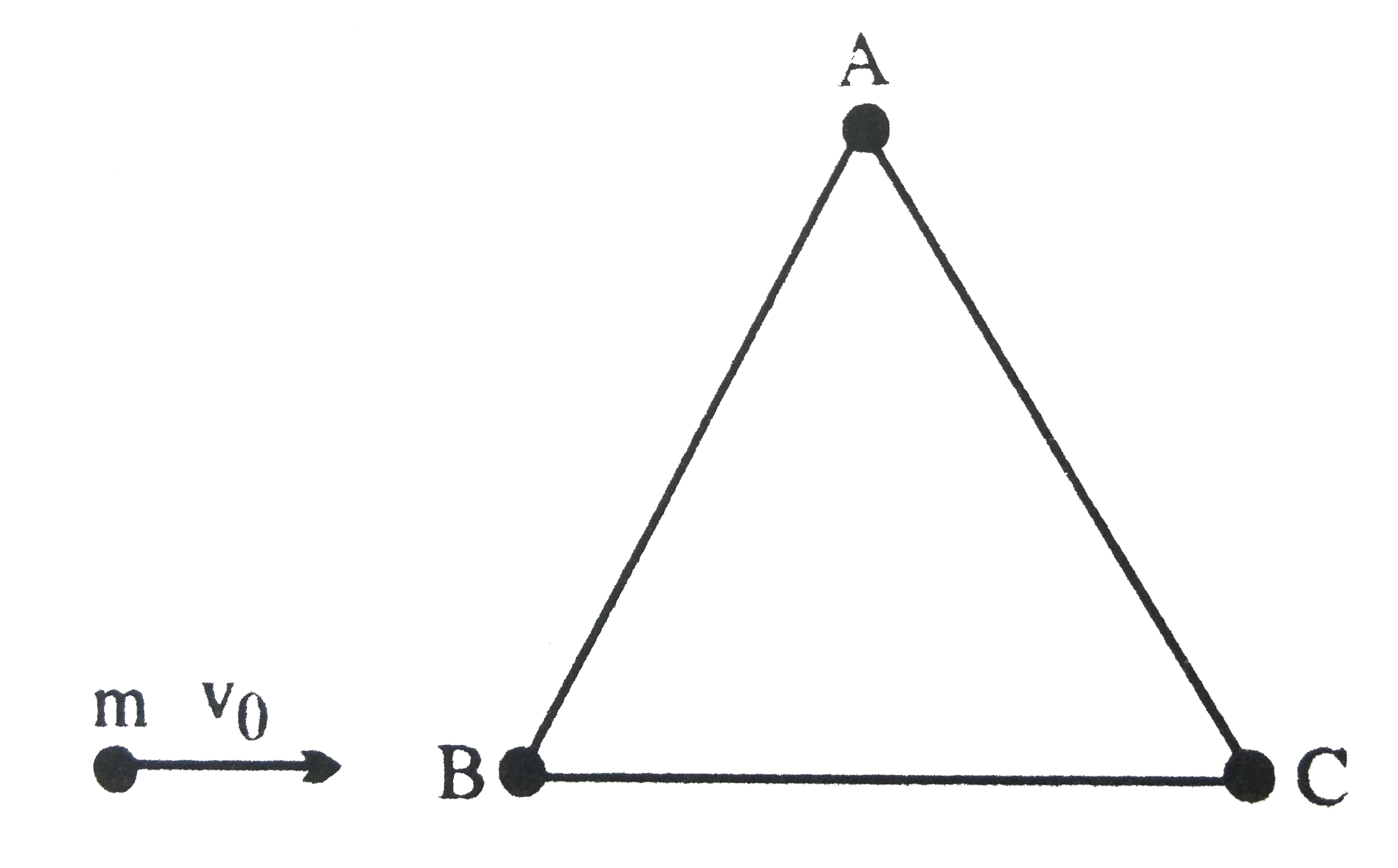
Three particles `A,B,C` of mass `m` each are joined to each other by massless rigid rods to form an equilateral triangle of side `a`. Another particle of mass `m` hits `B` with a velocity `v_(0)` directed along `BC` as shown. The colliding particle stops immediately after impact.

(i) Calculate the time required by the triangle `ABC` to complete half-revolution in its subsequent motion.
(ii) What is the net displacement of point `B` during this interval ?

Text Solution

Verified by Experts

The correct Answer is:
(i) `t = (6 a pi)/(sqrt(3) v_(0))` ;
(ii) `s = (a)/(sqrt(3)) sqrt(1 + (2 pi + sqrt(3))^(2)`.


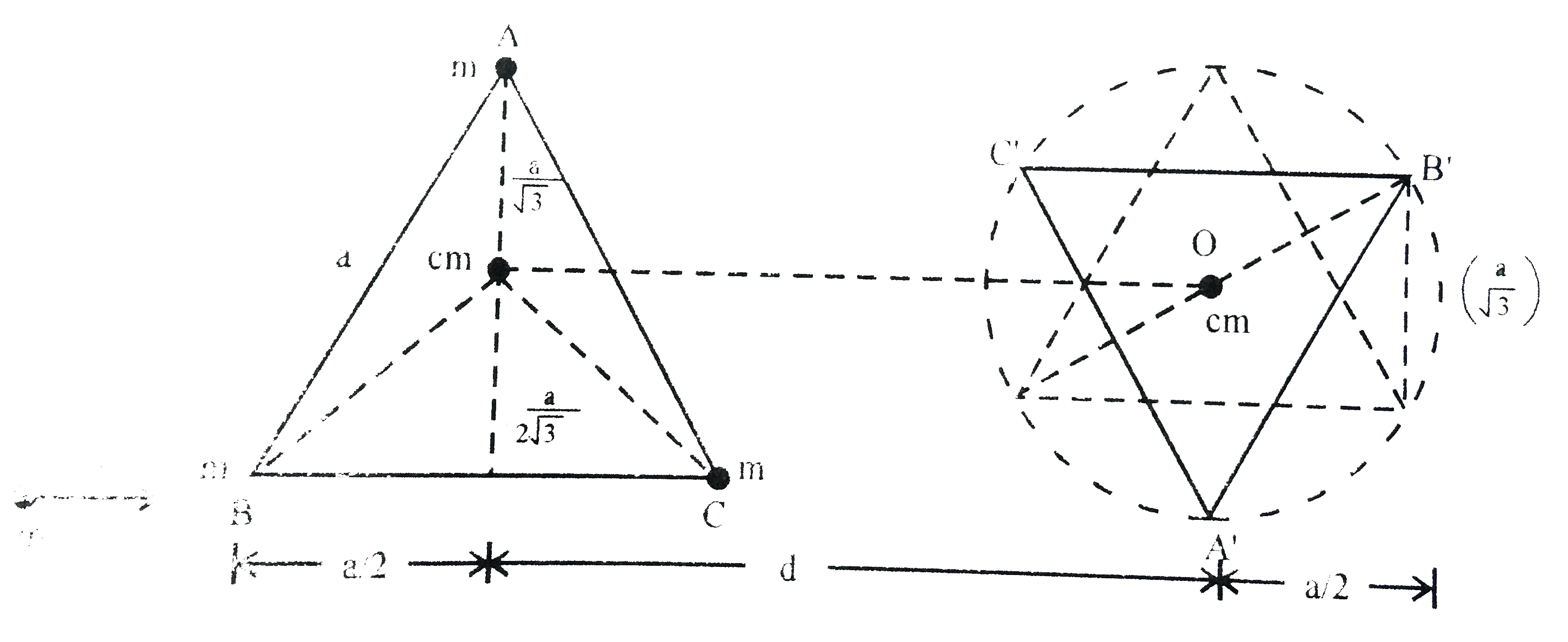
Structure will have translational motion of `C.M` and rotational motion about `C.M` From conservation of linear momentum
`mv_(0) = 3 mv_(CM)`
`v_(CM) = (v_(0))/(3)`
Impulse received by particle is `mv_(0)`. Same and opposite impulse will be received by structure so angular impulse `= I omega`
`mv_(0) xx (a)/(2 sqrt(3)) = 3m ((a)/(sqrt(3)))^(2) xx omega`
`omega = (v_(0))/(2 sqrt(3) a)`
(i) time taken to complete half revolution `= (pi)/(omega)`
`t = (pi)/((v_(0)//2 sqrt(3a))) rArr t = (2 sqrt(3) pi a)/(v_(0)) rArr t = (6 pi a)/(sqrt(3) v_(0))`
(ii) linear displacement
=`sqrt((d+a)^(2) + ((a)/(sqrt(3)))^(2)) = sqrt((v_(CM) t + a)^(2) + ((a)/(sqrt(3)))^(2))`
=`sqrt((v_(0)/(3) xx (6 pia)/(sqrt(3) v_(0)) +a)^(2) + ((a)/(sqrt(3)))^(2)) =sqrt((a^(2))/(3) (2 pi + sqrt(3))^(2) + (a^(2))/(3)) = (a)/(sqrt(3)) sqrt((2 pi + sqrt(3))^(2) + 1)`.
Promotional Banner

Similar Questions

Explore conceptually related problems

Three particles each of mass m are kept at the vertices of an euilateral triangle of side L . The gravitational field at the centre due to these particle is

Three particles have charges +10 mu C each and they are fixed at the corners of an equilateral triangle of side 0.5m .The force on each of the particles has magnitude:

Three particles each of mass m are palced at the corners of an equilateral triangle of side b . The gravitational potential energy of the system of particle is

Three particles each of mass m are kept at vertices of an equilateral triangle of side L. The gravitational field at centre due to these particle is

Three particles each of mass 2kg are at the corners of an equilateral triangle of side sqrt 3 m . If one of the particles is removed, the shift in the centre of mass is

Three particles each of mass m are kept at the vertices of an equilateral triangle of side L . What is the gravitational potential at the centroid of the triangle?

Three equal masses of 1.5 kg each are fixed at the vertices of an equilateral triangle of side 1 m. What is the force acting on a particle of mass 1 kg placed at its centroid ?

Three particles of equal mass 'm' are situated at the vertices of an equilateral triangle of side L . The work done in increasing the side of the triangle to 2L is

Three particles each of mass m are placed at the three corners of an equilateral triangle of side L. A particle of mass M is kept at the midpoint of any one side. What is the force acting on M, due to this system of 3 particles ?

If two particles each of mass m are placed at the two vertices of an equilateral triangle of side a , then the resultant gravitational force on mass m placed at the third vertex is

