Home
Class 11
PHYSICS
Two heavy metallic plates are joined tog...

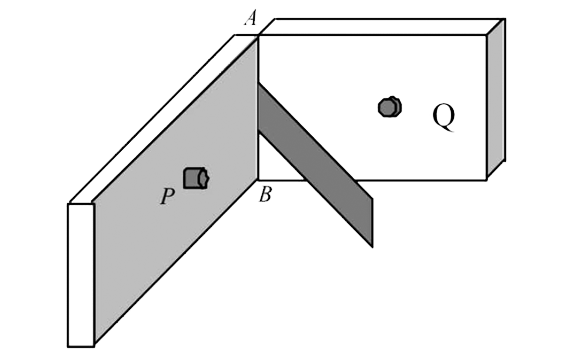
Two heavy metallic plates are joined together at `90^@` to each other. A laminar sheet of mass 30kg is hinged at the line AB joining the two heavy metallic plates. The hinges are frictionless. The moment of inertia of the laminar sheet about an axis parallel to AB and passing through its center of mass is 1.2 kg `m^2.` Two rubber obstacles P and Q are fixed, one on each metallic plate at a distance 0.5m from the line AB. This distance is chosen so that the reaction due to the hinges on the laminar sheet is zero during the impact. Initially the laminar sheet hits one of the obstacles with an angular velocity 1 rad/s and turns back. If the impulse on the sheet due to each obstacal is 6 N-s,
(a) Find the location of the center of mass of the laminar sheet from AB.
(b) At what angular velocity does the laminar sheet come back after the first impact?
(c) After how many impacts, does the laminar sheet come to rest?

Text Solution

Verified by Experts

The correct Answer is:

(a) `1 = 0.1 m` ;
(b) `w' = 1 rad//s` ;
( c) laminar sheet will never come to rest.

Let `r` be the perpendicular distance of `CM` from the line `AB` and `omega` is the angular velocity of the sheet just after colliding with rubber obstacle for the first time.
Obviosly the linear velocity of `CM` before and after collision will be
`v_(f) = ( r) (1 rad//s) = r` & `v_(f) = r omega`
`vec v_(i)` and `vec v_(f)` will be in opposite directions.
linear impulse of `CM` = change in linear momentum of `CM`
`6 = m(vec v_(f) - vec v_(i))`
`6 = 30 (r + r omega)`
`r (1 + omega) = (1)/(5)`
Similarly, angulasr impulse about `AB` = change in angular momentum about `AB`.
Angular impulse = linear impulse xx perpendicular distance of impulse from `AB`.
Hence, `6 xx 0.5 m = I_(AB) (omega + 1)`
[initial angular velocity `= 1 rad//sec`,]
`3 = [I_(CM) + Mr^(2)] )(1 + omega)`
`3 = [1.2 + 30 r^(2)] [ 1 + omega]` ....(2)
Solving Eq. (1) and (2) for `r`, we get
`r = 0.4 m` and `r = 0.1 m`
but at `r = 0.4 m, omega` comes out to be negative `(-0.5 rad//s)(s)` which is not acceptable. Therefore
(a) `r` = distance of `CM` from `AB = 0.1`
(b) Substuting `r = 0.1 m` in Eq. (1), we get `omega = 1 rad//s` i.e., the angular velocity with which sheet comes back after the first impact is `1 rad//s`.
( c) Since, the sheet returns with same angular velocity of `1 rad//s`, the sheet will never come to rest.
Promotional Banner

Similar Questions

Explore conceptually related problems

A light rod of length l has two masses m_1 and m_2 attached to its two ends. The moment of inertia of the system about an axis perpendicular to the rod and passing through the centre of mass is.

Consider a uniform square plate of of side and mass m . The moment of inertia of this plate about an axis perpendicular to its plane and passing through one of its corners is -

Consider a uniform square plate of side 'a' and mass 'm'. The moment of inertia of this plate about an axis perpendicular to its plane and passing through one of its corners is

Calculate the moment of inertia of a rod of mass 2 kg and length 5 m about an axis perpendicular to it and passing through one of its ends.

Consider a uniform square plate of side 'a' and mass 'm' The moment of inertia of heis plate about an axis perpendiucalar to its plane and passing through one of its corners is

Two masses m_(1) and m_(2) are placed at a distance r from each other. Find out the moment of inertia of system about an axis passing through their centre of mass.

Figure shows a thin metallic triangular sheet ABC . The mass of the sheet is M . The moment of inertia of the sheet about side AC is : .

If I moment of inertia of a thin circular plate about an axis passing through tangent of plate in its plane. The moment of inertia of same circular plate about an axis perpendicular to its plane and passing through its centre is
