Home
Class 11
PHYSICS
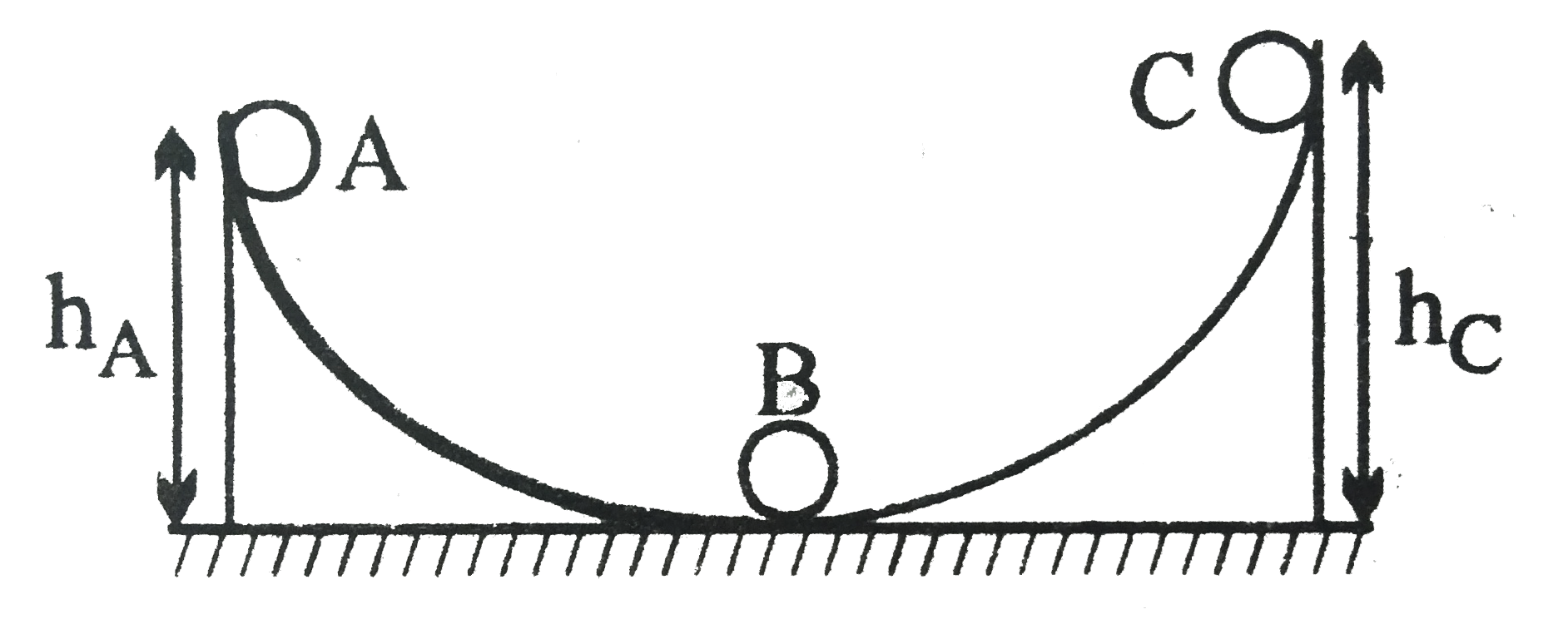
A ball moves over a fixed track as shown...

A ball moves over a fixed track as shown in the figure. From `A` to `B` ball rolls without slipping. Surface `BC` is frictionless. `K_(A), K_(B)` and `K_(C)` are kinetix energies of the ball at `A, B` and `C`, respectively. Then
.

A

`h_(A) gt h_(C) , K_(B) gt K_(C)`

B

`h_(A) gt h_(C) , K_(C) gt K_(A)`

C

`h_(A) =h_(C), K_(B) = K_(C)`

D

`h_(A) lt h_(C) , K_(B) gt K_(C)`

Text Solution

Verified by Experts

The correct Answer is:

A, B

At `A ME = mgh_(A)`…(1)
at `B ME - K_(B) = K_("rotational") (K_(C))`….(2)
at `C ME = mgh_(C), K_(B) gt K_(C)`
`(B) h_(A) gt h_(C), K_(C) gt K_(A)`
On smooth part `BC`, due to zero torque, angular velocity and hence the rotational kinetic energy remains constant. While moving from `B` to translational kinetic energy converts into gravitational potential energy.
Promotional Banner

Similar Questions

Explore conceptually related problems

A ball moves over a fixed track as shown in the figure. From A and B the ball rolls without slipping. If surface B is frictionless and K_(A),K_(B) and K_(C) are kinetic energies of the ball at A,B and C respectively then:

A ball moves over a fixed track as shown in thre figure. From A to B the ball rolls without slipping. If surface BC is frictionless and K_(A),K_(B) and K_(C) are kinetic energies of the ball at A, B and C respectively then (a). h_(A)gth_(C),K_(B)gtK_(C) (b). h_(A)gth_(C),K_(C)gtK_(A) (c). h_(A)=h_(C),K_(B)=K_(C) (d). h_(A)lth_(C),K_(B)gtK_(C)

A small bell starts moving from A over a fixed track as shown in the figure . Surface AB is friction from A to B the bell roll ralis without sipping BC is friction , K_(A)K_(B) and K_(C) are kinetic energy of the bell at A, B and C respacecvely.Then

A ball moves on a frictionless inclined table without slipping. The work done by the surface on the ball is :

A sphere is rolling on a horizontal surface without slipping. The ratio of the rotational K.E. to the total kinetic energy of the sphere is

One end of a light of length L is connected to a ball and other end is connected to a fixed point O . The ball is released from rest at t=0 with string horizontal and just taut. The ball then moves it vertival circular pathh as shown. The time taken by ball to go from position A to B is t_(1) and from B to lowest position C is t_(2) . Let the velocity of ball at B is vecv_(B) and at C is vecv_(C) respectively. if |vecv_(c)|=2|vecv_(B)| then the value of theta shown is

One end of a light of length L is connected to a ball and other end is connected to a fixed point O . The ball is released from rest at t=0 with string horizontal and just taut. The ball then moves it vertival circular pathh as shown. The time taken by ball to go from position A to B is t_(1) and from B to lowest position C is t_(2) . Let the velocity of ball at B is vecv_(B) and at C is vecv_(C) respectively. If |vecv_(c)|=2|vecv_(B)| then

A ball moves along a curved path of radius 5m as shown in figure. It starts from point A and reaches the point B. Calculate the normal force that acts on the ball at B, assuming that there is no friction between the ball and the surface of contact.

(i) Three balls 1, 2 and 3 lie on a smooth horizontal table. Ball 1 is given a velocity towards ball 2. Kinetic energy given to ball 1 is k_(0) . It collides with 2 and in turn ball 2 hits ball 3. All collisions are head on elastic. Masses of the balls are m, M and m respectively. (a) Calculate the kinetic energy (k_3) of ball 3 after ball 2 hits it. (b) Draw the variation of k_(3) as a function of M. (ii) Consider 10 balls laid on a smooth surface with masses m,(m)/(2),(m)/(4),(m)/(8)......(m)/(512) and first ball is pushed towards the second with kinetic energy k_(0) . [All collisions are elastic and head on]. The kinetic energy acquired by the last ball is k_(10) . In a separate experiment the 10^(th) ball is pushed towards 9^(th) ball with kinetic energy k_(0) . This time the kinetic energy acquired by 1^(st) ball is k_(1) . Compare k_(10) and k_(1)
