Home
Class 11
PHYSICS
Two blocks of masses 3kg and 6kg rest on...

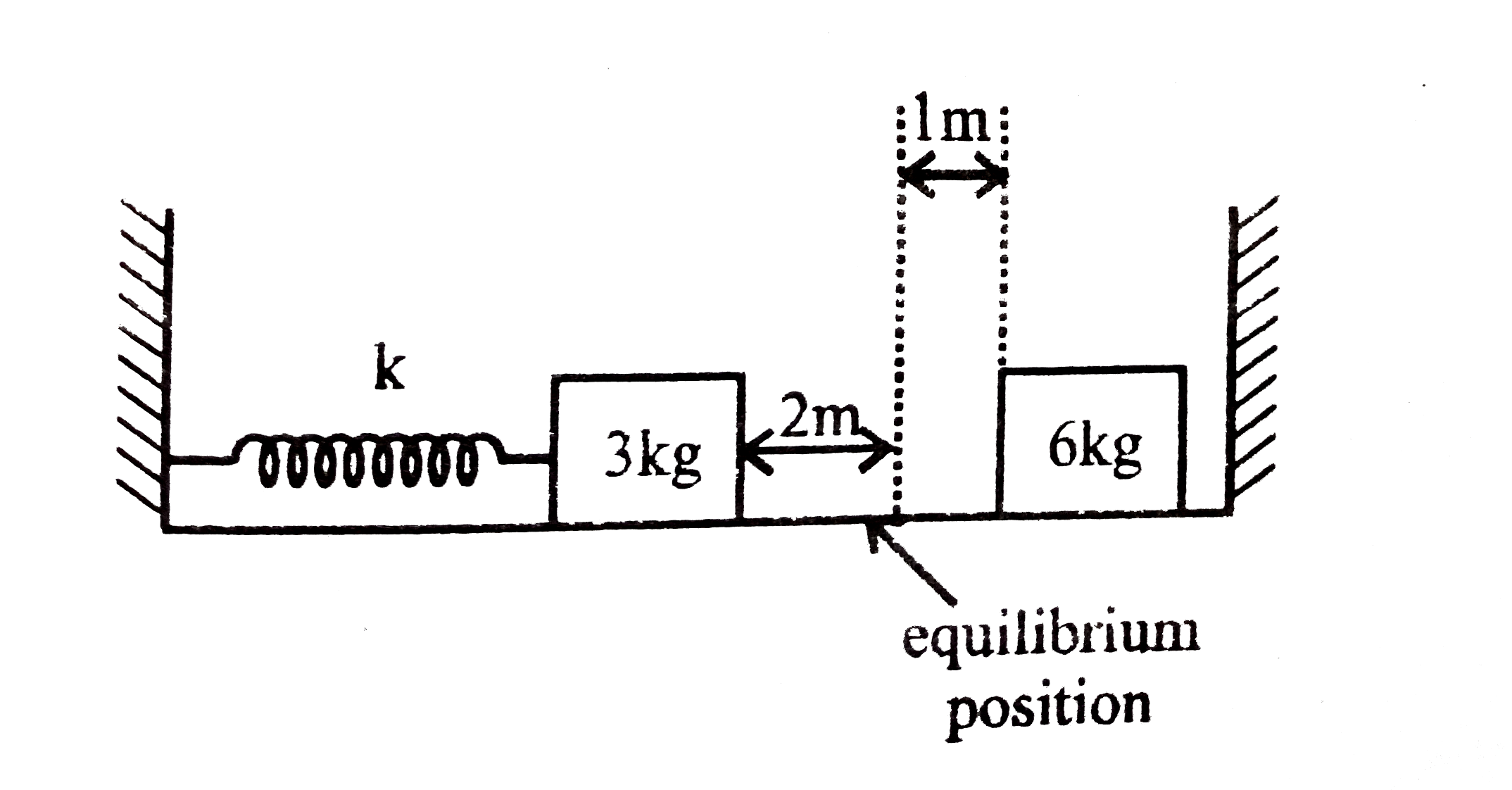
Two blocks of masses `3kg` and `6kg` rest on a horizontal smooth surface. The `3kg` block is attached to a spring with a force constant `k=900 Nm^(-1)` which is compressed `2m` from beyond the equilibrium position. `3kg` mass strikes the `6kg`mass and two stick together-

A

velocity of the combined masses immediately arter the collision is `10 ms^(-1)`

B

velocity of the conbined masses immediately after the collision is `5ms^(-1)`

C

Amplitude of the resulting oscillation is `sqrt2 m`

D

Amplitude of the resulting oscillation is `sqrt5//2m`

Text Solution

Verified by Experts

The correct Answer is:

A, C

Figure
Promotional Banner

Similar Questions

Explore conceptually related problems

Two blocks of masses 3 kg and 6kg rest on horizontal smooth surface. The 3 kg block is attached to a spring with a long constant k=900Nm^(-1) which is compressed 2m from beyond 1m from mean position. 3kg mass strikes the 6 kg mass and the two stick together.

Two blocks of masses 3kg block is attached to a spring with a force constant, k k = 900N//ma which is compressed 2m initially from its equilibrium position. When 3kg mass is released, it strikes the 6kg mass and the two stick togther in an inelastic collision. The velocities of a particle executing S.H.M. are 30cm//s and 16 cm//s when its displacements are 8cm and 15cm from the equilibrium position. then its amplitude of oscillation in cm is:

Two blocks of masses 3kg block is attached to a spring with a force constant, k k = 900N//ma which is compressed 2m initially from its equilibrium position. When 3kg mass is released, it strikes the 6kg mass and the two stick togther in an inelastic collision. The common velocity of the blocks after collision is

Two blocks of masses 3kg block is attached to a spring with a force constant, k k = 900N//ma which is compressed 2m initially from its equilibrium position. When 3kg mass is released, it strikes the 6kg mass and the two stick togther in an inelastic collision. The amplitude of resulting oscillation after the collision is:

Two blocks of masses 4 kg and 6 kg are kept on a rough horizontal surface as shown. If the acceleration of 6 kg block is 5n , then n is :

Two blocks of masses 3kg and 6kg respectivley are placed on a smooth horizontal surface. They are connected by a light spring of force constant k=200N//m . Initially the spring is unstretched. The indicated velocities are imparted to the blocks. Find the maximum extension of the spring.

Two blocks of masses m = 2 kg and m = 8 kg are connected to a spring of force constant K = 1 kN//m . The spring is compressed by 20 cm and the two blocks are held in this position by a string. The system is placed on a horizontal smooth surface and given a velocity u = 3 m//s perpendicular to the spring. The string snaps while moving. Find the speed of the block of mass m when the spring regains its natural length.

Two bodies of masses 1 kg and 3 kg respectively are connected rigidly by a vertcal spring. The body of mass 3 kg rests on a smototh horizontal surface. The force constant of the spring is 484Nm^(-1) . From the equilibrium position, the mass of 1 kg is displaced vertically through a distance of 0.02 m and then released. calculate (i) and frequency of oscillation of the mass of 1 kg (ii) the maximum velocity of this mass (iii) its oscillation energy and (iv) the reaction of the table on the mass of 3 kg, when mass 1 kg is having harmonic oscillations.

Two blocks of masses 3 kg and 6 kg are connected by a string as shown in the figure over a frictionless pulley. The acceleration of the system is

Two blocks of masses 1 kg and 2 kg are placed in contact on a smooth horizontal surface as shown in fig. A horizontal force of 6N is applied d(a) on a 1-kg block. Find the force of interaction of the blocks. .
