Home
Class 11
PHYSICS
A spring of force constant K is attached...

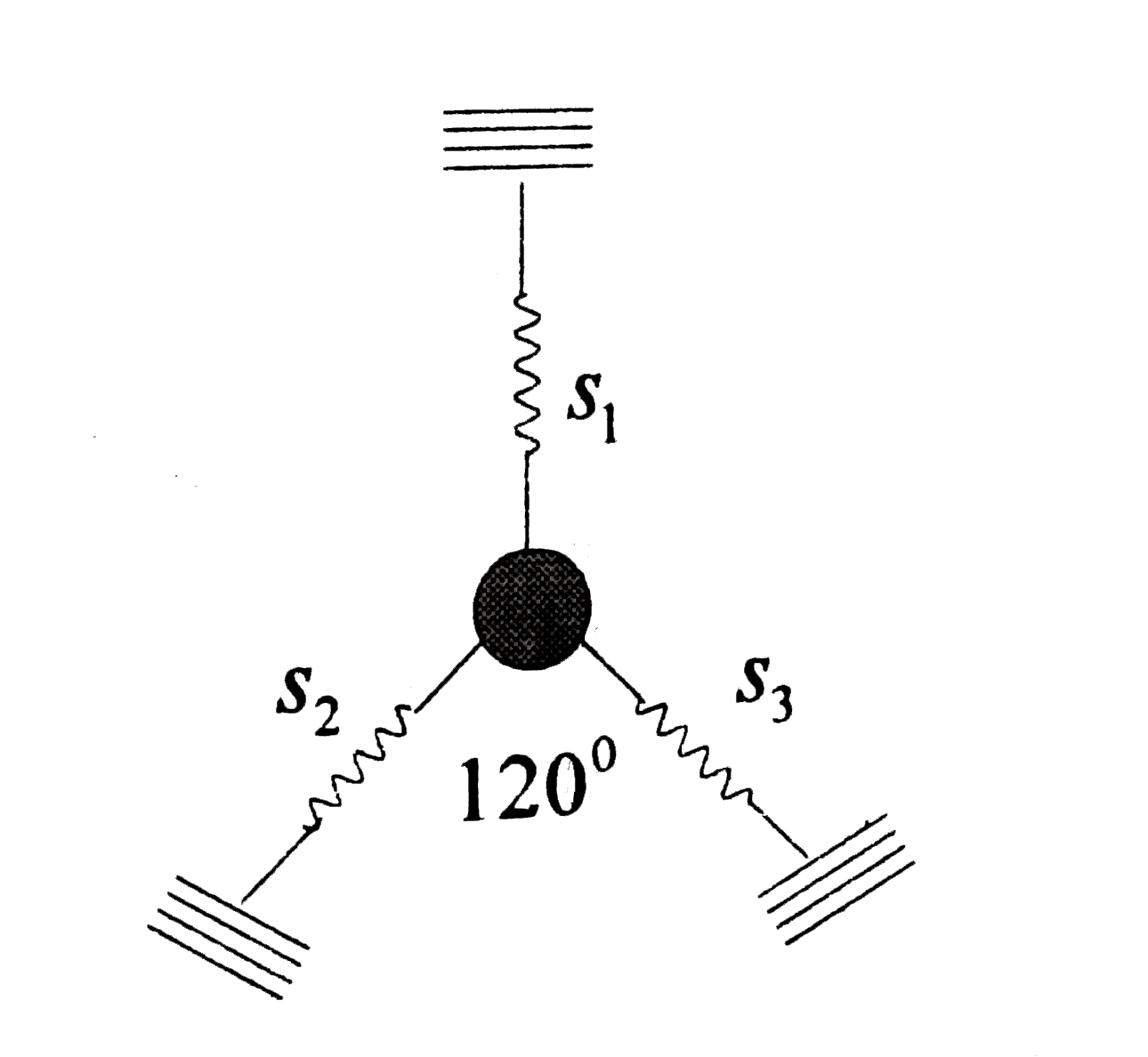
A spring of force constant `K` is attached with a mass executes with `S.H.M` has a time period `T`. It is cut into three equal parts
If the spring are attached to the load as shown in figure then effective spring constant is

A

`(K)/(2)`

B

`(K)/(3)`

C

`(5K)/(3)`

D

`(3K)/(2)`

Text Solution

Verified by Experts

The correct Answer is:

D

Figure
Promotional Banner

Similar Questions

Explore conceptually related problems

A spring of force constant K is attached with a mass executes with S.H.M has a time period T . It is cut into three equal parts If the springs are connected in parallel then the time period of the combination for the same mass is

A spring of force constant K is attached with a mass executes with S.H.M has a time period T . It is cut into three equal parts The frequency of arrangement when the springs are connected in series to the parallel combination for the same load is

A mass suspended from a spring of spring constant k is made to oscillate with a time period T. Now, the spring is cut into three equal parts and the mass is suspended from one of the parts. What will be the new time period of oscillations?

A spring (spring constant=k) is cuttend into 4 equal parts and two parts are connected in parallel. What is the effective spring constant?

A flat spiral spring of force constant K is loaded with mass M and oscillates vertically with a time period T. Then the mass suspended to the free end is

A spring having a spring constant k is loaded with a mass m. The spring is cut into two equal parts and one of these is loaded again with the same mass. The new spring constant i

Four springs of constant as shown are attached to a pair of masses m each as shown. The time period will be 2pi times

A flat spiral spring of force constant k is loaded with mass M and oscillate about vertical with a time period T. Then the mass suspended to the free end is

A spring of force constant 'k' is cut into four equal parts one part is attached with a mass m. The time period of oscillation will be
