Home
Class 11
PHYSICS
A(nonrotating) star collaps onto from an...

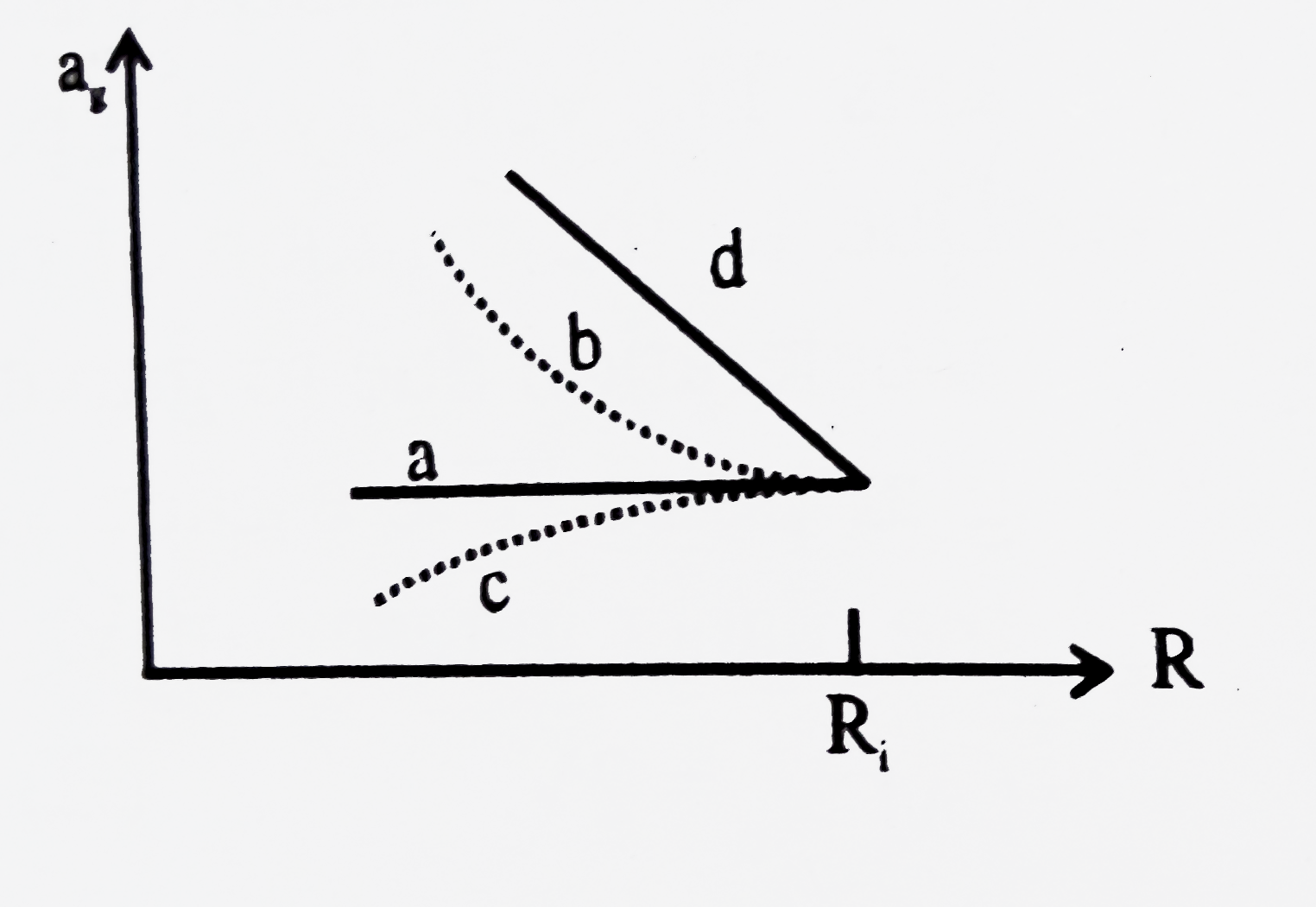
A(nonrotating) star collaps onto from an initial radius `R_(i)` with its mass remaining unchanged. Which curve in figure best gives the gravitational acceleration `a_(g)` on the surface of the star as a function of the radius of the star during the collapse?

A

`a`

B

`b`

C

`c`

D

`d`

Text Solution

Verified by Experts

The correct Answer is:

b

`g=(GM)/(R^(2))`
Promotional Banner

Similar Questions

Explore conceptually related problems

A spherical hole of radius R//2 is excavated from the asteroid of mass M as shown in the figure the gravitational acceleration at a point on the surface of the asteroid just above the excavation is

A uniform solid sphere of radius R produces a gravitational acceleration a_g on its surface. At what two distances from the centre of the sphere the acceleration due to gravity is a_g // 4 ?

The kinetic energy needed to project a body of mass m from the earth's surface to infinity is (R is radius of the earth, g is gravitational acceleration on the surface of the earth)

A satellite of mass m revolves around the earth of radius R at a hight x from its surface. If g is the acceleration due to gravity on the surface of the earth, the orbital speed of the satellite is

Assuming the earth to be a homogencous sphere of radius R. its density in terms of G (constant of gravitation) and g (acceleration due to gravity on the surface of the earth )is

A star of mass M and radius R is made up of gases. The average gravitational pressure compressing the star due to gravitational pull of the gases making up the star depends on R as

Two stars of mass M_(1) & M_(2) are in circular orbits around their centre of mass The star of mass M_(1) has an orbit of radius R_(1) the star of mass M_(2) has an orbit of radius R_(2) (assume that their centre of mass is not acceleration and distance between starts is fixed) (a) Show that the ratio of orbital radii of the two stars equals the reciprocal of the ratio of their masses, that is R_(1)//R_(2) = M_(2)//M_(1) (b) Explain why the two stars have the same orbital period and show that the period T=2pi((R_(1)+R_(2))^(3//2))/(sqrt(G(M_(1)+M_(2)))) .

Assuming the earth to be a homogeneous sphere of radius R , its density in terms of G (constant of gravitation) and g (acceleration due to gravity on the surface of the earth)
