Home
Class 12
PHYSICS
A glass rod having square cross-section ...

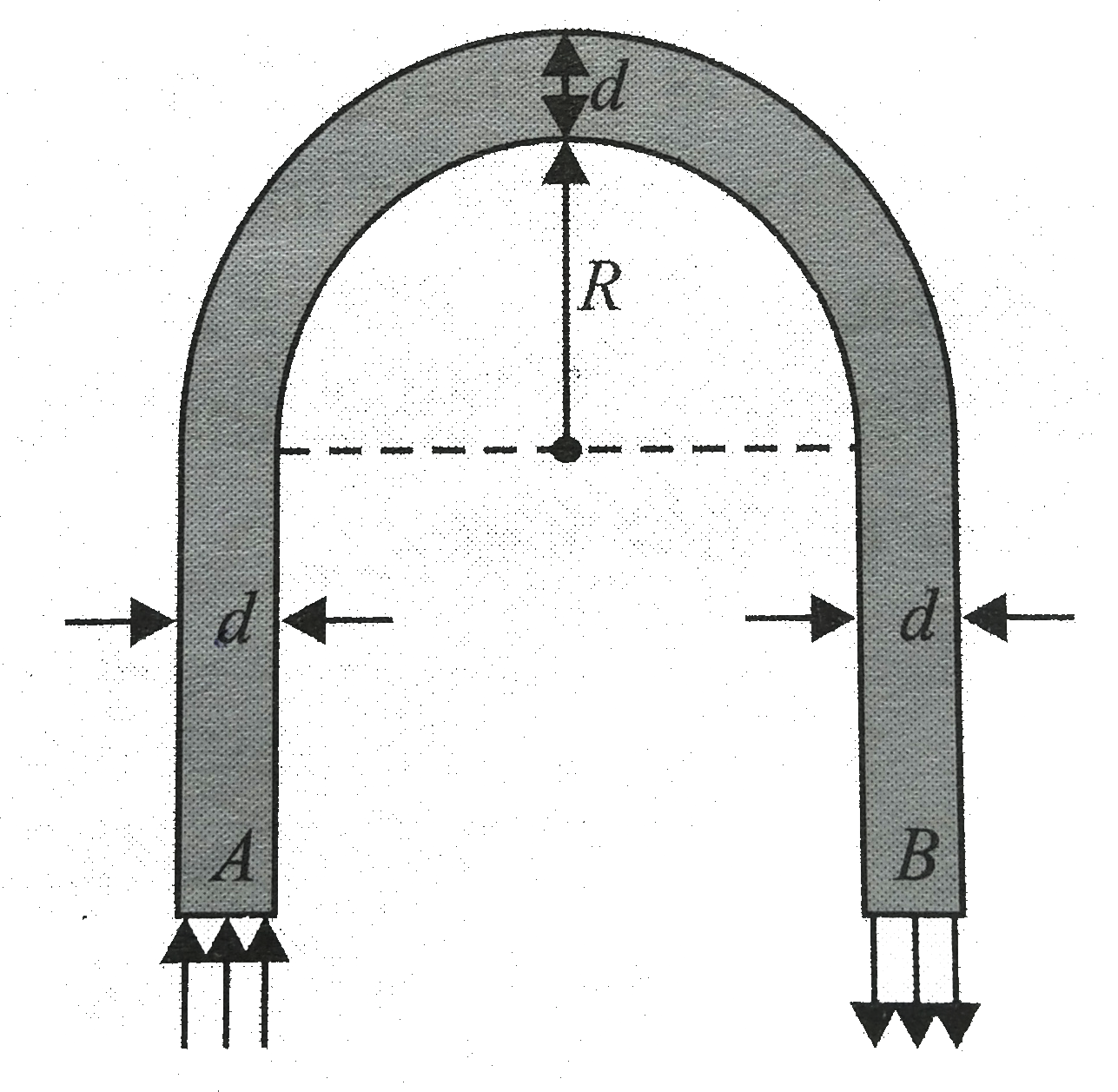
A glass rod having square cross-section is bent into the shape as shown in the figure. The radius of the inner semi-circle is R and width of the rod is d. Find the minimum value of `d//R` so that the light that enters at A will emerge at B. Refractive index of glass is `mu=1.5`

Text Solution

Verified by Experts

The correct Answer is:
`((d)/(R ))_(max)=(1)/(2)`

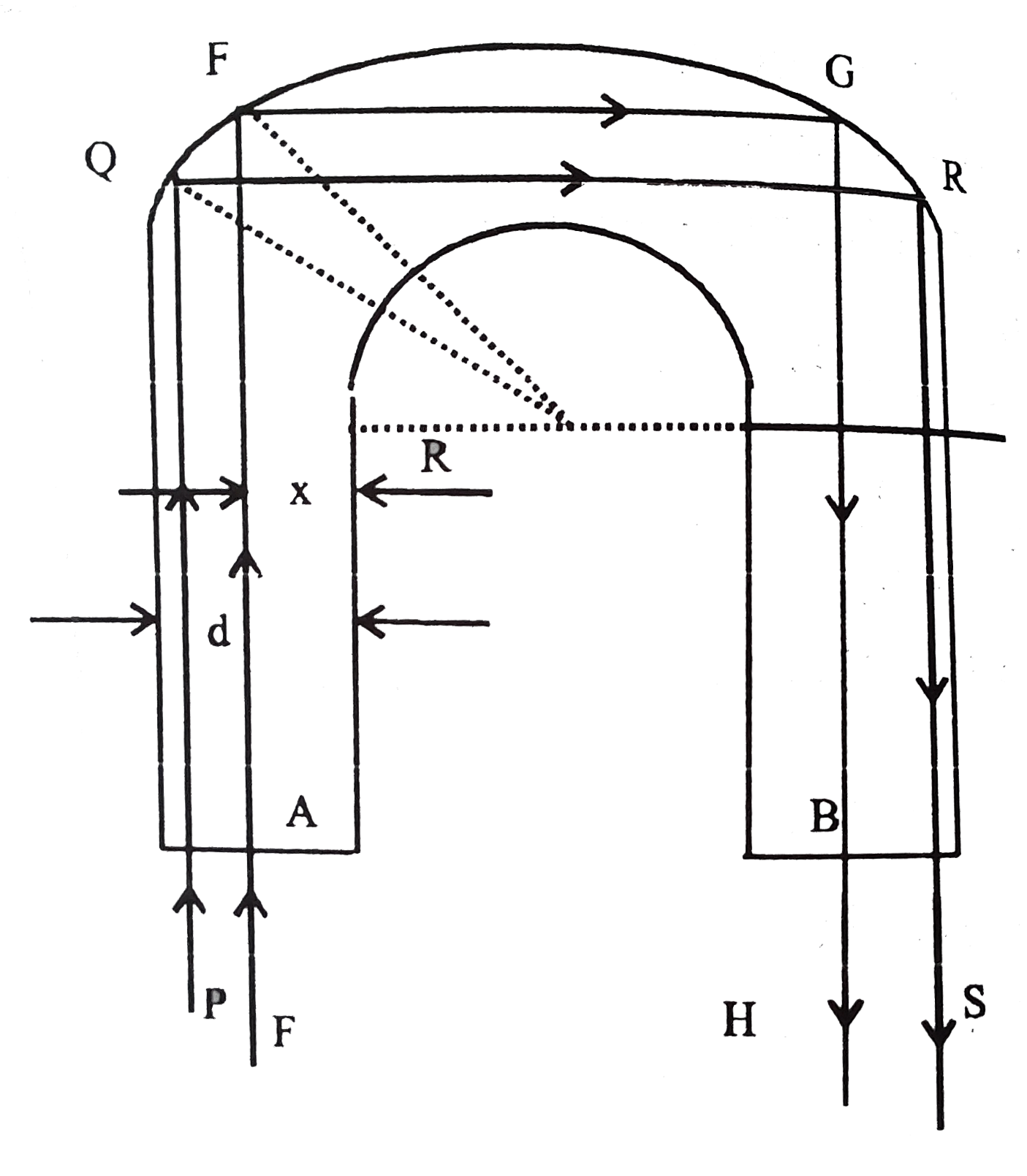
The path of incident parallel beam is shown in Fig.The beam entering face`A`will emerge from the face`B`,only if suffer total internal reflection at`Q`for ray`PQ`and at `F` for ray `EF`shown in fig.Obvisouly the angle of incidence is minimum for the light ray passing near inner wall.For total internal reflection angle of incidence must be greater than critical angle .For ray`EF`the angle of incident is given by
`sin i=(R+x)/(R+d)`
for minimum value ofi.x,=0
`:.sin i_(min)=(R)/(R+d)`
For total internal reflection
`i_(min)gtC`
`sin i_(min)gtsinC`
`(R)/(R+d)gtsin C`
As`SinC=(1)/(mu)=(1)/(1.5)=(2)/(3)`
`:.(R)/(R+d)gt(2)/(3)rArr3Rgt2R+2d rArrRgt2d`
`rArr (d)/(R)lt(1)/(2)`
`((d)/(R))_(max)=(1)/(2)`
Promotional Banner

Similar Questions

Explore conceptually related problems

A rod of glass ( mu = 1.5) and of square cross section is bent into the shape shown in the figure. A parallel beam of light falls on the plane flat surface A as shown in the figure. If d is the width of a side and R is the radius of circular arc then for what maximum value of (d)/(R) light entering the glass slab through surface A emerges from the glass through B

A sound wave of wavelength 32 cm enters the tube at S as shown in the figure. Then the smallest radius r so that a minimum of sound is heard at detector D is

A rod made of glass (mu = 1.5) and of square cross-section is equal is bent into the shape shown in figure. A parallel beam of light falls perpendicurly on the plane flat surface . A . Referring to the diagram, d is the width of a side & R is radius of inner semicircle. find the maximum value of ratio (d)/(R) so that all light entering the glass through surface A emerge from the glass through surface B.

The Figure shows the equatorial circle of a glass sphere of radius R having centre at C. The eye of an observer is located in the plane of the circle at a distance R from the surface. A small insect is crawling along the equatorial circle. (a) Calculate the length (L) of the are on the circle where the insect lies where its image is visible to the observer. (b) Calculate the value of L when the eye is brought very close to the sphere. Refractive index of the glass is mu =(1)/(sqrt(2))

An object is at a distance of d=2.5 cm from the surface of a glass sphere with a radius R=10 cm. Find the position of the final image produced by the sphere. The refractive index of glass is mu_1.5.

A glass prism in the shape of a quarter cylinder lies on a horizontal table. A uniform horizontal light beam falls on its vertical plane surface as shown in the figure. If the radius of the cylinder is R = 5cm and the refractive index of the glass is n = 1.5 where on the table beyond the cylinder will a path of light be found? (in cm) Light R

A glass prism of refractive index 1.5 is placed in water of refractive index 1.33. The minimum value of the angle of the prism so that it will not be possible to have any emergent ray is

