Home
Class 12
PHYSICS
An equilateral prism deviates a ray thro...

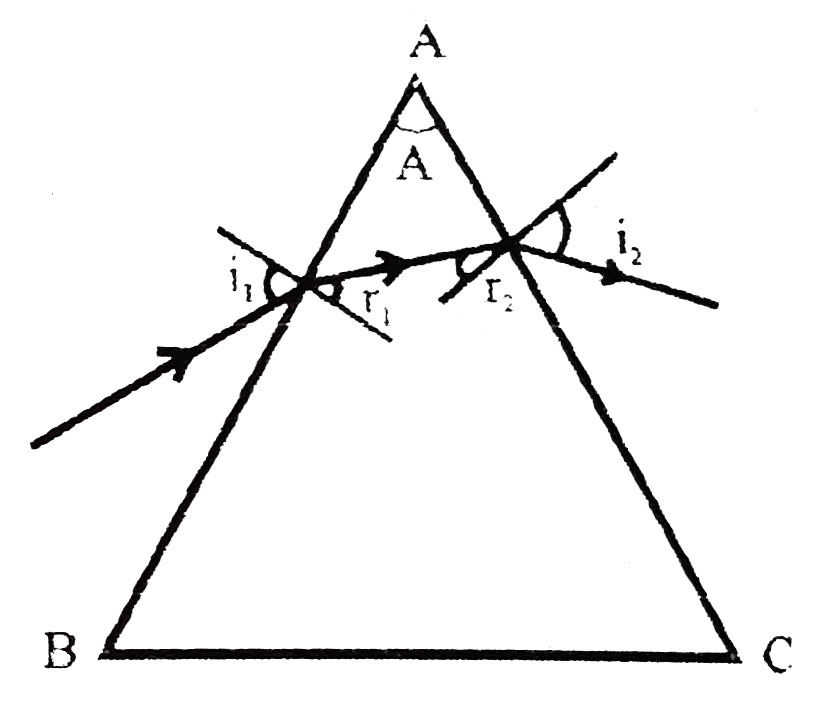
An equilateral prism deviates a ray through`23^(@)`for two angles of incidence differing by `23^(@)`find`mu`of the prism?

Text Solution

Verified by Experts

The correct Answer is:
`sqrt(43)/(5)`


`delta=(i_(1)+i_(2))-A`
`23^(@)=(i_(1)+i_(2))-60^(@)`
`i_(1)+i_(2)=83^(@)`
Given that `i_(2)-i_(1)=23^(@)……….(i)`
`i_(2)=53^(@),i_(1)=30^(@)………..(ii)`
taking refraction at`AB`
`1sin i_(1)=mu sin r_(1)`
`1 sin30^(@)=mu sinr_(1)`
`(1)/(2)=mu sin r_(1).........(iii)`
Taking refraction at`AC`
`1sin i_(2)=mu sin r_(2) rArr 1sin53^(@)=mu sinr_(2) rArr (4)/(5)=mu sinr_(@)`
` (4)/(5)=mu sin(A-r_(1))` since `r_(1)+r_(1)=A`
` (4)/(5)=mu sin(60^(@)-r_(1)).....(iv)`
from eq.(i)&(iii)
`(5)/(8)=(sin r_(1))/(sin(60^(@)-r_(1)))rArr5sin(60^(@)-r_(1))=8sin r_(1)`
`5[sin60^(@)cosr_(1)-cos60^(@)sinr_(1))=8sinr_(1) rArr 5[sqrt(3)/(2)cosr_(1)-(1)/(2)sin r_(1)]=8 sin r_(1)`
`=5sqrt(3)cosr_(1)-5 sin r_(1)=16sin r_(1)rArr 21sin r_(1)=5sqrt(3)cosr_(1)`
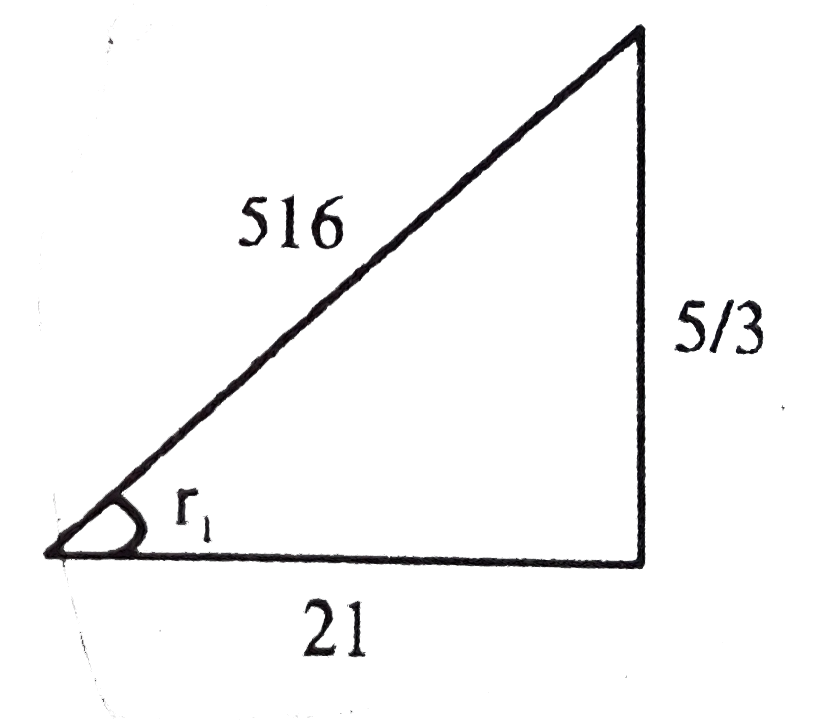
`tanr_(1)=(5sqrt(3))/(21)`or `sin r_(1)=(5sqrt(3))/(sqrt(516))`
from eq.(i)`(1)/(2)=mu sinr_(1) rArr (1)/(2)=mu xx 5sqrt((3)/(516))`
`(1)/(2)=muxx5sqrt((1)/(172))rArr=(sqrt(172))/(5xx2)rArrmu=sqrt(43)/(5)`
Promotional Banner

Similar Questions

Explore conceptually related problems

An equilateral prism deviates a ray through 45^(@) for the two angles of incidence differing by 20^(@) . The angle of incidence is

An equilateral prism deviates a ray through 40^@ for two angles of incidence differing by 20^@ . The possible angles of incidences is

An equilateral prism deviates a ray through 40° for two angles of incidence. The two incidence angels differ by 20° . Find their values.

A prism of angle 60^(@) deviates a ray of light through 31^(@) for two angles of incidence, which differ by 17^(@) . What is the refractive index of the glass of the prism ?

An equilateral prism produces a minimum deviation of 30^(@) . The angle of incidence is

A prism of angle 60^@ deviates a ray of light through 32^@ for two angles of incidence which differ by 12^@ . The angles of incidence are

A ray of light passes through an equilateral prism in such a way that the angle of incidence is equal to the angle of emergence and each of these angles is 3//4 th the angle of the prism. Determine the (i) angle of deviation and (ii) the refractive index of the prism.