Home
Class 11
PHYSICS
Two plane mirrors A and B are aligned pa...

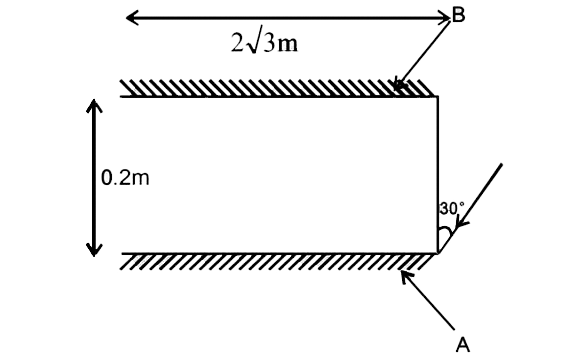
Two plane mirrors A and B are aligned parallel to each other, as shown in the figure. A light ray is incident at an angle 30degree at a point just inside one end of A. The plane of incidence coincides with the plane of the figure. The maximum number of times the ray undergoes reflections (including the first one) before it emerges out is

A

`28`

B

`30`

C

`32`

D

`34`

Text Solution

Verified by Experts

The correct Answer is:
B


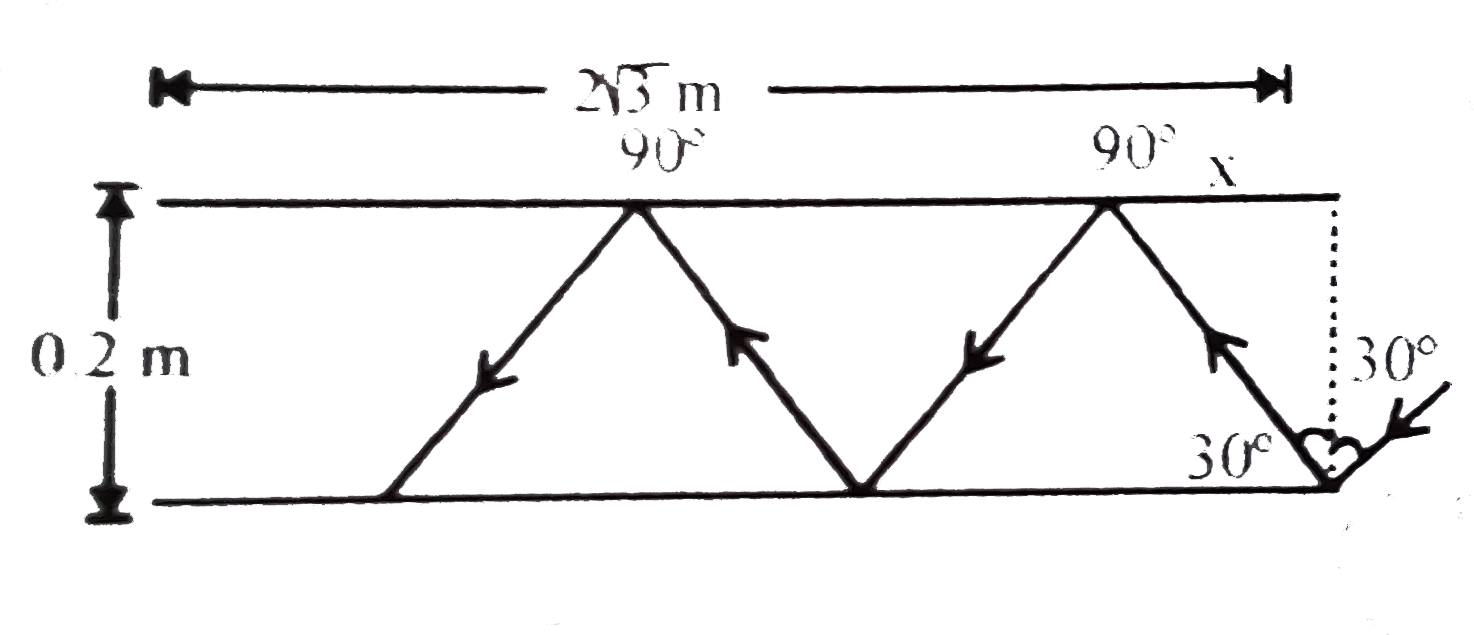
`(x)/(0.2)=tan30^(@)`
`n=(0.2)/(sqrt(3))`
`l=nx`
`n=(2sqrt(3))/(0.2)xxsqrt(3)`
`n=30`
Promotional Banner

Similar Questions

Explore conceptually related problems

Two plane mirrors P and Q are aligned parallel to each other, as shown in the figure. A light ray is incident at an angle of q at a point just inside one end of A. The plane of incidence coincides with the plane of the figure. The maximum number of times the ray undergoes reflections (including the first one) before it emerges out is:

Two plane mirrors A and B are aligned parallel to each other as shown in the figure. A light ray is incident at an angle of 30^(@) at a point just inside one end of A. The number of times the ray undergoes reflections (including the first one) before it emerges out is

If two plane mirrors are inclined at angle 0 to each other as shown, than angle of deviation of incident ray is

Two plane mirror are inclined to each other at 90^(@) . A ray of light is incident on one mirror. The ray will undergo a total deviation of

Two plane mirror inclined at an angle of 60° as shown in the figure, then the angle between the incident ray and the first reflected ray is_____°

Two plane mirrror are inclined to each other at 70^(@) . A ray of light is incident on one mirror. They ray after two reflections will undergo a total deviation of :

A ray of light is incident at an angle of 30^(@) with the plane of a plane mirror. Find the angle of reflection.

Two plane mirrors are inclined to each other at an angle theta . A ray of light is reflected at one mirror and then at the other. Find the total deviation of the ray.

