Home
Class 11
PHYSICS
A vertical pencil of rays comes from bot...

A vertical pencil of rays comes from bottom of a tank filled with a liquid ,When it is accerlerated with a n acceleration of `7.5m//s^(2)`,the ray is seen to be totally reflected by liquid surface, What is minimum possible refractive index of liquids?

A

slightly greater than `4//3`

B

slightly greater than `5//3`

C

slightly greater than `1.5`

D

slightly greater than `1.75`

Text Solution

Verified by Experts

The correct Answer is:
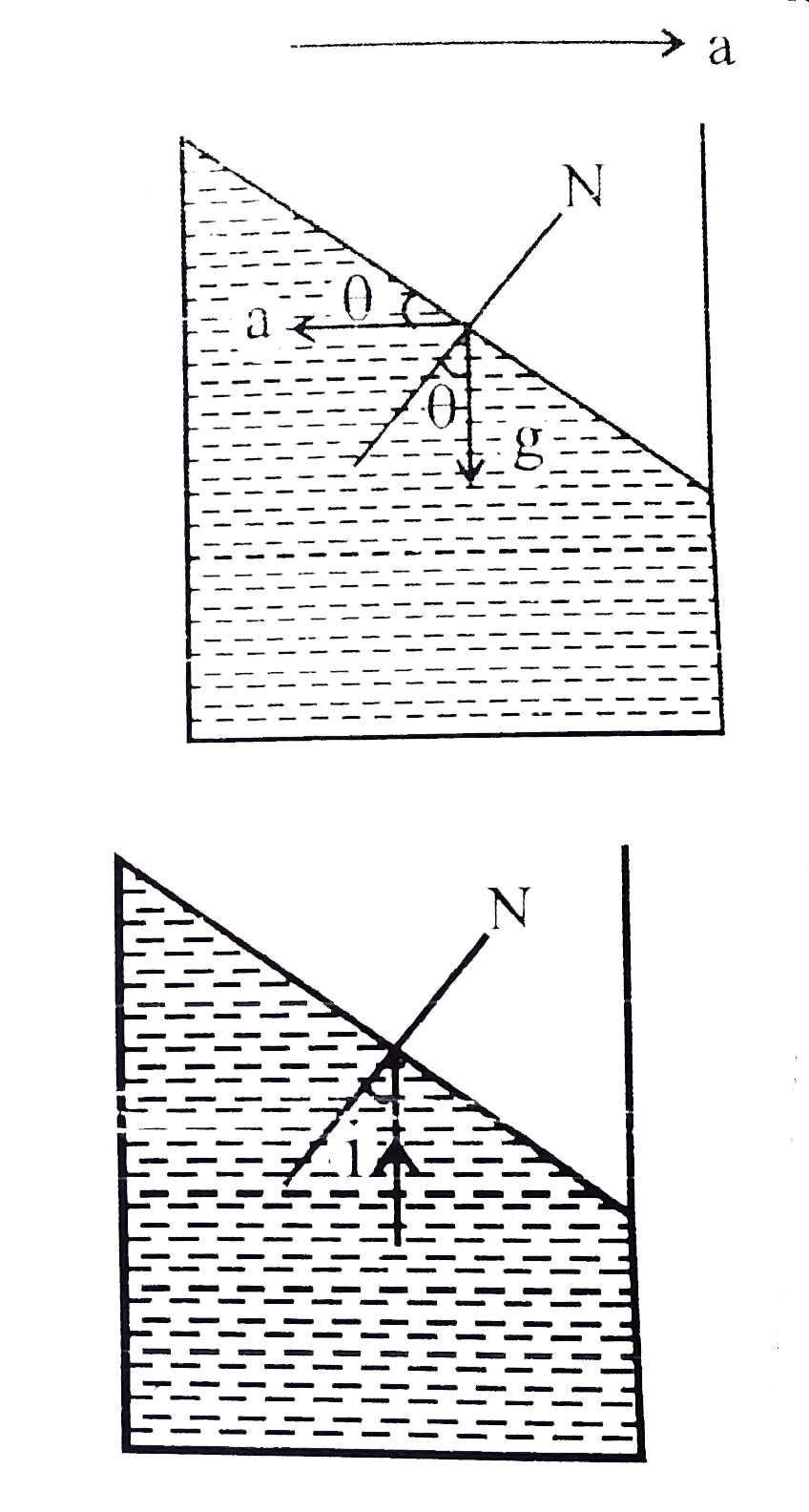
B

Due to psuedo force.Liquid surface will become be inclined

forT.I.R.

`i gt C`
`"sin"i gt "sin"C`
`sin i gt 1/mu`
`(a)/sqrt(a^(2)+g^(2)))gt(1)/(mu)`
`mu gt (sqrt(a^(2)+g^(2)))/(a)`
`mugt(sqrt((15//2)^(2)+(10^(2)))/(15//2)`
`mugt5//3`
Promotional Banner

Similar Questions

Explore conceptually related problems

The apparent depth of an object at the bottom of tank filled with a liquid of refractive index 1.3 is 7.7 cm. what is the actual depth of the liquid in the tank ?

An object is placed at the bottom of a tank filled with liquid of refractive index 1.6. If the actual depth of the tank is 10 cm, what will be the apparent depth of the object?

The minimum deviation produced by a hollow prism filled with a certain liquid is found to be 30^(@) . The light ray is also found to be refracted at angle of 30^(@) . The refractive index of the liquid is

Two plane mirrors M1 and M2 , placed at right angles, form two sides of a container. Mirror M1 is inclined at an angle theta_(0) to the horizontal. A light ray AB is incident normally on M1 . Now the container is filled with a liquid of refractive index mu so that the ray is first refracted, then reflected at M1 . The ray is next reflected at M2 and then comes out of the liquid surface making an angle theta with the normal to the liquid surface. Find theta .

A metal coin at the bottom of a beaker filled with a liquid of refractive index 4//3 to height of 6 cm . To an observer looking from above the surface of the liquid, coin will appear at a depth of (consider paraxial rays).

