

Home
Class 12
PHYSICS
Two inclined planes (I) and (II) have in...

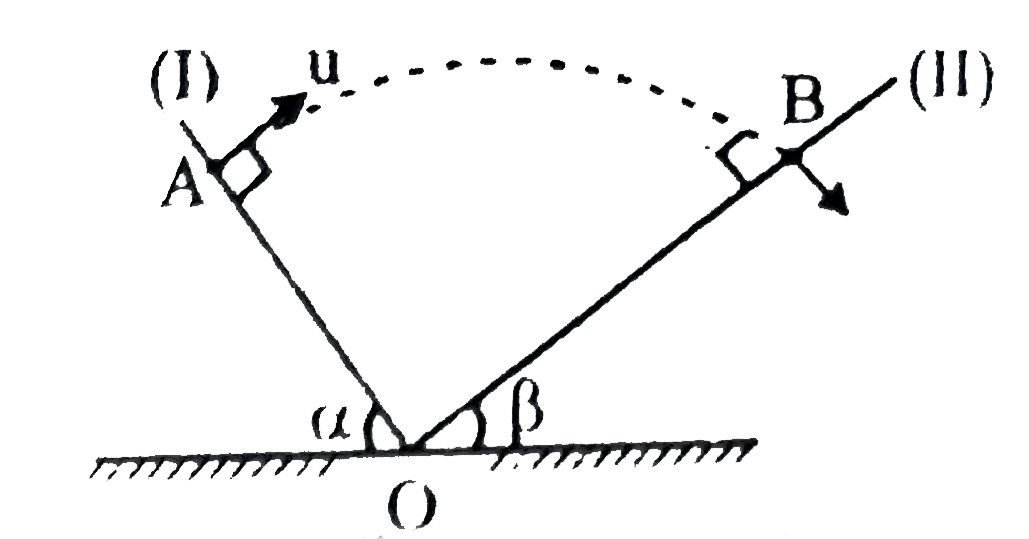
Two inclined planes (I) and (II) have inclination alpha and beta respectively with horizontal (where `alpha + beta=90^(@)`)intersect each other at point O as shown in figure A particle is projected from point A with velocity u along a direction perpendicular to plane (I) If the particle strikes (II) perpendicularly at B, then:

Promotional Banner

Similar Questions

Explore conceptually related problems

Two inclined planes OA and OB having inclination (with horizontal) 30^(@) and 60^(@) , respectively, intersect each other at O as shown in figure. A particle is projected from point P with velocity u = 10(sqrt3) ms^(-1) along a direction perpendicular to plane OA. If the particle strikes plane OB perpendicularly at Q, calculate The velocity with which particle strikes the plane OB,

Two inclined planes OA and OB having inclination (with horizontal) 30^(@) and 60^(@) , respectively, intersect each other at O as shown in figure. A particle is projected from point P with velocity u = 10(sqrt3) ms^(-1) along a direction perpendicular to plane OA. If the particle strikes plane OB perpendicularly at Q, calculate The velocity with which particle strikes the plane OB,

Two inclined planes OA and OB having inclination (with horizontal) 30^(@) and 60^@ (with horizontal), respectively, intersect each other at O as shown in figure. A particle is projected from point P with velocity u = 10sqrt3 ms^(-1) along a direction perpendicular to plane OA. If the particle strikes plane OB perpendicularly at Q, calculate The maximum height attained by the particle (from the line O)

Two inclined planes OA and OB having inclination (with horizontal) 30^(@) and 60^@() , respectively, intersect each other at O as shown in figure. A particle is projected from point P with velocity u = 10sqrt3 ms^(-1) along a direction perpendicular to plane OA. If the particle strikes plane OB perpendicularly at Q, calculate The maximum height attained by the particle (from the line O)

Two inclined planes OA and OB having inclination (with horizontal) 30^(@) and 60^@() , respectively, intersect each other at O as shown in figure. A particle is projected from point P with velocity u = 10sqrt3 ms^(-1) along a direction perpendicular to plane OA. If the particle strikes plane OB perpendicularly at Q, calculate The maximum height attained by the particle (from the line O)

Two inclined planes OA and OB having inclination (with horizontal) 30^(@) and 60^(@) , respectively, intersect each other at O as shown in figure. A particle is projected from point P with velocity u = 10sqrt3 ms^(-1) along a direction perpendicular to plane OA. If the particle strikes plane OB perpendicularly at Q, calculate The vertical height h of P from O,

Two inclined planes OA and OB having inclination (with horizontal) 30^(@) and 60^(@) , respectively, intersect each other at O as shown in figure. A particle is projected from point P with velocity u = 10sqrt3 ms^(-1) along a direction perpendicular to plane OA. If the particle strikes plane OB perpendicularly at Q, calculate The vertical height h of P from O,

Two inclined planes OA and OB having inclination (with horizontal) 30^(@) and 60^(@) , respectively, intersect each other at O as shown in figure. A particle is projected from point P with velocity u = 10(sqrt3) ms^(-1) along a direction perpendicular to plane OA. If the particle strikes plane OB perpendicularly at Q, calculate Time of flight of the particles

Two inclined planes OA and OB having inclination (with horizontal) 30^@ and 60^(@) , respectively, intersect each other at O as shown in figure. A particle is projected from point P with velocity u = 10(sqrt3) ms^(-1) along a direction perpendicular to plane OA. If the particle strikes plane OB perpendicularly at Q, calculate The distance PQ,