Home
Class 12
PHYSICS
A particle carrying charge + q is hel...

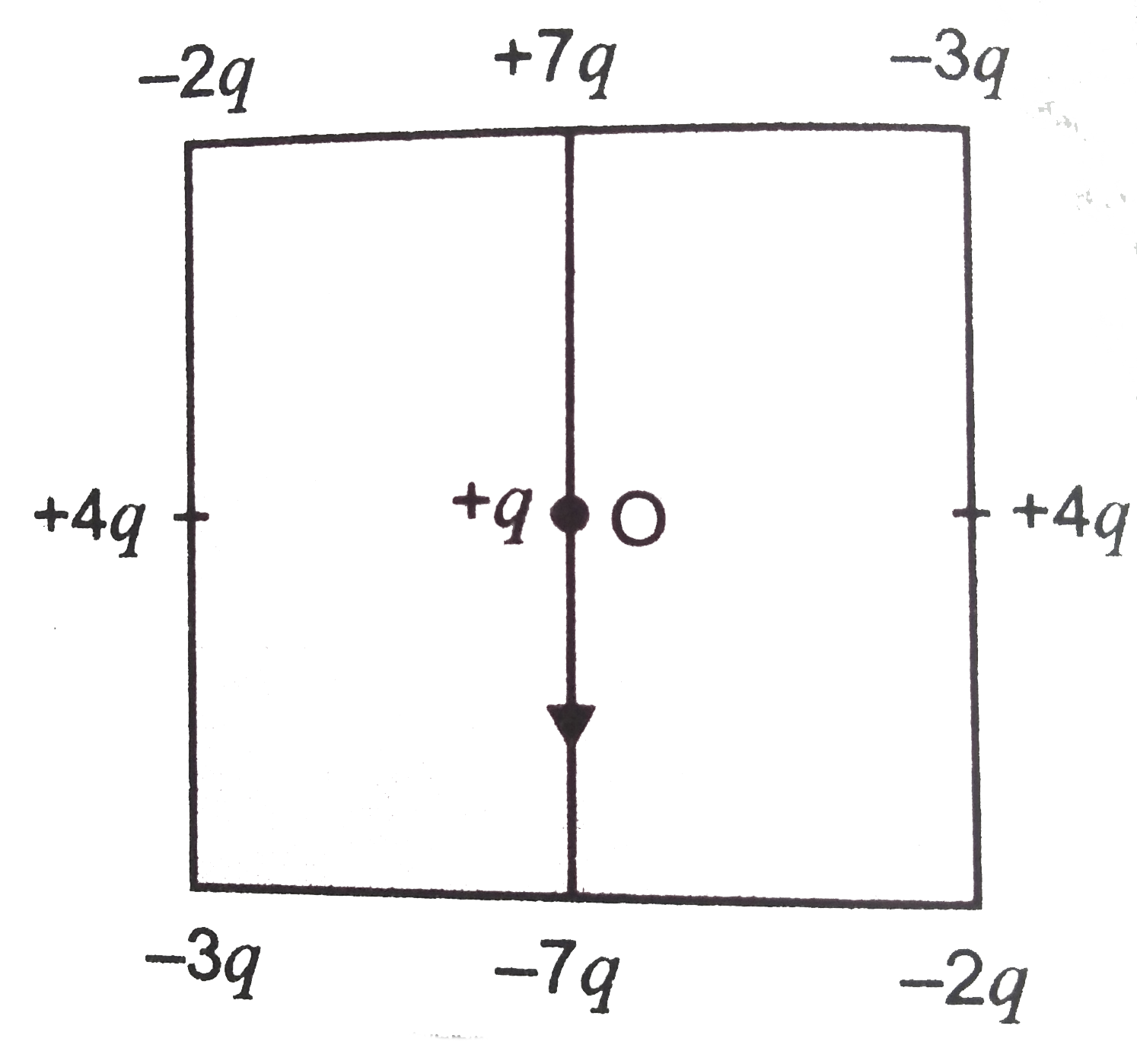
A particle carrying charge + q is held at the center of a square of each side arranged on the square as shown in Fig. If q = 2 muC, what is the net force on the particle?

A

`36xx14xx4xx10^(-3) N`

B

`16xx14xx4xx10^(-3) N`

C

`26xx14xx4xx10^(-3) N`

D

`6xx14xx4xx10^(-3) N`

Text Solution

Verified by Experts

The correct Answer is:

A

As in clear from Fig. I(a)., forces on the particle at O due to `(-2 q, -2 q) , (-3 q, -3 q) and (+4 q, + 4 q)` are equal and opposite They cancel out in pairs. However, forces due to +7 q add up. There, net force on the particle at O is
` F = (1)/(4pi in_(o)) xx ((7q) (q) + 7q(q))/((1//2)^(2))`
= `(9xx10^(9)xx14(2xx10^(-6))^(2))/(1//4)`
` = 36xx14xx4xx10^(-3) N`
Promotional Banner

Similar Questions

Explore conceptually related problems

The electric field at the centre of a square having equal charge q at each of the coner (side of square a )

Four particles, each of mass m and charge q, are held at the vertices of a square of side 'a'. They are released at t = 0 and move under mutual repulsive forces speed of any particle when its distance from the centre of square doubles is

Four point charges are placed at the corners of a square ABCD of side 10 cm, as shown in figure. The force on a charge of 1muC placed at the centre of square is

Four charge Q, q, Q and q are kept at the four corners of a square as shown below. What is the relation between Q and q, so that the net force on a charge q is zero ?

Two charges, each equal to q, are kept at x=-a and x=a on the x-axis. A particle of mass m and charge q_0=q/2 is placed at the origin. If charge q_0 is given a small displacement (ylt lt a) along the y-axis, the net force acting on the particle is proportional to

Four idential charges each of charge q are placed at the corners of a square .Then at the centre of the square the resultant electric intensity E and the net electric potential V are

A point charge q is placed at a distnace a/2 directly above the centre of a square of side a, as shown figure. Find the magnitude of the electric flux through the square.
