Home
Class 12
PHYSICS
Three points A,B,C lie in a uniform elec...

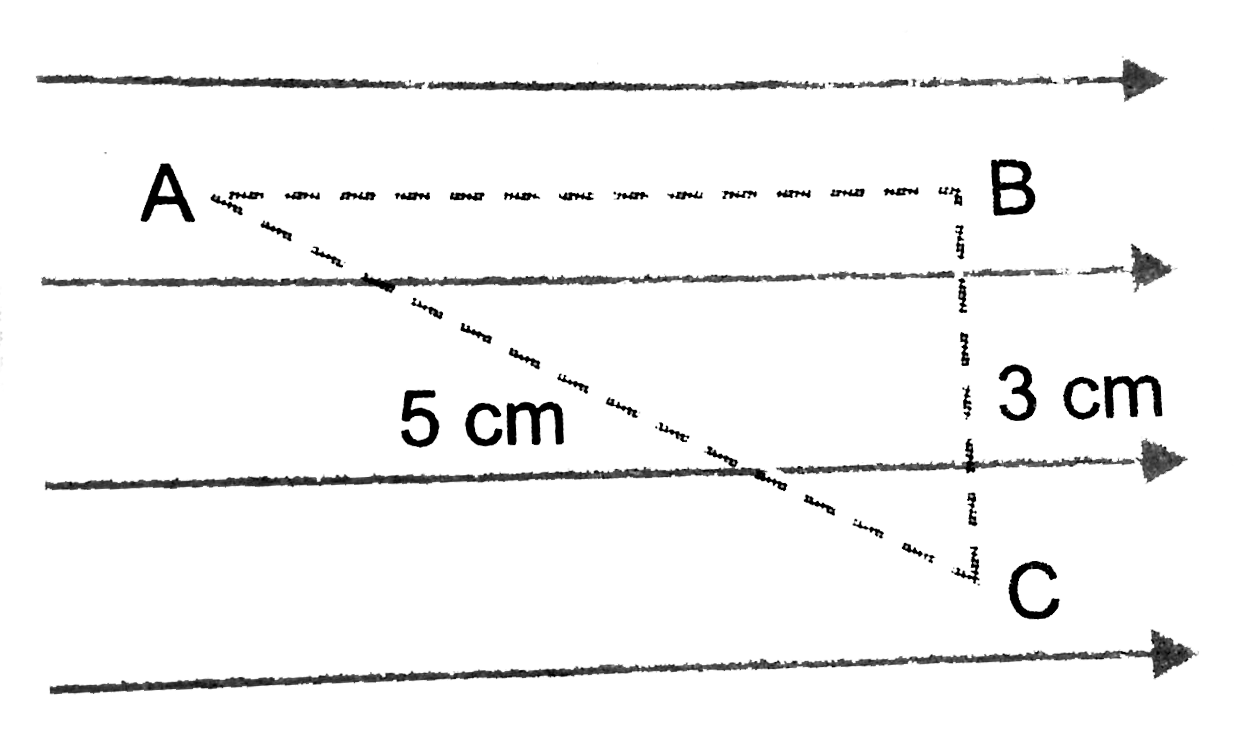
Three points A,B,C lie in a uniform electric field E of `5xx10^(3) N//C` as shown in Fig. Find the potential difference between A and C.

Text Solution

Verified by Experts

In fig as B and C are in same verticale line, therefore `V_(B) = V_(C)`
Now, potenital difference between A and C = potential difference between A and B
`V_(AC) = V_(AB) = -E (Delta x)`
Now, `Delta x = AB = sqrt(AC^(2) - BC^(2)) = sqrt(5^(2) - 3^(2))`
`= 4 cm = 4xx10^(-2) m`
`:. V_(AC) = -5xx10^(3)xx4xx10^(-2)`
`= -200 V`
Promotional Banner

Similar Questions

Explore conceptually related problems

A uniform electric field exists in x y plane as shown in Fig. 3.45. Find the potential difference. Between origin O and A(d,d,0) . .

A test charge q is moved without acceleration from A to C along the path from A to B and then from B to C in electric field E as shown in Fig. (i) Calculate the potential difference between A and C (ii) At what point [of A and C] is the electric potential more and why?

Consider a unifrom electric field in a region as shown below. Then, potential difference between points A and C is given by

A test charge q is moved without acceleration from A to C along the path form A to B and then from B to C in electric field E as shown in the figure. (i) Calculate the potential difference between A and C. (ii) At which point (of the two) is the electric potential more and why?

There is a electric circuit as shown in the figure. Find potential difference between points a and b.

A proton when released from point A moves to a point B in an electric field. Which of A and B is at a higher potential ? Explain. If the potential difference between the points A and B is 5 V, find the amount of work done in moving a proton from B to A (Take charge of proton as +1.6 xx 10^(-19)C ).

In uniform electric field E=10 N//C , find a. V_A-V_B , b. VB-V_C

An electric dipole of moment 5xx10^(-8) C-m is aligned in a uniform electric field of 1*44xx10^(4) N//C . Calculate potenitial energy of the diople at 60^(@) with the direction of electric field.
