Home
Class 12
PHYSICS
An indinitely long positively charged ...

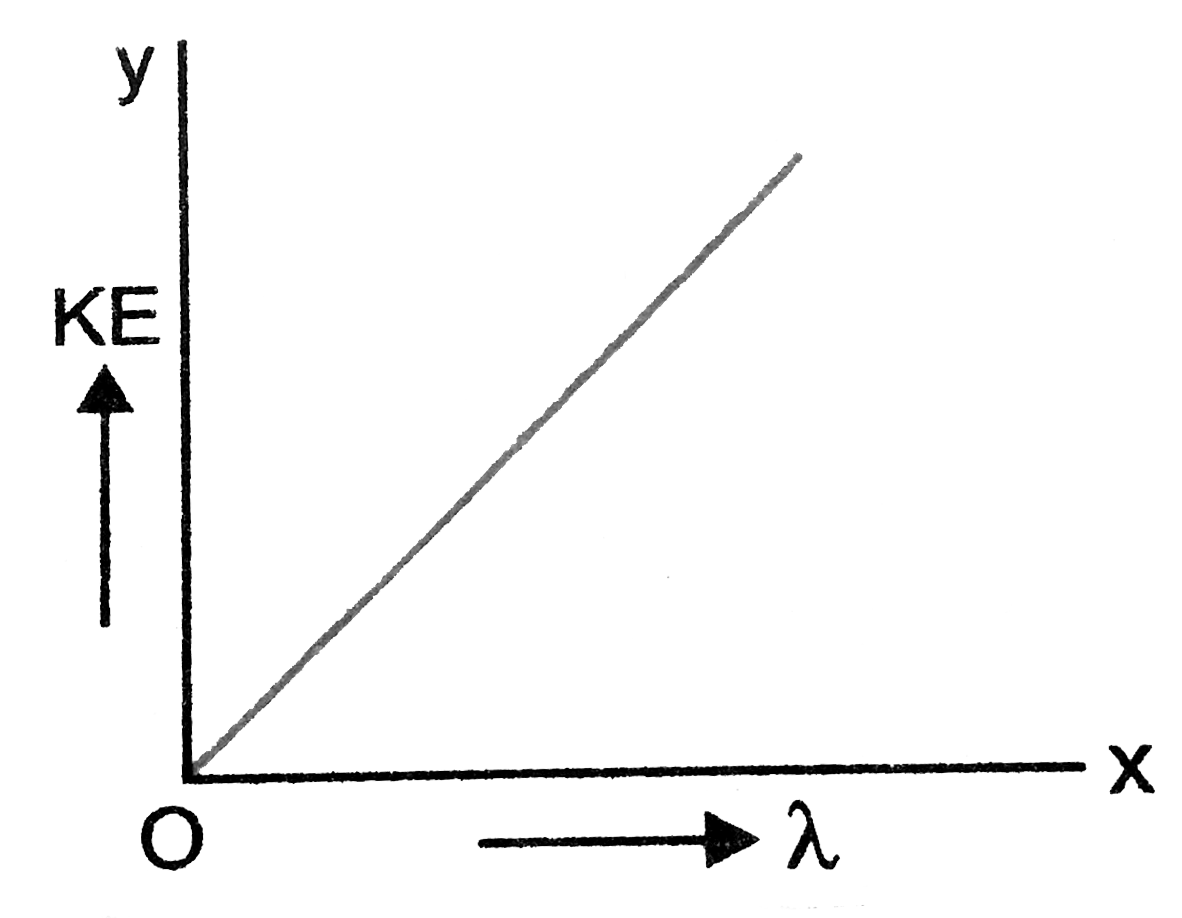
An indinitely long positively charged wire has a linear charge density `lambda cm^(-1)`. An electron is revolving around the wire as its center with a constant velocity in a circular plane perpendicular to the wire. Deduce the expression for KE of electron. Plot a graph of K.E as a function of charge density `lambda`.

Text Solution

Verified by Experts
The electostatic force exerted by the infinitely long line charge provides the necessary centripetal force to the revolving electron.
`:. eE = (mv^(2))/(r ) , but E = (lambda)/(2pi in_(0) r)`
`(e lambda)/(2pi in_(0) r) = (mv^(2))/(r ) or v^(2) = (e lambda)/(2pi in_(0) m)`
`KE = (1)/(2) mv^(2) = (1)/(2) m ((e lambda)/(2pi in_(0) m)) = (e lambda)/(4pi in_(0))`
As KE `prop lambda`, therefore, graph of KE as a function of charge density will be a straight line as shown in Fig.
Promotional Banner

Similar Questions

Explore conceptually related problems

An infinitely long thin straight wire has uniform linear charge density of 1//3 "coul" m^(-1) .Then the magnitude of the electric intensity at a point 18cm away is

A long cylindrical wire carries a positive charge of linear density lambda . An electron (-e ,m) revolves around it in a circular path under the influence of the attractive electrostatic force. Find the speed of the electron.

A semi-infinite insulating rod has linear charge density lambda . The electric field atthe pointPshown in figure-1.418 is:

There is one long line charge with linear charge density lambda . One electron is moving in a circular path around this line charge. Plane of the circle is perpendicular to line charge and line charge passes through centre of circle. Prove that kinetic energy of electron is independent to the radius of a circle.

Find ratio of electric at point A and B. Infinitely long uniformly charged wire with linear charge density lamda is kept along z-axis:

Consider a very long plastic wire with charge density lambda .Flux passing through a circle of radius R having centre at one of ends of wire is

A long cylindrical wire carries a positive charge of linear density 2.0 xxx 10^(-8) C m^(-1). An electron revolves around it in a circular path under the influence of the attactive electrostatic force. Find the kinetic energy of the electron. Note that it is independent of the radius.

Twelve infinite long wire of uniform linear charge density (lambda) are passing along the twelve edges of a cube. Find electric flux through any face of cube. ,

