Home
Class 12
PHYSICS
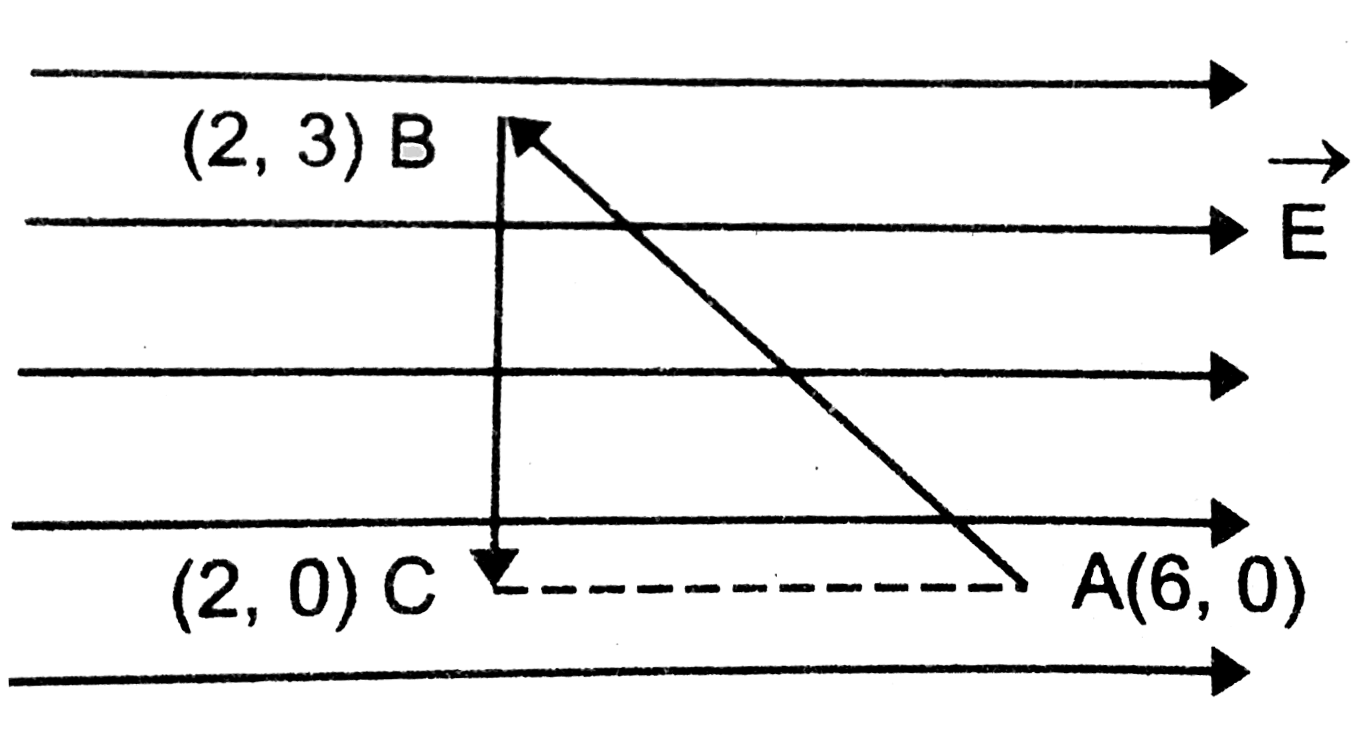
A test charge q is moved without acceler...

A test charge q is moved without acceleration from A to C along the path from A to B and then from B to C in electric field E as shown in Fig. (i) Calculate the potential difference between A and C (ii) At what point [of A and C] is the electric potential more and why?

Text Solution

Verified by Experts

(i) p.d. does not depend upon the path along which the test charge moves.
`:. E = - (dV)/(dx) = (-(V_(C) - V_(A)))/(2-6) = (V_(C) - V_(A))/(4)`
or `V_(C) - V_(A) = 4E`. Therefore, `V_(C) - V_(A)`
(ii) Direction of electric field is in the direction of decreasing potential. So, `V_(C) gt V_(A)`
Promotional Banner

Similar Questions

Explore conceptually related problems

A test charge q is moved without acceleration from A to C along the path form A to B and then from B to C in electric field E as shown in the figure. (i) Calculate the potential difference between A and C. (ii) At which point (of the two) is the electric potential more and why?

Three points A,B,C lie in a uniform electric field E of 5xx10^(3) N//C as shown in Fig. Find the potential difference between A and C.

In circuit shown in figure calculate the potential difference between the points A and B and between the points B and C in the steady state.

A test charge q_(0) is moved without acceleration from A to C over the path ABC as shown in Fig. Calcualate potential difference beetween A and C.

There is a electric circuit as shown in the figure. Find potential difference between points a and b.

Consider a unifrom electric field in a region as shown below. Then, potential difference between points A and C is given by

In the diagram shown find the potential difference between the points A and B and between the points B and C in the steady state.

A charge of 5 C is moved between two point is an electric field and 20 J of work was done to do so. Calculate the potential difference between the two points.
