Home
Class 12
PHYSICS
Electric potential at a point 0 due to ...

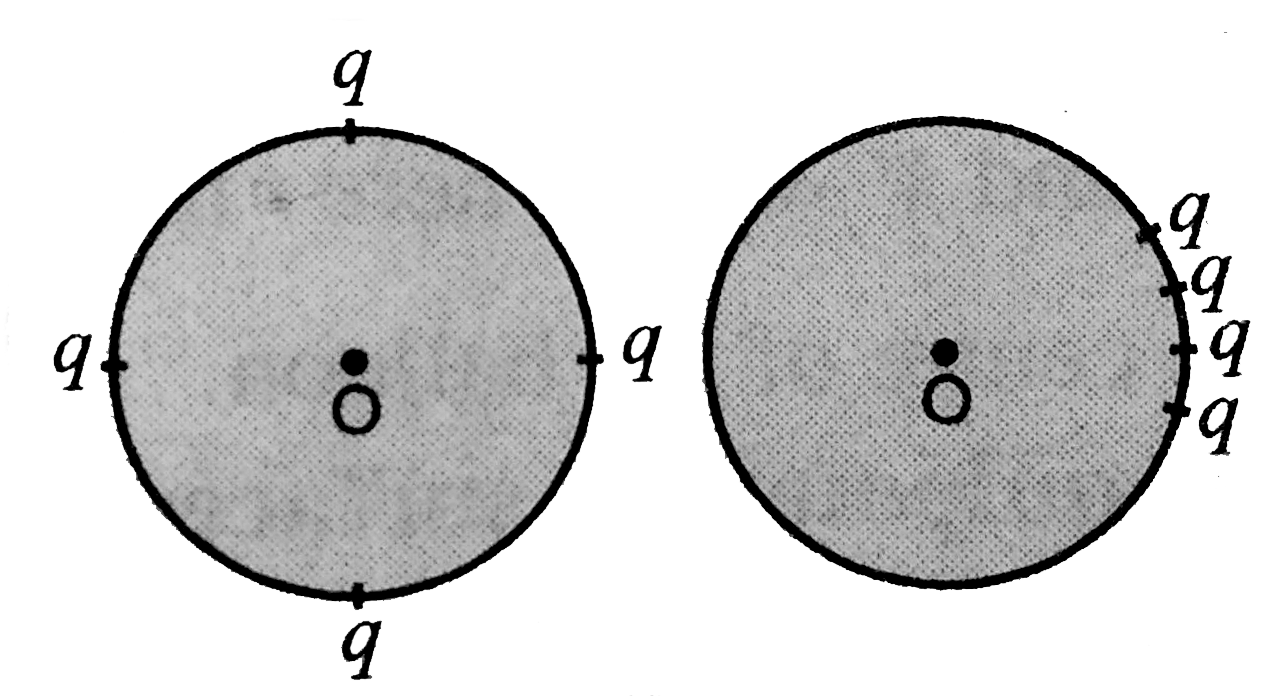
Electric potential at a point 0 due to a number of a point charges equidistant from 0 si `V_(1)` when charges are uniformly distributed and it is `V_(2)` when charges are non uniformly distributed , Fig. Is `V_(1) = V_(2) ? Justify.

Text Solution

Verified by Experts

If r is radius of the sphere with center 0,then by defiinition
`V_(1) = 4 ((q)/(4pi in_(0) r)) , and V_(2) = 4 ((q)/(4pi in_(0) r))`
`:. V_(1) = V_(2)`
This is because electric potential is a scaler quanity.It depends only on distance of the point from the charge and not on direction of its location from the charge.
Promotional Banner

Similar Questions

Explore conceptually related problems

The electric potential at 0.9m from a point charge is +50 V . What is the magnitude and sign of the charge ?

Electric potential at a point P, r distance away due to a point charge q kept at point A is V. If twice of this charge is distributed uniformly on the surface of a hollow sphere of radius 4r with centre at point A the potential at P now is

The electric potential at a point certain distance from a point charge is 600 V and the electric field is 200 NC^(-1) . Which of the following statements will be true?

Electric potential at a point P , r distance away due to a point charge located at a point A is V .If twice of this charge is distributed uniformly on the surface of a hollow sphere of radius 4r with centre at point A ,the potential at P now is given as: (v)/(x) value of x is

Potential at a point due to a point charge is V. The charge is doubled and also the distance of the point from the charge is doubled. The new potential is

Electric Potential Basics, Electric Potential due to a point charge, Potential due to cntinuous charge distribution, Ring, Spherical Shell

The electric potential at point A is 1V and at another point B is 5V. A charge 3muC is released from B. What will be the kinetic energy of the charge as it passes through A?

Electric potential due to multiple point charges and continuous charge distributions including spherical symmetries
