Home
Class 12
PHYSICS
A uniform electric field E exists betwee...

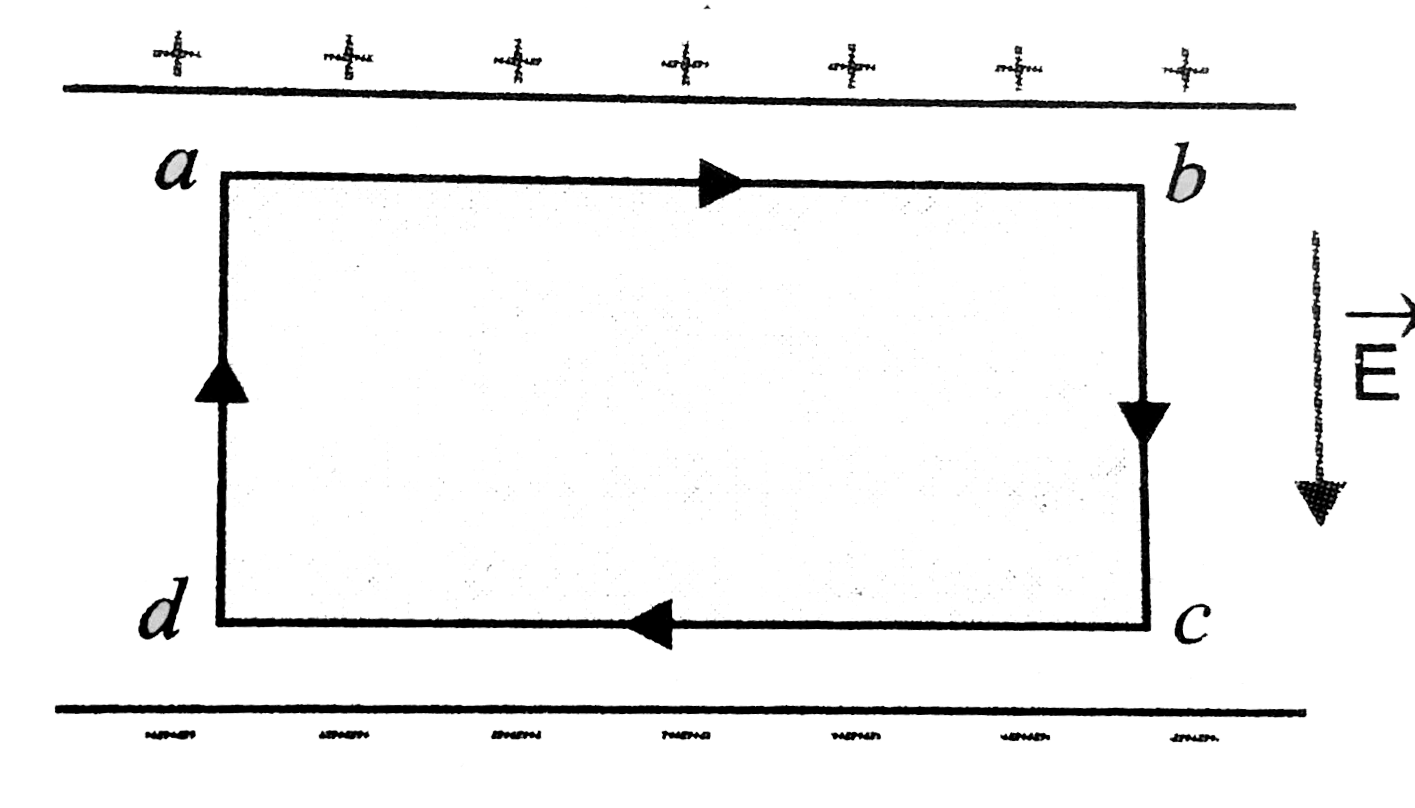
A uniform electric field E exists between two oppositely charged plates (Fig. 3.38). What will be the work done in moving a charge q along a closed rectangular path ?
.

Text Solution

Verified by Experts

Refer to Fig, work done in moving a charge q on path abcd.
`= q vec(E). vec((ab)) + q vec(E). vec((bc)) +q vec(E). vec((cd)) + q vec(E) . vec((da))`
`= qE (ab) cos 90^(@) + qE (bc) cos 0^(@)`
`+ qE (cd) cos 90^(@) + qE(da) cos 180^(@)`
`= 0 + qE (bc) + 0 - qE (da) = 0 ( :. bc = da)`
Promotional Banner

Similar Questions

Explore conceptually related problems

A uniform electric field E axis between two charged plates as shown in Fig. What would be work done in moving a charge q along the closed recetangualr path ABCDA ?

A uniform electric field exists in a region between two oppositely charged plates. An electron is released from rest at the surface of the negatively charged plate and strikes the surface of the opposite plate, 3.0 cm away, in a time 1.5 xx 10^(-8) s . Just as the electron strikes the second plate, what are the its (a) momentum magnitude and (b) kinetic energy ? (c ) What is the magnitude of the electric field vec(E) ?

(a) Obtain the expression for the energy stored per unit volume in a charged parallel palte capacitor. (b) The electric field inside a parallel plate capacitor is E. Find the amount of work done in moving a charge q over a closed rectangular loop abcda as shown in figure.

An uniform electric field E exists along positive x-axis. The work done in moving a charge 0.5 C through a distance 2 m along a direction making an angle 60^(@) with x-axis is 10 J. Then the magnitude of electric field is

The electric field (vec( E)) between two parallel plates of a capacitor will be uniform if.

A uniform electric field 'E' exists between two parallel plates having opposite having opposite charge on each plates. An electron enters the field between the plates with speed v_0 as shown in the figure. If length of each plate is l then angle with which electron deviates from its initial path is (m is mass of electron ) (##AAK_TST_05_NEET_YEAR(19)_PHY_E05_133_Q01##)