Home
Class 12
PHYSICS
A few electric field lines for a system ...

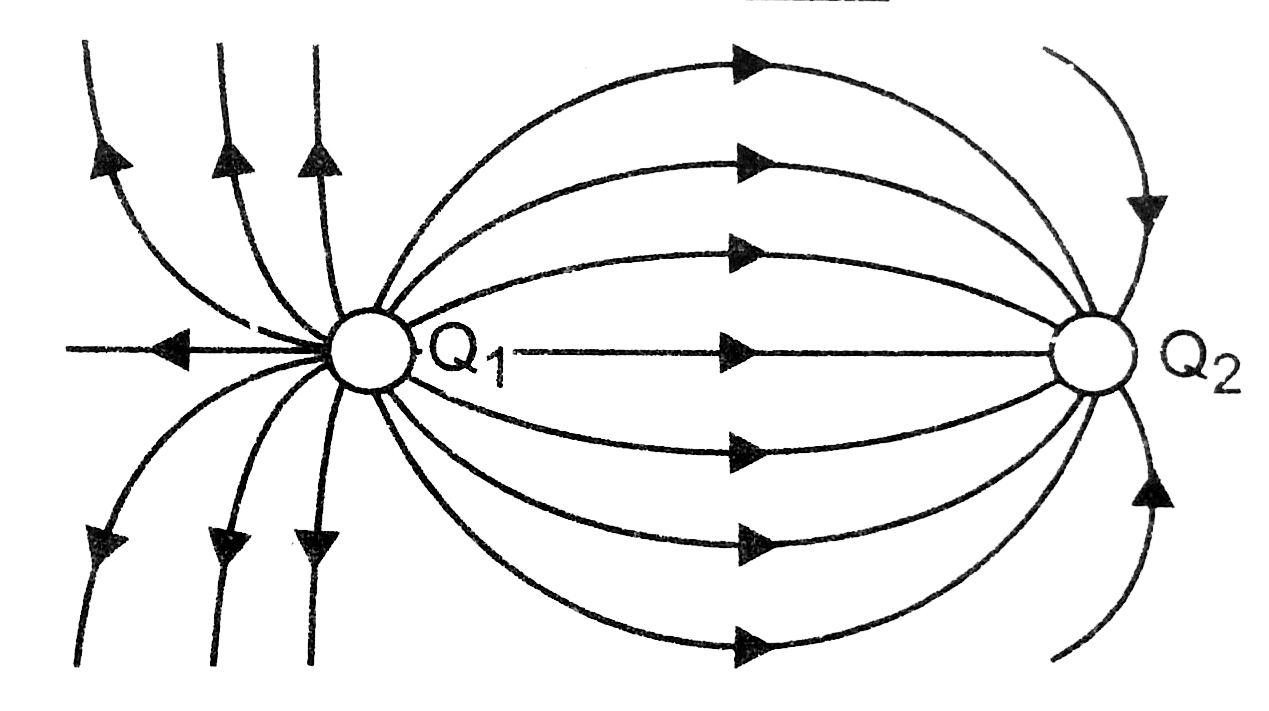
A few electric field lines for a system of two charges `Q_(1) and Q_(2)` fixed at two different points on the X-axis are shown in Fig.

(i) what is the nature of charges ?
(ii) which one of the two is bigger ?
(iii) What is the ratio of magnitude of two charges ?
(iv) Where can the electric field due to two charges be zero ?

Text Solution

Verified by Experts

(i) As electric lines of force start from `Q_(1)` and end at `Q_(2)`, therefore `Q_(1)` is possitive and `Q_(2)` is negative.
(ii) Strength of charge is determined by the number fo electric lines of force. Therefore, `Q_(1) gt Q_(2)`.
(iii) `(Q_(1))/(Q_(2)) = (14)/(9)`
(iv) The electric field due to the sytem fo two charges will be zero at a point to the right of charge `Q_(2)`.
Promotional Banner

Similar Questions

Explore conceptually related problems

A few electric field lines for a system of two charges Q_1 and Q_2 fixed at two different points on the x-axis are shown in the figure. These lines suggest that

A few electric field lines for a system of two charges Q_(1) and Q_(2) fixed at two different points on the x -axis are shown in the figure. These lines suggest that (i) |Q_(1) | gt |Q_(2)| (ii) |Q_(1)| lt |Q_(2)| (iii) At a finite distance to the left of Q_(1) the electric field is zero (iv) At a finite distance to the right of Q_(2) the electric field is zero

The given figure gives electric line of force due to two charges q_(1) and q_(2) . What are the signs of the two charges ?

What are the two kinds of electric charges ?

Two point charges +8q and -2q are located at x=0 and x=L respectively. The location of a point on the x axis at which the net electric field due to these two point charges is zero is

two point charges + 16 q and -4q located at x=0 and x=L respectively. the location of a point on the x-axis from x=0, at which the net electric field due to these two charges is zero is

The electric lines of force of two point charges are shown in fig. What is the value of the ratio q_(1)//q_(2) ?
