Home
Class 12
PHYSICS
An electric dipole consists of charges p...

An electric dipole consists of charges `pm 2.0 xx 10^(8) C` separated by a distance of `2.0 xx 10^(-3)` m. It is placed near a long line charge of linear charge density `4.0 xx 10^(-4) C m^(-1)` as shown in figure (30-W4), Such that the negative charge is at a distance of `2.0 cm from the line charge. Find the force acting on the dipole.

Text Solution

Verified by Experts
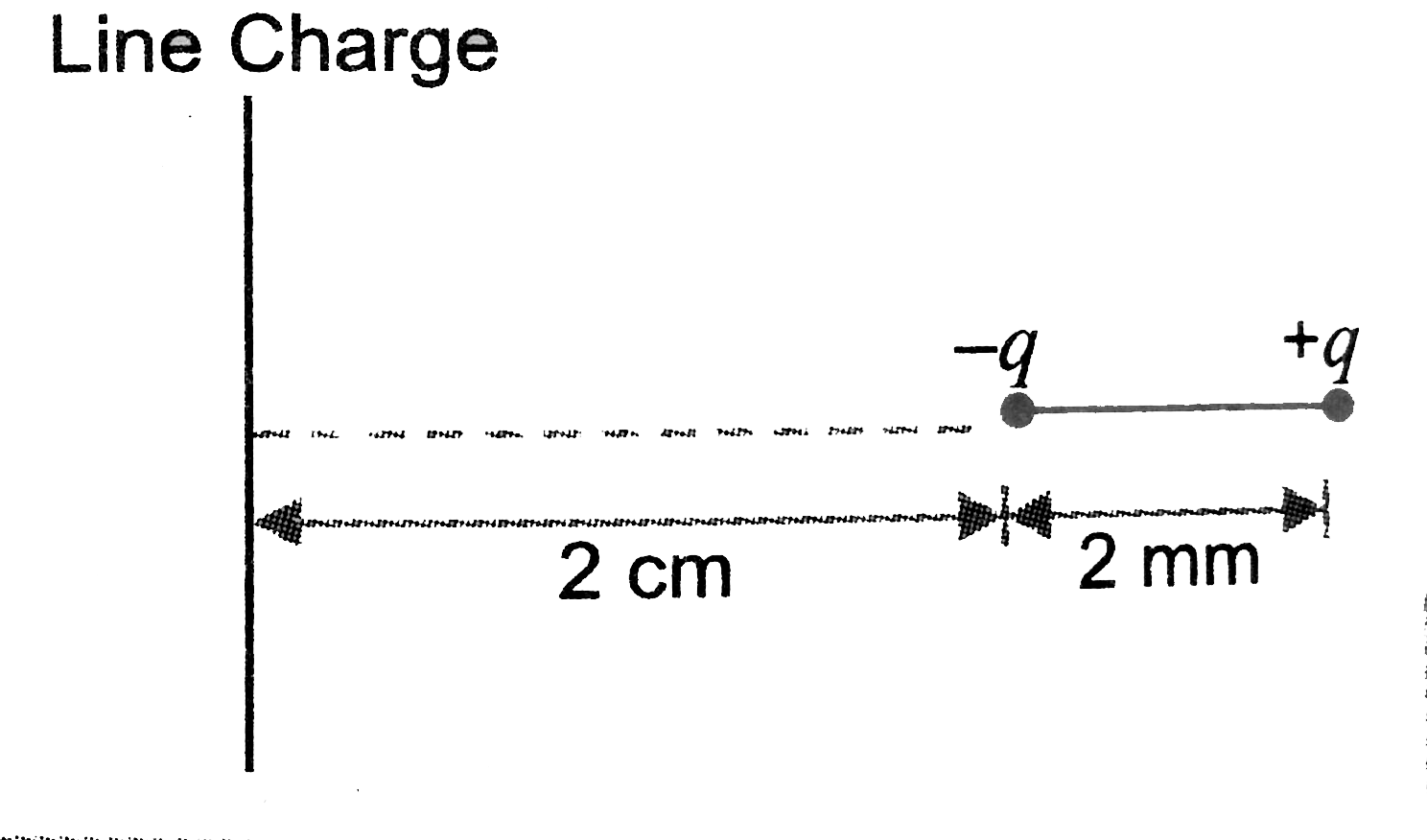
Here, `q = +- 2.0xx10^(-8) C`
`2a = 2mm = 2xx10^(-3)m`
`lambda = 4.0xx10^(-4) C//m`

Distanc eof `-q` charge from line charge,
`r_(1) = 2cm = 0.2 m`
Eelectric field at location of `-q` due to line charge.
`E_(1) = (lambda)/(2pi in_(0) r_(1)) = (2xx9xx10^(9)xx4xx10^(-4))/(0.02)`
`= 3.6xx10^(8) N//C`
Force on `-q` due to line charge
`F_(1) = qE_(1) = 2xx10^(-8)xx3.6xx10^(8) = 7.2 N`
The direction of `F_(1)` is towards the line charge. Electric field at the location of `+q` due to the line chage,
`E_(2) = (lambda)/(2pi in_(0) r_(2)) = (2xx9xx10^(9)xx4xx10^(-4))/((0.002 + 0.002))`
Force on `+q` due to line charge,
`F_(2) = qE_(2) = 2xx10^(-8)xx3.27xx10^(8) = 6.54 N`
The direction of `F_(2)` is away from the line charge.
`:.` Net force on electric dipole `= F_(1) - F_(2)`
`= 7.2-6.54 = 0.66N`
The net force is directed towards the line charge.
Promotional Banner

Similar Questions

Explore conceptually related problems

An electric dipole consists of charges pm 2.0 xx 10^(8) C separated by a distance of 2.0 xx 10^(-3) m. It is placed near a long ilne charge of linear charge density 4.0 xx 10^(-4) C m^(-1) as shown in figure (30-W4), Such thet the negative charge is at a distance of 2.0 cm from the line charge. Find the force acting on the dipole.

An electric dipole consists of charges +- 2.0 xx 10^(-8) C separated by distance of +- 2.0 xx 10^(-3) m. It is placed at a distance of 6 cm from a line charge of linear charge density 4.0 xx 10^(-4) Cm^(-1) as shown in figure such that the dipole makes an angle of theta = 60^@ with line AB. Find the force acting on the dipole.

An electric dipole consisting of two opposite charges of 2xx10^(-6)C each separated by a distance of 3 cm is placed in an electirc field of 2xx10^(5)N//C . The maximum torque on the dipole is will be

A spherical volume contains a uniformaly distributed charge of density 2.0 xx 10^(4) C m^(3) . Find the electric field at a piont inside the volume at a distance 4.0 cm from the centre.

A line charge having a linear charge density of 3 xx 10^-6 C/m is placed as shown in figure. A dipole is placed on x-axis as shown. Find the charge q if it is subjected to a force of 4N.

A charged partical having a charge of -2.0 xx 10^(-6) C is placed close to a nonconducting plate having a surface charge density 4.0 xx 10^(6) C m^(-2). Fine the force of attraction between the particle and the plate.

Find the magnitude of the electric field at a point 4 cm away from a line charge of density 2 xx 10^(-6) C m^(-1) .

An infinite line charge produces a field of 9xx10^(4) NC^(-1) at a distance of 4 cm . Calculate the linear charge density.

An electric dipole is placed on x-axis in proximity to a line charge of linear charge density 3.0 xx 10^(-6) C/m. Line charge is placed on z-axis and positive and negative charge of dipole is at a distance of 10 mm and 12 mm from the origin respectively. If total force of 4 N is exerted on the dipole, find out the amount of positive or negative charge of the dipole.

An infinite line charge produces a field of 9xx10^(-4)N" "C^(-1) at a distance of 2 cm. calculate the linear charge density.

