Home
Class 12
PHYSICS
When an electron moves from A to B along...

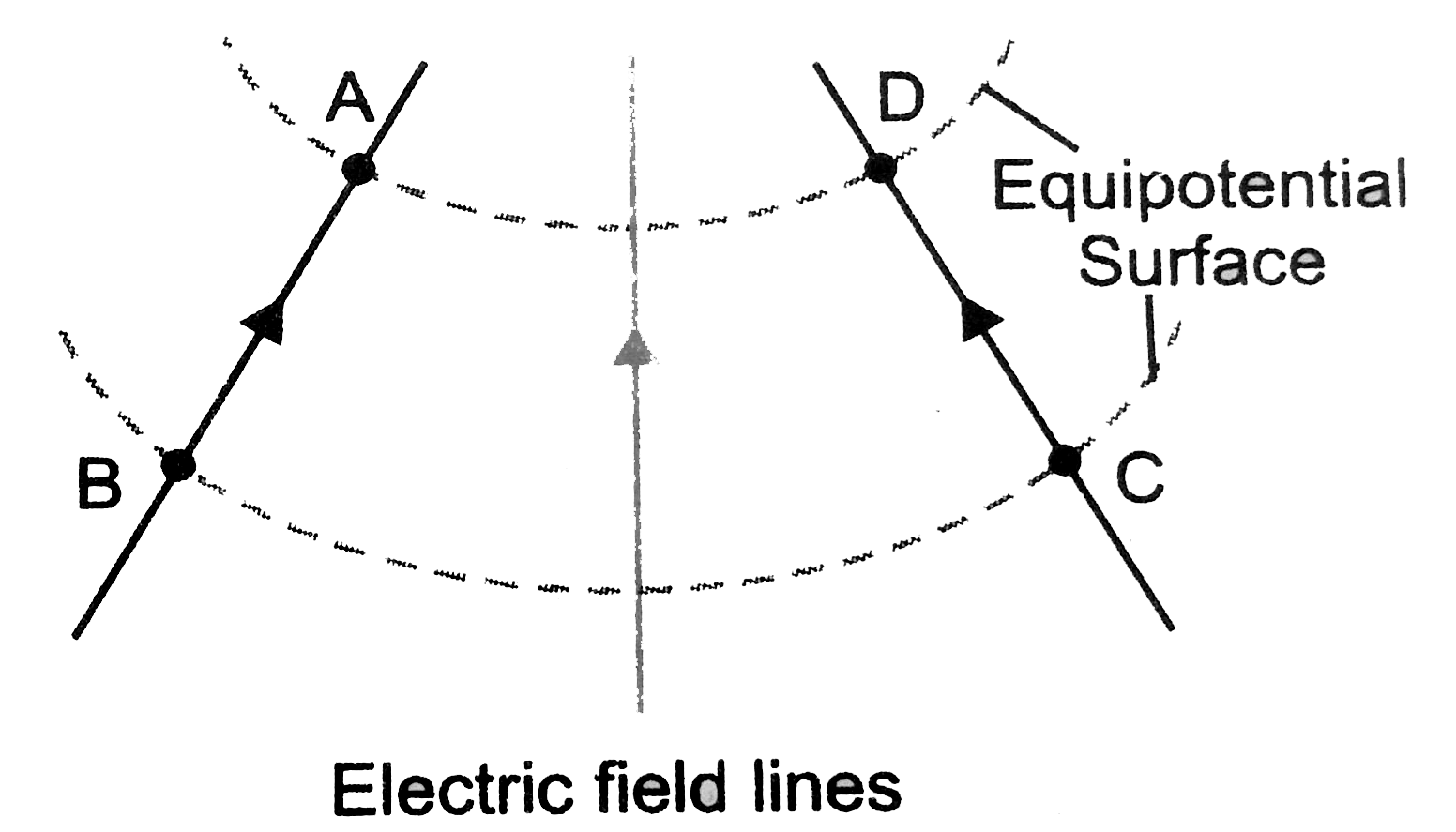
When an electron moves from A to B along and electric field line as shown in Fig. the electric field does `3.94xx10^(-19)J` of work on it. What are the electric potential differences
`(V_(B) - V_(A)) , (V_(C) - V_(A)) , (V_(C) - V_(B))` ?

Text Solution

Verified by Experts

Here, `q = e = -1.6xx10^(-19)C`
`Delta W = 3.94xx10^(-19) J`
By definition, `V_(B) - V_(A) = (-Delta W)/(q)`
`= (-3.94xx10^(-19))/(-1.6xx10^(-19)) = 2.46V`
Again, `V_(C) - V_(A) = V_(B) - V_(A) = 2.46 V`
`( :' V_(C) = V_(B))`
And, `V_(C) - V_(B) = 0` because points B and C lie on the same equipotential surface.
Promotional Banner

Similar Questions

Explore conceptually related problems

In moving from A to B along an electric field line, the work done by the electric field on an electron is 6.4 xx 10^-19 J . If phi_1 and phi_2 are equipotential surfaces, then the potential difference V_C - V_A is. .

Potential difference V_(A) - V_(B) in the network shown in

Potential difference V_(B)-V_(A) in the network shown is

In figure two points A and B are located in a region of electric field . The potential difference V_(B)-V_(A) is

15 joule of work has to be done against an existing electric field to take a charge of 0.01 C from A to B. Then the potential difference (V_(B) - V_(A)) is :-

The work done in carrying an electron from point A to a point B in an electric is 10 MJ. The potential difference (V_(B)-V_(A)) is then

20 J of work has to be done against an existing electric field to take a charge of 0.05 C from A to B. How much is the potential difference V_(B)-V_(A) ?

A uniform electric field of 30NC^(-1) exists along the X-axis calculate the potential difference V_(B)-V_(A) between the points A (4m,2m) and B(10m,5m).

The work done in carrying a charge of 5 mu C form a point A to a point B in an electric field is 10mJ . The potential difference (V_(B) - V_(A)) is then
