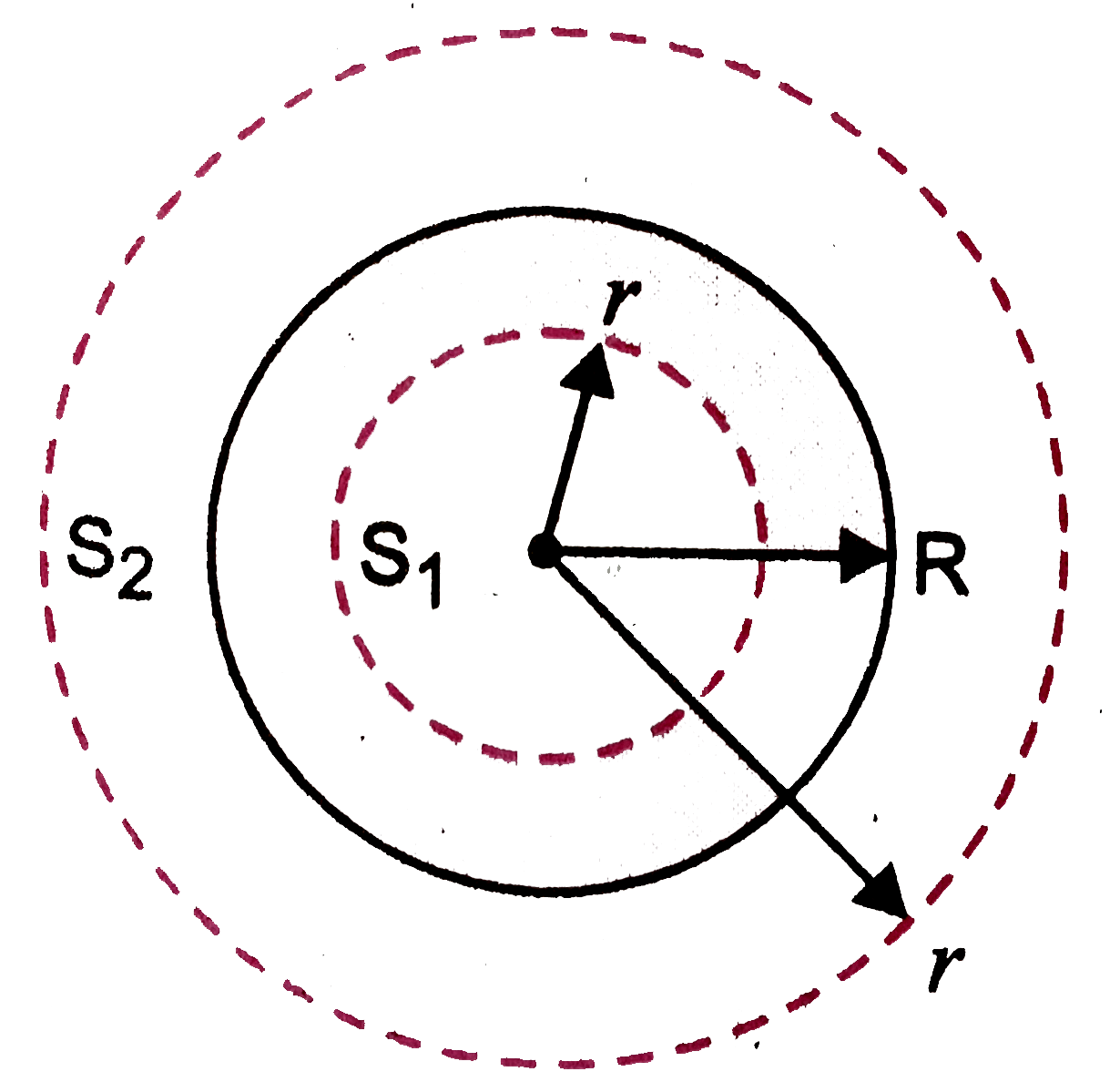
The given charge density distribution of the sphere fo radius R is
`rho (r ) = k r` for `r le R`
`= 0` for `r gt R`
The electric field is obviously radial, as shown in Fig.
For points `r lt R`
Let us consider a spherical Gaussian surface `S_(1)` of radius r. Then on the surface,
`oint vec(E). vec(ds) = (1)/(in_(0)) int rho dV`
As `V = (4)/(3) pi r^(3), dV = (4)/(3) pi 3, r^(2) dr = 4pi r^(2) dr and rho(r) = kr :. oint vec(E). vec(ds) = (1)/(in_(0)) 4pi k int_(0)^(r) r r^(2) dr`
`(E) 4pi r^(2) = (4pi k)/(in_(0)) (r^(4))/(4)`
or `E = (1)/(4 in_(0)) kr^(2)` ...(i)
The direction of `vec(E)` is radially outwards (for positive charge density)
For points `r gt R`, let us consider a sphericall Gaussian surface `S_(2)` of radius r. Then on the surface, when `r = R`
`oint vec(E). vec(ds) = (1)/(in_(0)) int rho. dV`
`E(4pi r^(2)) = (4pi k)/(in_(0)) int_(0)^(R) r^(3) dr = (4pi k)/(in_(0)) dr = (4pi k)/(in_(0)) (R^(4))/(4)`
or `E = (k)/(4 in_(0)) (R^(4))/(r^(2))`
The direction of `vec(E)` is radially outwards (for positive charge density).
(b) From symmetry, we find that the two protons must be on the opposite sides of the center, along a diameter of the sphere as shown in Fig. Proceeding as above, charge on the sphere.
`q = int_(0)^(R) rho dV = int_(0)^(R) (kr) 4pi r^(2) dr = 4pi k (R^(4))/(4) = 2e`
`:. k = (2e)/(pi R^(4))` ....(iii)
If protons 1 and 2 are embedded at distance r from the center of the sphere as shown , then attractive force on proton 1 due to charge distribution is
`F_(1) = -e E = -e (kr^(2))/(4 in_(0))` ....using (i)
Repulsive force on proton 1 due to proton 1 due to proton 2 is `F_(2) = (e^(2))/(4pi in_(0) (2r)^(2))`
Net force on proton 1 `F = F_(1) + F_(2) = -e (kr^(2))/(4in_(0)) + (e^(2))/(16pi in_(0) r^(2))`
Using (iii), `F = [- (er^(2))/(4in_(0)) (2e)/(pi R^(4)) + (e^(2))/(16pi in_(0) r^(4)) ]`
This net force on proton 1 will be zero, when `(e r^(2). 2e)/(4 in_(0)) = (e^(2))/(16 pi in_(0) r^(2)) or r^(4) = (R^(4))/(8) or r = (R)/((8)^(1//4))`
This is the distance of each of the two protons from the center of the sphere.