Home
Class 12
PHYSICS
Two charges -q each are fixed separated ...

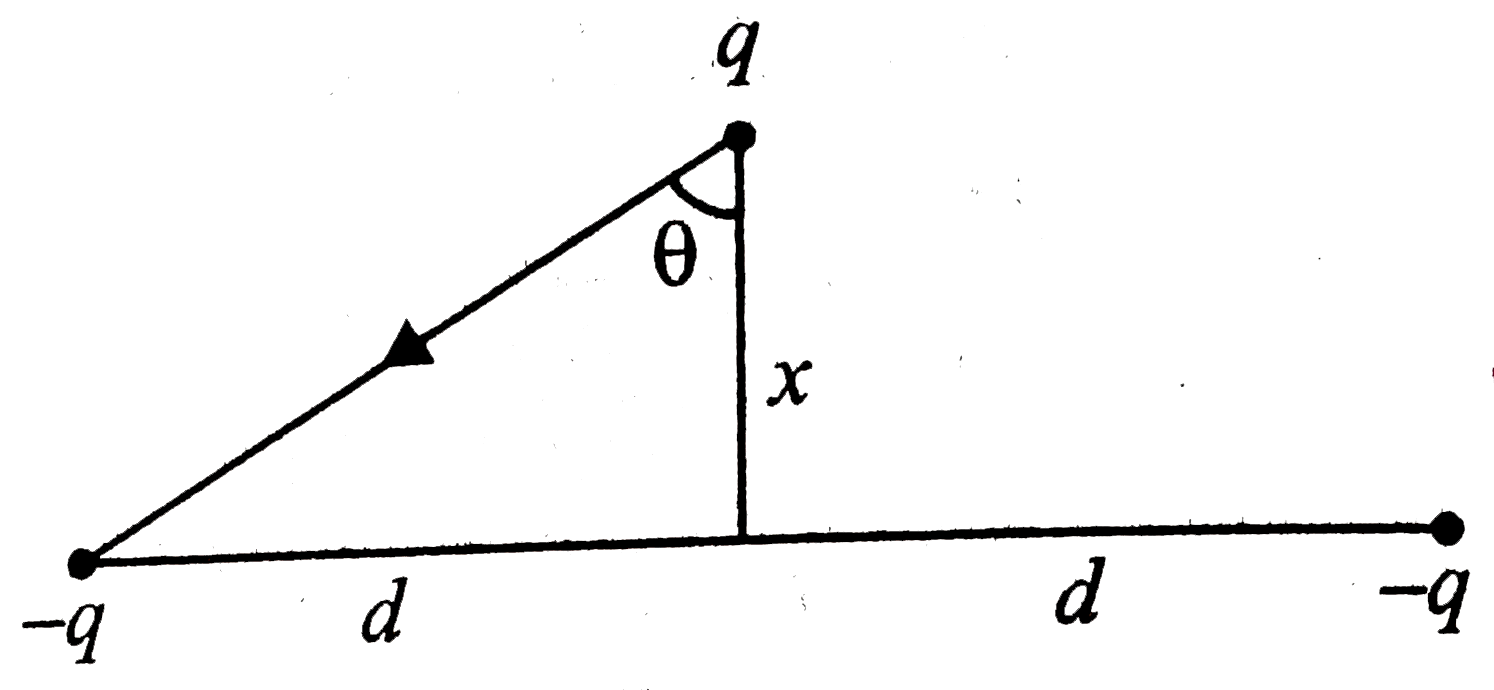
Two charges `-q` each are fixed separated by distance 2d. A third charge q of mass m placed at the mid-point is displaced at the mid-point is placed slightly by `x (xltltd)` perpendicular to the line joining the two fixed charges as shown in Fig. Show that q will perform simple harmonic oscillarion of time period.
`T = [(8pi^(3) in_(0) md^(3))/(q^(2))]^(1//2)`

Text Solution

Verified by Experts
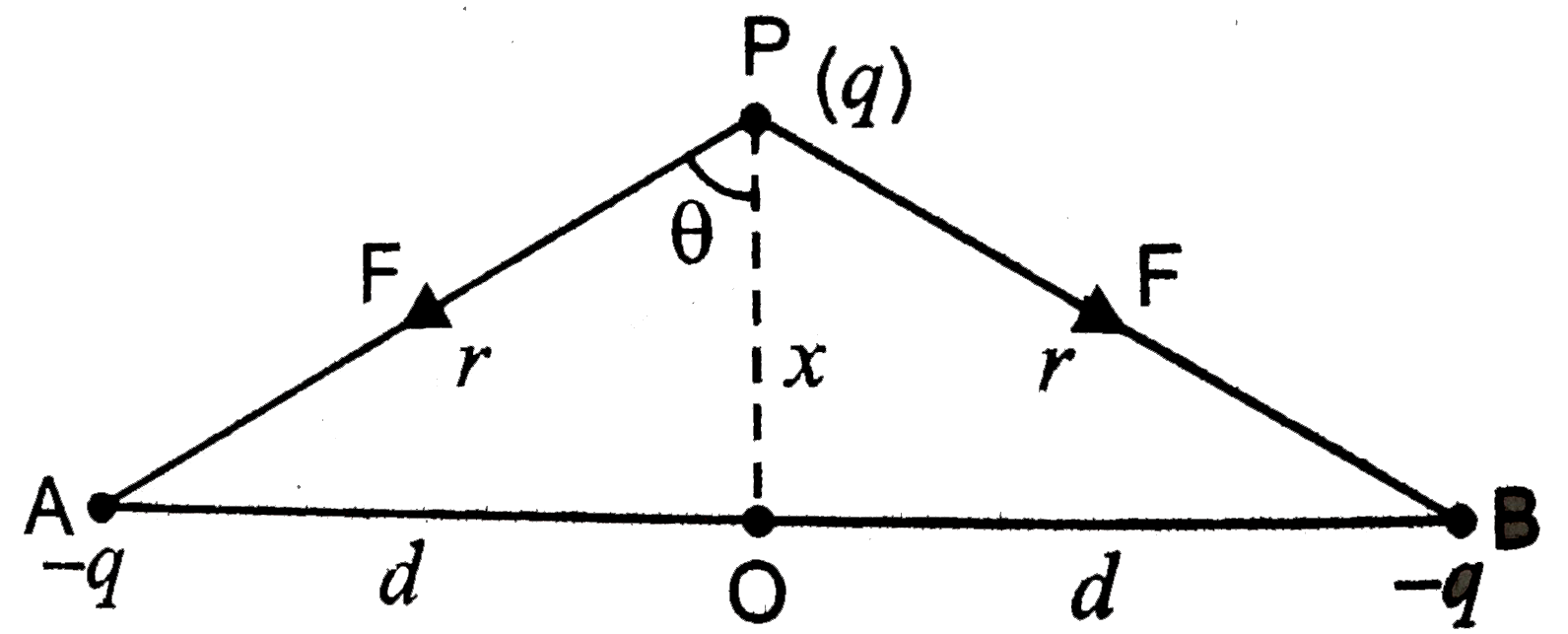
In fig, two charges `-q` each are held at A and B where`AB = 2d`. A third charge `+q` of mass m is placed at 0, middle point of AB. Let it be displaced perpendicular to AB, through a small distance `OP = x`, force of attraction at p towards A and B are each
`F = (q(q))/(4pi in_(0) r^(2))`, where `AP = BP = r`
Horizontal components of those forces cancel out. Vertical components along PO add. If `/_ APO = theta`, the net force on q along PO is `F' = 2F cos theta`
`F = (q(q))/(4pi in_(0) r^(2)) ((x)/(r)) = (2q^(2) x)/(4pi in_(0) (d^(2) + x^(2))^(3//2))`
When `x lt lt d, F' = (2q^(2) x)/(4pi in_(0) d) = K x, where K = (2q^(2))/(4pi in_(0) d^(3))`
i.e., force on charge q is proportional to its displacement from the center 0 and is directed towards 0, Hence, motion of charge q would be simple harmonic, where
`omega = sqrt((K)/(m)) and T = (2pi)/(omega) = 2pi sqrt((m)/(K)) = 2pi = sqrt((m.4pi in_(0) d^(3))/(2d^(2))) = [(8pi^(3) in_(0) m d^(3))/(q^(2))]^(1//2)`
Promotional Banner

Similar Questions

Explore conceptually related problems

Two electrons each are fixed at a distance '2d'. A third charge proton placed at the midpoint is displaced slightly by a distance x (x lt lt d) perpendicular to the line joining the two fixed charges. Proton will execute simple harmonic motion having angular frequency : (m = mass of charged particle)

Two electrons are fixed at a seperation of 2d from each other.A proton is placed at the mid point and displaced slightly in a direction perpendicular to line joining the two electrons. Find frequency of oscillation of proton

Two positive point charges , each Q , are fixed at separation d . A third charge q is placed in the middle. Describe the equilibrium of the third charge.

Two charge q and –3q are placed fixed on x–axis separated by distance d. Where should a third charge 2q be placed such that it will not experience any force ?

Two charges q and 3q are placed fixed on x-axis separated by distance 'd'. Where should a third charge 2q be placed such that it will not experience any force ?

Two point charges q each are fixed at (a,0) and (-a,0). A third charge Q is placed at origin. Electrons potential energy of the system will

Two points charges +4 and +q are separated by distance r, where should a third point charge Q be placed that the whole system remains in equilibrium

