Home
Class 12
PHYSICS
Find the equatio of the equipotentials f...

Find the equatio of the equipotentials for an infinite cylinder of radius `r_(0)` carrying charge of linear density `lamda`.

Text Solution

Verified by Experts
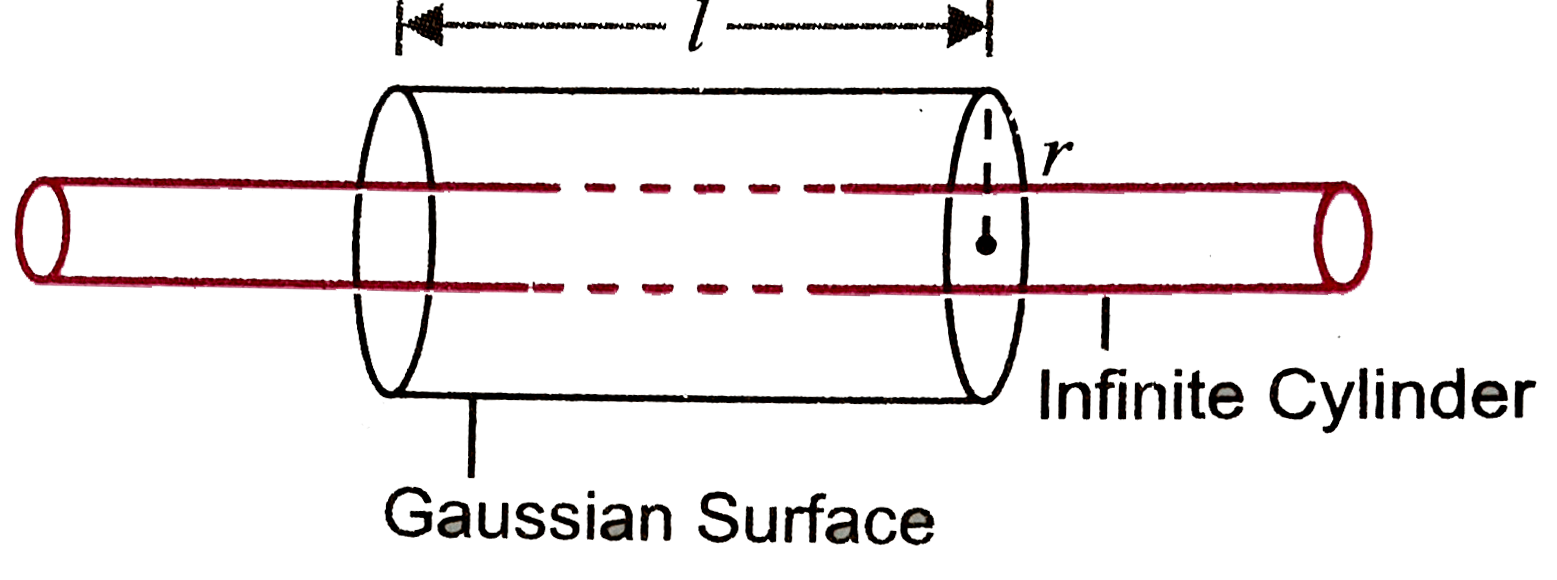
Fig shows an infinite cyclinder of radius `r_(0)` carrying charge of linear density `lambda`, From symetry, we find that the field lines must be radially outwards. Imagine a cylindrical Gaussian surface of radius r and length l. According to Gauss's theroem,
`oint vec(E), vec(ds) = (q)/(in_(0)) = (lambda l)/(in_(0))`
`E(2 pi r l) = (lambda l)/(in_(0)) or E = (lambda)/(2pi in_(0) r)` ..(i)
`:. V (r) - V(r_(0)) = int_(r_(0))^(r) vec(E). vec(dl) = (lamda)/(2pi in_(0)) log_(e) (r_(0))/(r)`
For an equipotential surface of given V(r),
`log_(e) (r)/(r_(0)) = (2pi in_(0))/(lambda) [V (r) - V (r_(0))] :. r = r_(0) e^(-2 pi in_(0) [V(r) - V(r_(0))]//lambda)` ...(ii)
Hence, equipotential surfaces are cylinders of radius r given by (ii).
Promotional Banner

Topper's Solved these Questions

  • ELECTROSTATICS

    PRADEEP|Exercise VALUE BASED QUESTIONS|7 Videos
  • ELECTROSTATICS

    PRADEEP|Exercise Exercise|414 Videos
  • ELECTROSTATICS

    PRADEEP|Exercise ADDITIONAL QUESTIONS|2 Videos
  • ELECTRONIC DEVICES

    PRADEEP|Exercise Fill in the Blanks|1 Videos
  • MAGNETIC EFFECT OF CURRENT AND MAGNETISM

    PRADEEP|Exercise Competition Focus (Multiple Choice Questions)|2 Videos

Similar Questions

Explore conceptually related problems

Find the magntiude and diraction of the magnitude induction vector B (a) of an infinite palne carrying a current of linear density I, the vector i is the same at all points of the plane, (b) of two parallel infinite planes carrying currents of linear densities a dn -1, the vectors i and -i are cohnstant at all points of the corresponding planes.

Find the electric field at the centre of a uniformly charged semicircular ring of radius R. Linear charge density is lamda

Find the electric field due to an infinitely long cylindrical charge distribution of radius R and having linear charge density lambda at a distance half of the radius from its axis.

A particle of charge -q and mass m moves in a circle of radius r around an infinitely long line charge of linear charge density +lamda . Then, time period will be where , k=1/4piepsilon_0)

State Gauss's law in electrostatics. Use this law to derive an expression for the electric field due to an infinitely long straight wire of linear charge density lamda cm^(-1)

Find ratio of electric at point A and B. Infinitely long uniformly charged wire with linear charge density lamda is kept along z-axis:

Draw the electric field vs distance (from the centre ) graph for (i) a long charged rod having linear charge density lamda gt 0 (ii) spherical shell of radius R and charge Q gt 0 .

A long cylinder of radius a carrying a unifrom surface charge rotates about its axis with an anglur velocity omega . Find the magnetic field energy per unit length of the cylinder if the linear charge density equals lambda and mu = 1 .

