Home
Class 12
PHYSICS
(a) In a quark model of elementary parti...

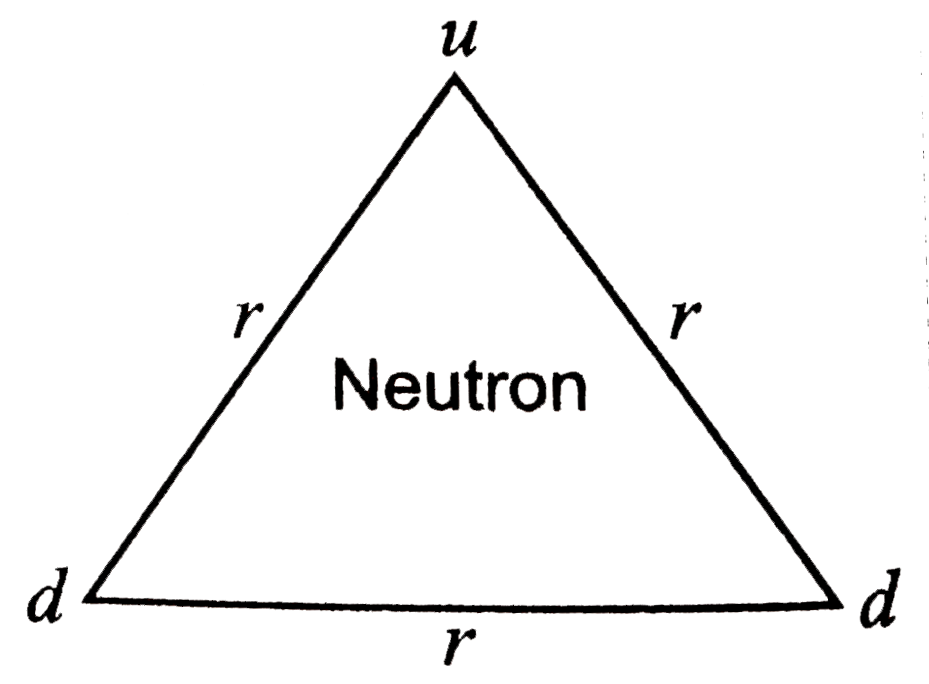
(a) In a quark model of elementary particles, a neutron is made of one up quarks [charge `(2//3)`e] and two down quarks [charges - `(1//3) e]. Assume that they have a triangle configuration with side length of the order of `10^(-15) m`. Calculate electrostatic potential energy of neutron and compare it with its mass 939 MeV.
(b) Repeat above exercise for a proton which is made of two up and one down quark.

Text Solution

Verified by Experts
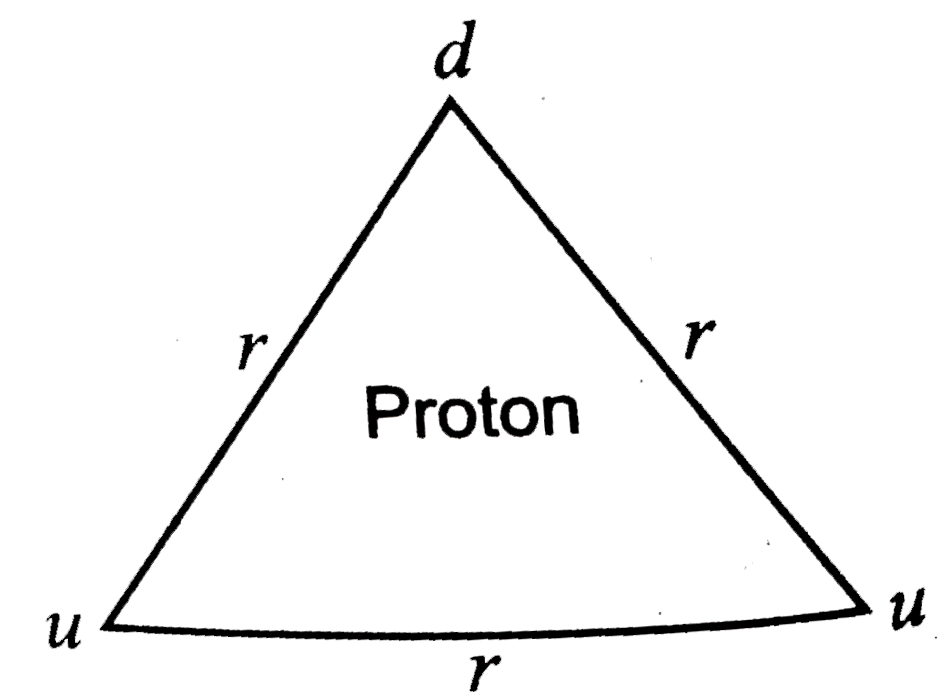
Fig shows quark model of a neutral, where `r = 10^(-15) m`.
Potential energy of neutron
`U = (1)/(4pi in_(0) r) [q_(e) q_(d) + q_(u) q_(d) + q_(u) q_(d)]`
`= (9xx10^(9))/(10^(-15)) [(-(e)/(3)) (-(e)/(3)) + ((2e)/(3)) (-(e)/(3)) + ((2e)/(3)) (-(e)/(3))]`
`U = (9xx10^(9))/(10^(-15)) ((1)/(9) - (4)/(9)) (1.6xx10^(-19))^(2) = -7.68xx10^(-14)J`
`U = (-7.68xx10^(-14))/(1.6xx10^(-19)) eV = -4.8xx10^(5) eV = -0.48 MeV`
`m_(n) C^(2) = 939 MeV :. (U)/(m_(n) C^(2)) = (0.48)/(939) = 5.11xx10^(-4)`
Proceed similarly for a proton whose quark model in shown in Fig.
Promotional Banner

Similar Questions

Explore conceptually related problems

Calculate the electrostatic potential energy for a system of three point charges q placed at the corners of an equilateral triangle of side ‘a’.

Three charges +q, 2 q and -4q are placed on the three vertices of an equale-laterail triangle of each side 0*1m . Calculate electrostatic potential energy of the system, take q = 10^(-7) C

Compare a proton and a neutron in respect of mass and charge.

Compare an electron, a proton and a neutron in respect of their relative masses and charges.

Calculation OF charge in space by E ||Electrostatic Potential

Three charges of 1 nC, 2 nC and 3 nC are placed at the corners of an equilateral triangle of side sqrt(3) m. Calculate electrostatic potential at a point equidistant from the three corners of the triangle.

Define a neutron. Mention its mass and charge.

