Home
Class 12
PHYSICS
A parallel plate capacitor is made of tw...

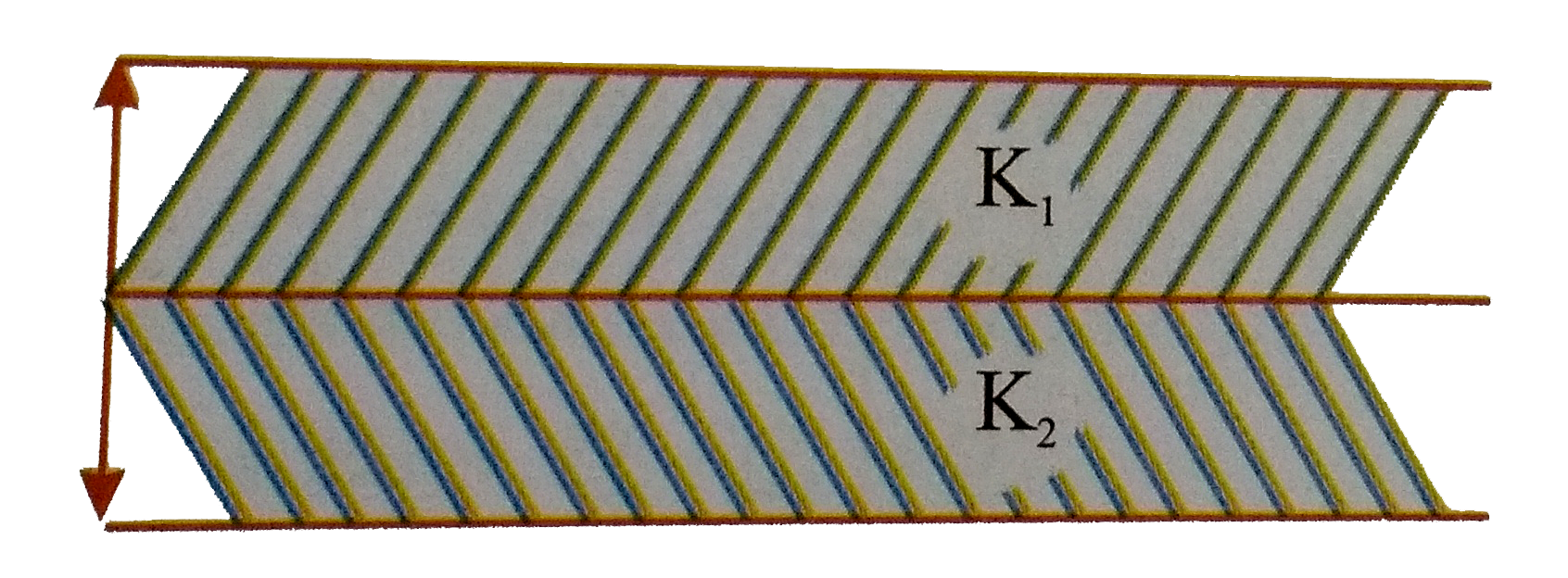
A parallel plate capacitor is made of two dielectric blocks in series. One of the blocks has thickness `d_(1)` and dielectric constant `K_(1)` and the other has thickness `d_(2)` and dielectric constant `K_(2)` as shown in figure. This arrangement can be through as a dielectric slab of thickness `d (= d_(1) + d_(2))` and effective dielectric constant `K`. The `K` is.
.

A

`(k_(1) d_(1) + k_(2) d_(2))/(d_(1) + d_(2))`

B

`(k_(1) d_(1) + k_(2) d_(2))/(k_(1) + k_(2))`

C

`(k_(1) k_(2) (d_(1) + d_(2)))/((k_(1) d_(2) + k_(2) d_(1)))`

D

`(2 k_(1) k_(2))/(k_(1) + k_(2))`

Text Solution

Verified by Experts

The correct Answer is:

C

The capacities of two individual condensers are `C_(1) = (k_(1) in_(0) A)/(d_(1))` and `C_(2) = (k_(2) in_(0) A)/(d_(2))`
The arrangement is equivalent to two capacitors joined in series. Therefore, the combined capacity `(C_(s))` is given by
`(1)/(C_(s)) = (1)/(C_(1)) + (1)/(C_(2)) = (d_(1))/(k_(1) in_(0) A) + (d_(2))/(k_(2) in_(0) A) = (1)/(in_(0) A) [(d_(1))/(k_(1)) + (d_(2))/(k_(2))] = (d_(1) k_(2) + d_(2) k_(1))/(in_(0) A K_(1) K_(2))`
or `C_(s) = (in_(0) A k_(1) k_(2))/(d_(1) k_(2) + d_(2) k_(1)) = (k in_(0) A)/((d_(1) + d_(2))) :. K = (k_(1) k_(2) (d_(1) + d_(2)))/((d_(1) k_(2) + d_(2) k_(1)))`
Promotional Banner

Topper's Solved these Questions

  • ELECTROSTATICS

    PRADEEP|Exercise FILL IN THE BLANKS|8 Videos
  • ELECTROSTATICS

    PRADEEP|Exercise PROBLEMS FOR PRACTICE|8 Videos
  • ELECTROSTATICS

    PRADEEP|Exercise VALUE BASED QUESTIONS|7 Videos
  • ELECTRONIC DEVICES

    PRADEEP|Exercise Fill in the Blanks|1 Videos
  • MAGNETIC EFFECT OF CURRENT AND MAGNETISM

    PRADEEP|Exercise Competition Focus (Multiple Choice Questions)|2 Videos

Similar Questions

Explore conceptually related problems

Between the plates of a parallel plate condenser, a plate of thickness t_(1) and dielectric constant k_(1) is placed. In the rest of the space, there is another plate of thickness t_(2) and dielectric constant k_(2) . The potential difference across the condenser will be

A parallel plate capacitor has the space between its plates filled by two slabs of thickness (d)/(2) each and dielectric constant K_(1) and K_2 . d is the plate separation of the capacitor. The capacitance of the capacitor is

A parallel plate capacitor with square plates is filed with four dielectrics of dielectric constants K_(1),K_(2),K_(3),K_(4), arranged as shown in the figure. The effective dielectric constant K will be :

A parallel plate capacitor of plate area A and separation d is filled with two materials each of thickness d/2 and dielectric constants in_1 and in_2 respectively. The equivalent capacitance will be

A parallel plate capacitor is charged to a certain voltage. Now if the dielectric material (with dielectric constant k ) is removed then the

A parallel plate capacitor with air as the dielectric has capacitance C. A slab of dielectric constant K and having the same thickness as the separation between plates is introduced so as to fill one-fourth of the capacitor as shown in the figure. The new capacitance will be :

A parallel plate capacitor carries a harge Q. If a dielectric slab with dielectric constant K=2 is dipped between the plates, then

The capacitance of a capacitor, filled with two dielectrics of same dimensions but of dielectric constants K_1 and K_2 respectively as shown will be -

A parallel plate capacitor has plate area A and plate separation d. The space betwwen the plates is filled up to a thickness x (ltd) with a dielectric constant K. Calculate the capacitance of the system.

PRADEEP-ELECTROSTATICS-Exercise
  1. The electrostatic potential on the surface of a charged concducting sp...

    Text Solution

    |

  2. Equipotentials at a great distance from a collection of charges whose ...

    Text Solution

    |

  3. A parallel plate capacitor is made of two dielectric blocks in series....

    Text Solution

    |

  4. Consider a uniform electric field in the hat (z) direction. The potent...

    Text Solution

    |

  5. Equipotential surfaces

    Text Solution

    |

  6. The work done to move a charge along an equipotential from A to B

    Text Solution

    |

  7. In a region of constant potential

    Text Solution

    |

  8. In the circuit shown in figure , initially key K(1) is closed and key...

    Text Solution

    |

  9. If a conductor has a potential V != 0 and there are no charges anywher...

    Text Solution

    |

  10. A parallel plate capacitor is connected to a battery as shown in figur...

    Text Solution

    |

  11. Chage Q is distributed to two different metwllic spheres having radii ...

    Text Solution

    |

  12. Force between two identical charges placed at a distance of r in vacu...

    Text Solution

    |

  13. A charged ball B hangs from a silk thread S, which makes an angle thet...

    Text Solution

    |

  14. Four charges equal to -Q are placed at the four corners of a square an...

    Text Solution

    |

  15. Three identical spheres, each having a charge q and radius R. are kept...

    Text Solution

    |

  16. A certain charge Q is divided into two parts q and Q-q, wheich are the...

    Text Solution

    |

  17. An infinite number of charges, each of charge 1 mu C are placed on the...

    Text Solution

    |

  18. Two identical charged spheres are suspended by strings of equal length...

    Text Solution

    |

  19. A uniformly charged thin spherical shell of radius R carries uniform s...

    Text Solution

    |

  20. A tiny spherical oil drop carrying a net charge q is balanced in still...

    Text Solution

    |
