Home
Class 12
PHYSICS
Consider a uniform spherical charge dist...

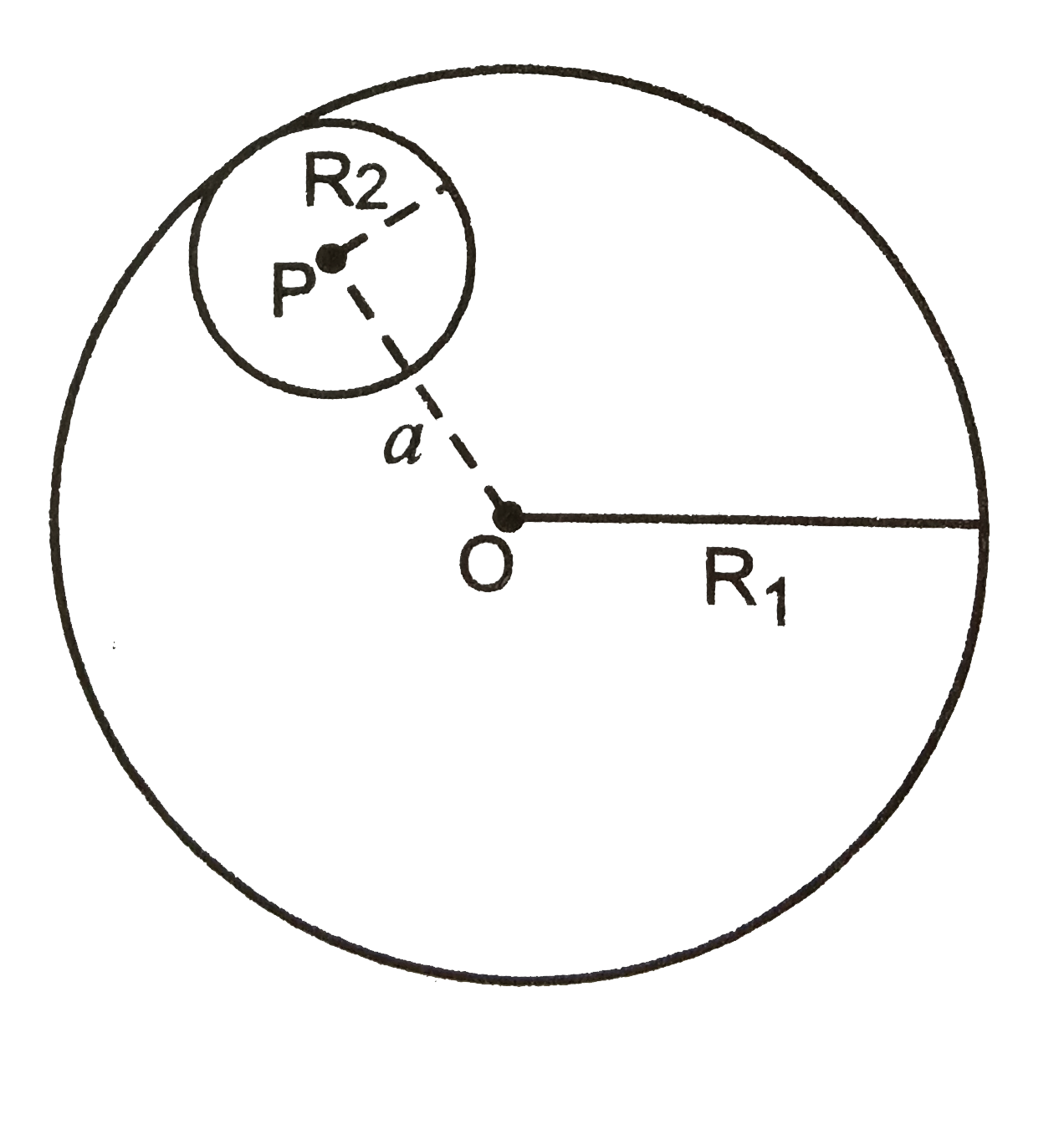
Consider a uniform spherical charge distribution of radius `R_(1)` centred at the orgin `O`. In this distribution a spherical cavity fo radius `R_(2)`, centred at `P` with distance `OP = a = R_(1) - R_(2)` (fig) is made.If the electric field inside the cavity at position `vec(r )`, then the correct statement is

A

`vec(E)` is uniform,its magnitude is independent of `R_(2)`. But its direction depends on `vec(R )`

B

`vec(E)` is uniformly, its magnitude depends on `R_(2)`, and its direction depends on `vec(r )`

C

`vec(E)` is uniform,its magnitude is independent of `a`. But its direction depends on `a`

D

`vec(E)` is uniform and both its magnitude and direction depend on `vec(a)`

Text Solution

Verified by Experts

The correct Answer is:
D

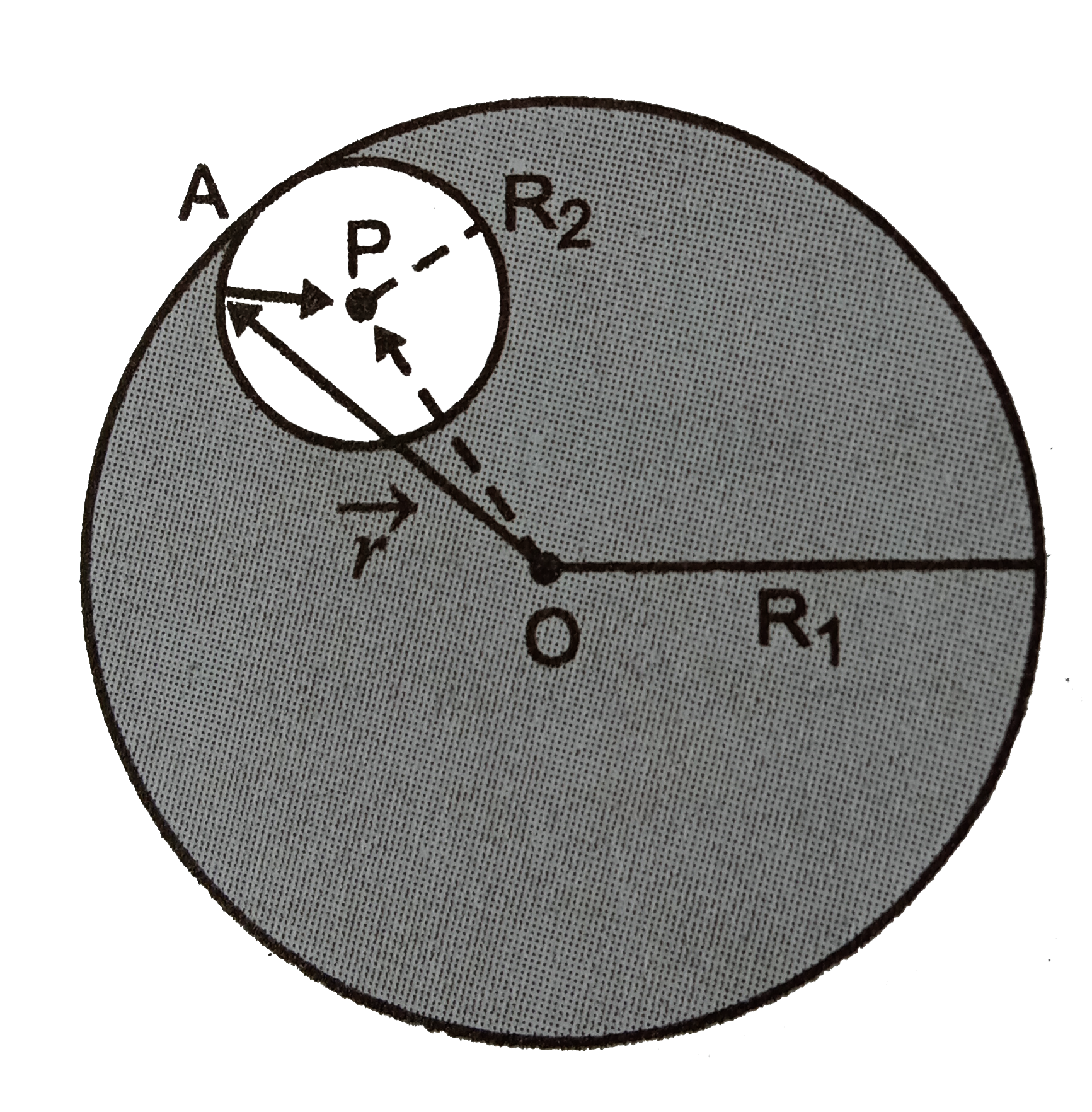
Here, total electric field `vec(E) = vec(E_(1)) + vec(E_(2))`
`= (rho)/(3 in_(0)) vec(OA) + (rho)/(3 in_(0)) + vec(AP) = (rho)/(3 in_(0)) (vec(OA) + vec(AP))`

`vec(E) = (rho)/(3 in_(0)) (vec(OP)) = (rho)/(3 in_(0)) vec(a)`
Hence `vec(E)` is uniform and botyh its magnitude and direction depend on `vec(a)`.
Promotional Banner

Topper's Solved these Questions

  • ELECTROSTATICS

    PRADEEP|Exercise FILL IN THE BLANKS|8 Videos
  • ELECTROSTATICS

    PRADEEP|Exercise PROBLEMS FOR PRACTICE|8 Videos
  • ELECTROSTATICS

    PRADEEP|Exercise VALUE BASED QUESTIONS|7 Videos
  • ELECTRONIC DEVICES

    PRADEEP|Exercise Fill in the Blanks|1 Videos
  • MAGNETIC EFFECT OF CURRENT AND MAGNETISM

    PRADEEP|Exercise Competition Focus (Multiple Choice Questions)|2 Videos

Similar Questions

Explore conceptually related problems

Consider a uniform spherical volume charge distribution of radius R. Which of the following graphs correctly represents the magnitude of the electric field E as a distance r from the center of the sphere ?

Inside a uniformly charged infinitely long cylinder of radius 'R' and volume charge density 'rho' there is a spherical cavity of radius 'R//2'. A point 'P' is located at a dsintance 2 R from the axis of the cylinder as shown. Then the electric field strength at the point 'P' is

Two spherical cavities of radii a and b are hollowed out from the interior of a neutral conducting sphere of radius R . At the center of each cavity , a point charge is placed . Call these charges q_(a) and q_(b) . The electric field inside the cavity of radius a at a distance r from the center of cavity is

Consider a uniform charged sphere of charge density r and radius R.If the cavity of radius R/2is made inside the sphere and the removed part is again placed near the charge distribution as shown in the figure. If the electric field at the centre of the cavity is (rho R)/(n varepsilon_(0) find n .

A solid sphere having uniform charge density rho and radius R is shown in figure. A spherical cavity ofradius (R)/(2) is made in it. What is the potential at point O?

A positively charged sphere of radius r_(0) carries a volume charge density rho_(E) (Figure). A spherical cavity of radius r_(0)//2 is then scooped out and left empty, as shown. What is the direction and magnitude of the electric field at point B?

7.Consider a uniform charged sphere of charge density p and radius R.If the cavity of radius R/2is made inside the sphere and the removed part is again placed near the charge distribution as shown in the figure.If the electric field at the centre of the cavity is (rho R)/(n varepsilon_(0)) find n .

The figure represents a solid uniform sphere of mass M and radius R . A spherical cavity of radius r is at a distance a from the centre of the sphere. The gravitational field inside the cavity is

A solid sphere of mass M and radius R has a spherical cavity of radius R/2 such that the centre of cavity is at a distance R/2 from the centre of the sphere. A point mass m is placed inside the cavity at a distanace R/4 from the centre of sphere. The gravitational force on mass m is

Inside a uniform sphere of mass M and radius R, a cavity of radius R//3 , is made in the sphere as shown :

PRADEEP-ELECTROSTATICS-Exercise
  1. Two path balls carrying eqaul chareges are suspended froom a common ...

    Text Solution

    |

  2. Two charges, each equal to q, aer kept at x=-a and x=a on the x-axis. ...

    Text Solution

    |

  3. Consider a uniform spherical charge distribution of radius R(1) centr...

    Text Solution

    |

  4. A long cylindrical shell carries positive surface charge sigma in the ...

    Text Solution

    |

  5. Two point charges +8q and -2q are located at x=0 and x=L respectively....

    Text Solution

    |

  6. If potential (in volts) in a region is expressed as V (x, y, z) = 6xy ...

    Text Solution

    |

  7. The figure below depict two situations in which two infinitely long st...

    Text Solution

    |

  8. Poistive and negative point charges of equal magnitude are kept at (0,...

    Text Solution

    |

  9. A thin semi-circular ring of radius r has a positive charge q distribu...

    Text Solution

    |

  10. Two charges q(1) and q(2) are placed 30 cm apart, as shown in the figu...

    Text Solution

    |

  11. The point charges + q, -2q and + q are placed at point (x = 0, y = a, ...

    Text Solution

    |

  12. A thin conducting ring orf radius R is given a chareg +Q, Fig. The el...

    Text Solution

    |

  13. Let there be a spherically symmetric charge distribution with charge d...

    Text Solution

    |

  14. A thin semi-circular ring of radius r has a positive charge q distribu...

    Text Solution

    |

  15. Let P(r)=(Q)/(piR^4)r be the charge density distribution for a solid s...

    Text Solution

    |

  16. Two positive charges of magnitude q are placed at the ends of a side (...

    Text Solution

    |

  17. Conisder a thin spherical shell of radius R with centre at the origin,...

    Text Solution

    |

  18. Charges Q, 2Q and 4Q are uniformly distributed in three dielectric sol...

    Text Solution

    |

  19. The electric field in a certain region is acting radially outwards and...

    Text Solution

    |

  20. An assmebly of charges +q, -q , +q, -q….. are at positions x = 1 m, ...

    Text Solution

    |

